Thank you for visiting SNEWPapers!
Sign up free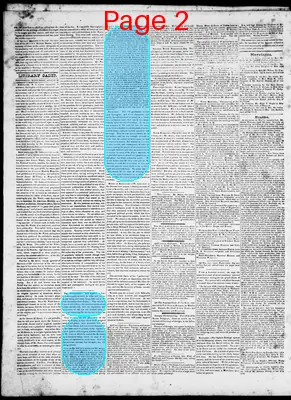
Editorial
August 29, 1827
Literary Cadet And Rhode Island Statesman
Providence, Providence County, Rhode Island
What is this article about?
An editorial defends Henry Clay against a fabricated letter from an elderly Mr. Munday, published in opposition papers, accusing Clay of hypocrisy for supporting John Q. Adams despite past criticisms. The piece dismisses the letter as a hoax by Clay's enemies.
Clipping
OCR Quality
98%
Excellent
Full Text
The Opposition.
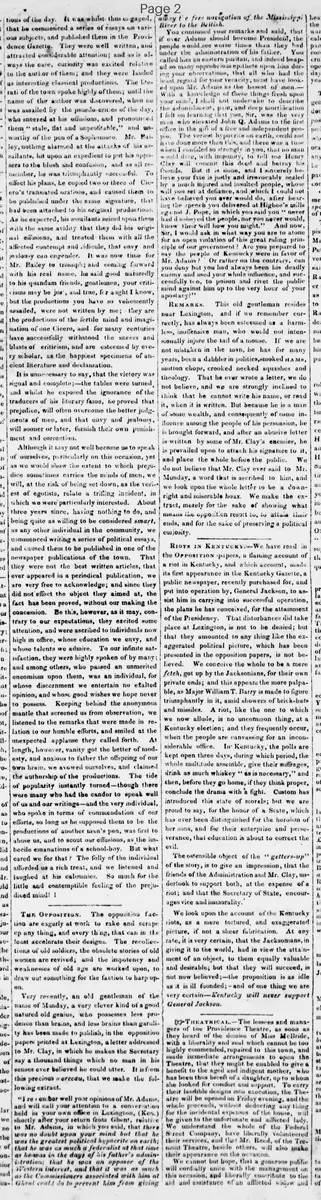
The opposition faction are eagerly at work to rake and scrape up any thing, and every thing, that can in the least accelerate their designs. The recollections of old soldiers, the obsolete stories of old women are revived; and the impotency and weaknesses of old age are worked upon, to draw out something for the faction to harp upon.
Very recently, an old gentleman of the name of Munday, a very clever kind of a good natured old genius, who possesses less prudence than brains, and less brains than garrulity has been made to publish, in the opposition papers printed at Lexington, a letter addressed to Mr. Clay, in which he makes the Secretary say a thousand things which no man in his senses ever believed he could utter. It is from this precious morceau, that we take the following extract.
"I remember well your opinions of Mr. Adams, and will call your attention to a conversation held in your own office in Lexington, (Ken.) shortly after your return from Ghent, relative to Mr. Adams, in which you said, that there was no doubt upon your mind but that he was the greatest political hypocrite on earth; that he was as much a federalist at that time as he was in the days of his father's administration; that he was an opposer of the Western interest, and that it was as much as the Commissioners associated with him at Ghent could do to prevent him from giving away the free navigation of the Mississippi River to the British. You continued your remarks and said, that if ever Adams should become President, the people would see worse times than they had under the administration of his father. You called him an eastern puritan, and indeed heaped so many opprobrious epithets upon him during your observations, that all who had the least regard for your veracity, must have looked upon Mr. Adams as the basest of men.—With a knowledge of these things fresh upon your mind, I shall not undertake to describe the astonishment, pain, and deep mortification I felt on learning that you, Sir, was the very man who elevated John Q. Adams to the first office in the gift of a free and independent people. The veriest hypocrite on earth, could not have done more than this, and there was a time when I confided so strongly in you, that no man would dare, with impunity, to tell me Henry Clay would commit this deed and betray his friends. But it is done, and I sincerely believe your fate is justly and irrevocably sealed by a much injured and insulted people, whose will you set at defiance, and which I could not have believed you ever would do, after hearing the speech you delivered at Higbee's mills against J. Pope, in which you said you "never had disobeyed the people, nor you never would, know their will how you might." And now, Sir, I would ask in what way you are to atone for an open violation of this great ruling principle of our government? Are you prepared to say the people of Kentucky were in favor of Mr. Adams? Or rather on the contrary, can you deny but you had always been his deadly enemy and used your whole influence, and successfully too, to poison and rivet the public mind against him up to the very hour of your apostacy?"
REMARKS.
This old gentleman resides near Lexington, and if we remember correctly, has always been esteemed as a harmless, inoffensive man, who would not intentionally injure the tail of a mouse. If we are not mistaken in the man, he has for many years, been a dabbler in politics, smoked hams, mutton chops, crooked necked squashes and theology. That he ever wrote a letter, we do not believe, and we are strongly inclined to think that he cannot write his name, or read it, when it is written. But because he is a man of some wealth, and consequently of some influence among the people of his persuasion, he is brought forward, and after an abusive letter is written by some of Mr. Clay's enemies, he is prevailed upon to attach his signature to it, and place the whole before the public. We do not believe that Mr. Clay ever said to Mr. Munday, a word that is ascribed to him, and we look upon the whole letter to be a downright and miserable hoax. We make the extract, merely for the sake of showing what means the opposition resort to, to attain their ends, and for the sake of preserving a political curiosity.
The opposition faction are eagerly at work to rake and scrape up any thing, and every thing, that can in the least accelerate their designs. The recollections of old soldiers, the obsolete stories of old women are revived; and the impotency and weaknesses of old age are worked upon, to draw out something for the faction to harp upon.
Very recently, an old gentleman of the name of Munday, a very clever kind of a good natured old genius, who possesses less prudence than brains, and less brains than garrulity has been made to publish, in the opposition papers printed at Lexington, a letter addressed to Mr. Clay, in which he makes the Secretary say a thousand things which no man in his senses ever believed he could utter. It is from this precious morceau, that we take the following extract.
"I remember well your opinions of Mr. Adams, and will call your attention to a conversation held in your own office in Lexington, (Ken.) shortly after your return from Ghent, relative to Mr. Adams, in which you said, that there was no doubt upon your mind but that he was the greatest political hypocrite on earth; that he was as much a federalist at that time as he was in the days of his father's administration; that he was an opposer of the Western interest, and that it was as much as the Commissioners associated with him at Ghent could do to prevent him from giving away the free navigation of the Mississippi River to the British. You continued your remarks and said, that if ever Adams should become President, the people would see worse times than they had under the administration of his father. You called him an eastern puritan, and indeed heaped so many opprobrious epithets upon him during your observations, that all who had the least regard for your veracity, must have looked upon Mr. Adams as the basest of men.—With a knowledge of these things fresh upon your mind, I shall not undertake to describe the astonishment, pain, and deep mortification I felt on learning that you, Sir, was the very man who elevated John Q. Adams to the first office in the gift of a free and independent people. The veriest hypocrite on earth, could not have done more than this, and there was a time when I confided so strongly in you, that no man would dare, with impunity, to tell me Henry Clay would commit this deed and betray his friends. But it is done, and I sincerely believe your fate is justly and irrevocably sealed by a much injured and insulted people, whose will you set at defiance, and which I could not have believed you ever would do, after hearing the speech you delivered at Higbee's mills against J. Pope, in which you said you "never had disobeyed the people, nor you never would, know their will how you might." And now, Sir, I would ask in what way you are to atone for an open violation of this great ruling principle of our government? Are you prepared to say the people of Kentucky were in favor of Mr. Adams? Or rather on the contrary, can you deny but you had always been his deadly enemy and used your whole influence, and successfully too, to poison and rivet the public mind against him up to the very hour of your apostacy?"
REMARKS.
This old gentleman resides near Lexington, and if we remember correctly, has always been esteemed as a harmless, inoffensive man, who would not intentionally injure the tail of a mouse. If we are not mistaken in the man, he has for many years, been a dabbler in politics, smoked hams, mutton chops, crooked necked squashes and theology. That he ever wrote a letter, we do not believe, and we are strongly inclined to think that he cannot write his name, or read it, when it is written. But because he is a man of some wealth, and consequently of some influence among the people of his persuasion, he is brought forward, and after an abusive letter is written by some of Mr. Clay's enemies, he is prevailed upon to attach his signature to it, and place the whole before the public. We do not believe that Mr. Clay ever said to Mr. Munday, a word that is ascribed to him, and we look upon the whole letter to be a downright and miserable hoax. We make the extract, merely for the sake of showing what means the opposition resort to, to attain their ends, and for the sake of preserving a political curiosity.
What sub-type of article is it?
Partisan Politics
What keywords are associated?
Henry Clay
John Q Adams
Political Hoax
Opposition Tactics
Kentucky Politics
Lexington Papers
What entities or persons were involved?
Henry Clay
John Q. Adams
Mr. Munday
Opposition Faction
Editorial Details
Primary Topic
Defense Against Opposition Hoax Accusing Henry Clay Of Hypocrisy In Supporting John Q. Adams
Stance / Tone
Supportive Of Henry Clay, Critical Of Opposition Tactics
Key Figures
Henry Clay
John Q. Adams
Mr. Munday
Opposition Faction
Key Arguments
Opposition Faction Uses Old Stories And Weak Individuals To Advance Designs
Mr. Munday's Letter Is A Fabrication By Clay's Enemies
Clay Never Made The Critical Statements Attributed To Him About Adams
The Letter Is A Hoax Exploiting Munday's Gullibility And Influence
Opposition Resorts To Low Means To Attack Clay