Thank you for visiting SNEWPapers!
Sign up free
Story
November 23, 1807
Norfolk Gazette And Publick Ledger
Norfolk, Virginia
What is this article about?
The National Intelligencer defends the President's message against Federalist accusations of falsehood regarding U.S. ministers' negotiations and signing of a treaty with Britain, involving Monroe and Pinkney. It argues discrepancies are explainable without deceit, citing possible changes or differing opinions.
Clipping
OCR Quality
95%
Excellent
Full Text
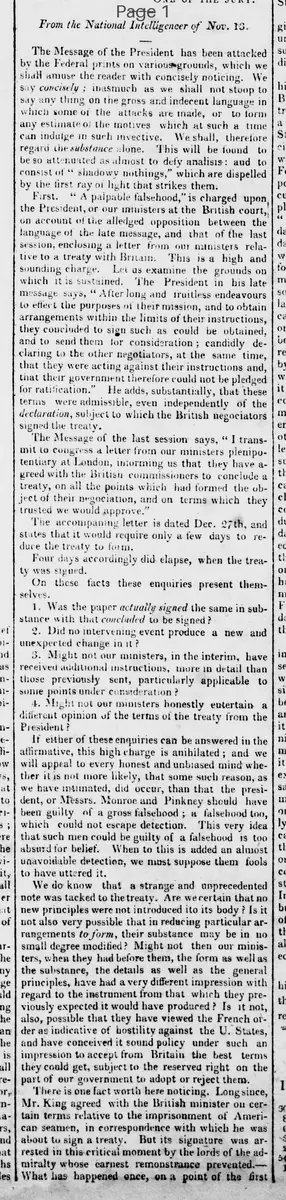
From the National Intelligencer of Nov. 13.
The Message of the President has been attacked by the Federal prints on various grounds, which we shall amuse the reader with concisely noticing. We say concisely; inasmuch as we shall not stoop to say any thing on the gross and indecent language in which some of the attacks are made, or to form any estimate of the motives which at such a time can indulge in such invective. We shall, therefore regard the substance alone. This will be found to be so attenuated as almost to defy analysis: and to consist of "shadowy nothings," which are dispelled by the first ray of light that strikes them:
First. "A palpable falsehood," is charged upon the President, or our ministers at the British court, on account of the alledged opposition between the language of the late message, and that of the last session, enclosing a letter from our ministers relative to a treaty with Britain. This is a high and sounding charge. Let us examine the grounds on which it is sustained. The President in his late message says, "After long and fruitless endeavours to effect the purposes of their mission, and to obtain arrangements within the limits of their instructions, they concluded to sign such as could be obtained, and to send them for consideration; candidly declaring to the other negotiators, at the same time, that they were acting against their instructions and, that their government therefore could not be pledged for ratification." He adds, substantially, that these terms were admissible, even independently of the declaration, subject to which the British negotiators signed the treaty.
The Message of the last session says, "I transmit to congress a letter from our ministers plenipotentiary at London, informing us that they have agreed with the British commissioners to conclude a treaty, on all the points which had formed the object of their negociation, and on terms which they trusted we would approve."
The accompanying letter is dated Dec. 27th, and states that it would require only a few days to reduce the treaty to form.
Four days accordingly did elapse, when the treaty was signed.
On these facts these enquiries present themselves.
1. Was the paper actually signed the same in substance with that concluded to be signed?
2. Did no intervening event produce a new and unexpected change in it?
3. Might not our ministers, in the interim, have received additional instructions, more in detail than those previously sent, particularly applicable to some points under consideration?
4. Might not our ministers honestly entertain a different opinion of the terms of the treaty from the President?
If either of these enquiries can be answered in the affirmative, this high charge is annihilated; and we will appeal to every honest and unbiased mind whether it is not more likely, that some such reason, as we have intimated, did occur, than that the president, or Messrs. Monroe and Pinkney should have been guilty of a gross falsehood; a falsehood too, which could not escape detection. This very idea that such men could be guilty of a falsehood is too absurd for belief. When to this is added an almost unavoidable detection, we must suppose them fools to have uttered it.
We do know that a strange and unprecedented note was tacked to the treaty. Are we certain that no new principles were not introduced into its body? Is it not also very possible that in reducing particular arrangements to form, their substance may be in no small degree modified? Might not then our ministers, when they had before them, the form as well as the substance, the details as well as the general principles, have had a very different impression with regard to the instrument from that which they previously expected it would have produced? Is it not, also, possible that they have viewed the French order as indicative of hostility against the U. States, and have conceived it sound policy under such an impression to accept from Britain the best terms they could get, subject to the reserved right on the part of our government to adopt or reject them.
There is one fact worth here noticing. Long since, Mr. King agreed with the British minister on certain terms relative to the imprisonment of American seamen, in correspondence with which he was about to sign a treaty. But its signature was arrested in this critical moment by the lords of the admiralty whose earnest remonstrance prevented.—
What has happened once, on a point of the first
The Message of the President has been attacked by the Federal prints on various grounds, which we shall amuse the reader with concisely noticing. We say concisely; inasmuch as we shall not stoop to say any thing on the gross and indecent language in which some of the attacks are made, or to form any estimate of the motives which at such a time can indulge in such invective. We shall, therefore regard the substance alone. This will be found to be so attenuated as almost to defy analysis: and to consist of "shadowy nothings," which are dispelled by the first ray of light that strikes them:
First. "A palpable falsehood," is charged upon the President, or our ministers at the British court, on account of the alledged opposition between the language of the late message, and that of the last session, enclosing a letter from our ministers relative to a treaty with Britain. This is a high and sounding charge. Let us examine the grounds on which it is sustained. The President in his late message says, "After long and fruitless endeavours to effect the purposes of their mission, and to obtain arrangements within the limits of their instructions, they concluded to sign such as could be obtained, and to send them for consideration; candidly declaring to the other negotiators, at the same time, that they were acting against their instructions and, that their government therefore could not be pledged for ratification." He adds, substantially, that these terms were admissible, even independently of the declaration, subject to which the British negotiators signed the treaty.
The Message of the last session says, "I transmit to congress a letter from our ministers plenipotentiary at London, informing us that they have agreed with the British commissioners to conclude a treaty, on all the points which had formed the object of their negociation, and on terms which they trusted we would approve."
The accompanying letter is dated Dec. 27th, and states that it would require only a few days to reduce the treaty to form.
Four days accordingly did elapse, when the treaty was signed.
On these facts these enquiries present themselves.
1. Was the paper actually signed the same in substance with that concluded to be signed?
2. Did no intervening event produce a new and unexpected change in it?
3. Might not our ministers, in the interim, have received additional instructions, more in detail than those previously sent, particularly applicable to some points under consideration?
4. Might not our ministers honestly entertain a different opinion of the terms of the treaty from the President?
If either of these enquiries can be answered in the affirmative, this high charge is annihilated; and we will appeal to every honest and unbiased mind whether it is not more likely, that some such reason, as we have intimated, did occur, than that the president, or Messrs. Monroe and Pinkney should have been guilty of a gross falsehood; a falsehood too, which could not escape detection. This very idea that such men could be guilty of a falsehood is too absurd for belief. When to this is added an almost unavoidable detection, we must suppose them fools to have uttered it.
We do know that a strange and unprecedented note was tacked to the treaty. Are we certain that no new principles were not introduced into its body? Is it not also very possible that in reducing particular arrangements to form, their substance may be in no small degree modified? Might not then our ministers, when they had before them, the form as well as the substance, the details as well as the general principles, have had a very different impression with regard to the instrument from that which they previously expected it would have produced? Is it not, also, possible that they have viewed the French order as indicative of hostility against the U. States, and have conceived it sound policy under such an impression to accept from Britain the best terms they could get, subject to the reserved right on the part of our government to adopt or reject them.
There is one fact worth here noticing. Long since, Mr. King agreed with the British minister on certain terms relative to the imprisonment of American seamen, in correspondence with which he was about to sign a treaty. But its signature was arrested in this critical moment by the lords of the admiralty whose earnest remonstrance prevented.—
What has happened once, on a point of the first
What sub-type of article is it?
Historical Event
Deception Fraud
What themes does it cover?
Deception
Justice
What keywords are associated?
Monroe Pinkney Treaty
Presidential Message
Federalist Attacks
Diplomatic Negotiation
British Treaty
Falsehood Accusation
What entities or persons were involved?
President
Monroe
Pinkney
Mr. King
Where did it happen?
British Court
Story Details
Key Persons
President
Monroe
Pinkney
Mr. King
Location
British Court
Event Date
Nov. 13
Story Details
Defense against Federalist charges of falsehood in presidential messages about U.S. ministers' negotiation and signing of a treaty with Britain, suggesting possible explanations like changed terms or differing opinions without deceit.