Thank you for visiting SNEWPapers!
Sign up free
Gazette Of The United States
Philadelphia, Philadelphia County, Pennsylvania
What is this article about?
In this installment (No. VIII), Harrington argues that the House of Representatives must have access to treaty-related documents to exercise its free agency in providing legislative aid for execution, using quotes from opponents like Mr. Harper to defend against charges of encroaching on executive powers in the context of the British treaty.
Clipping
OCR Quality
Full Text
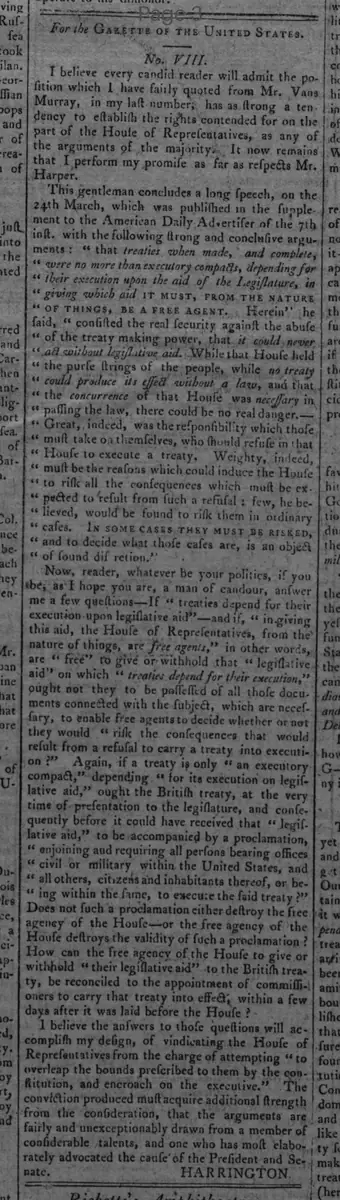
No. VIII.
I believe every candid reader will admit the position which I have fairly quoted from Mr. Vans Murray, in my last number; has as strong a tendency to establish the rights contended for on the part of the House of Representatives, as any of the arguments of the majority. It now remains that I perform my promise as far as respects Mr. Harper.
This gentleman concludes a long speech, on the 24th March, which was published in the supplement to the American Daily Advertiser of the 7th inst. with the following strong and conclusive arguments: "that treaties when made, and complete, were no more than executory compacts, depending for their execution upon the aid of the Legislature, in giving which aid IT MUST, FROM THE NATURE OF THINGS, BE A FREE AGENT. HEREIN'' he said, "consisted the real security against the abuse of the treaty making power, that it could never act without legislative aid. While that House held the purse strings of the people, while no treaty could produce its effect without a law, and that the concurrence of that House was necessary in passing the law, there could be no real danger.— Great, indeed, was the responsibility which those must take on themselves, who should refuse in that House to execute a treaty, Weighty, indeed, must be the reasons which could induce the House to risk all the consequences which must be expected to result from such a refusal: few, he believed, would be found to risk them in ordinary CASES. IN SOME CASES THEY MUST BE RISKED, and to decide what those cases are, is an object of sound discretion."
Now, reader, whatever be your politics, if you be, as I hope you are, a man of candour, answer me a few questions—If "treaties depend for their execution upon legislative aid"—and if, "in giving this aid, the House of Representatives, from the nature of things, are free agents," in other words, are "free" to give or withhold that "legislative aid" on which "treaties depend for their execution," ought not they to be possessed of all those documents connected with the subject, which are necessary, to enable free agents to decide whether or not they would "risk the consequences that would result from a refusal to carry a treaty into execution?" Again, if a treaty is only "an executory compact," depending "for its execution on legislative aid," ought the British treaty, at the very time of presentation to the legislature, and consequently before it could have received that "legislative aid," to be accompanied by a proclamation, "enjoining and requiring all persons bearing offices civil or military within the United States, and all others, citizens and inhabitants thereof, or being within the same, to execute the said treaty?" Does not such a proclamation either destroy the free agency of the House—or the free agency of the House destroys the validity of such a proclamation? How can the free agency of the House to give or withhold "their legislative aid" to the British treaty, be reconciled to the appointment of commissioners to carry that treaty into effect; within a few days after it was laid before the House?
I believe the answers to those questions will accomplish my design, of vindicating the House of Representatives from the charge of attempting "to overleap the bounds prescribed to them by the constitution, and encroach on the executive." The conviction produced must acquire additional strength from the consideration, that the arguments are fairly and unexceptionably drawn from a member of considerable talents, and one who has most elaborately advocated the cause of the President and Senate.
HARRINGTON
What sub-type of article is it?
What themes does it cover?
What keywords are associated?
What entities or persons were involved?
Letter to Editor Details
Author
Harrington
Recipient
Gazette Of The United States
Main Argument
the house of representatives, as a free agent in providing legislative aid for treaty execution, must have access to necessary documents to decide whether to support or refuse treaties, as illustrated by inconsistencies in opponents' arguments regarding the british treaty.
Notable Details