Thank you for visiting SNEWPapers!
Sign up free
The New England Weekly Review
Hartford, Hartford County, Connecticut
What is this article about?
In 19th-century England, lawyer William Etherington, desperate to marry Ellen Norris, joins smuggler Johnson in robbing a mail coach carrying bank funds, causing the driver's death and widespread ruin. Exposed and tormented by guilt, Etherington suicides on his wedding night, leaving his bride and family devastated.
Merged-components note: Continuation of the story 'The Mail Robber' across pages 1 and 2; original label for second part was 'literary', changed to 'story' as dominant content.
Clippings
1 of 2
OCR Quality
Full Text
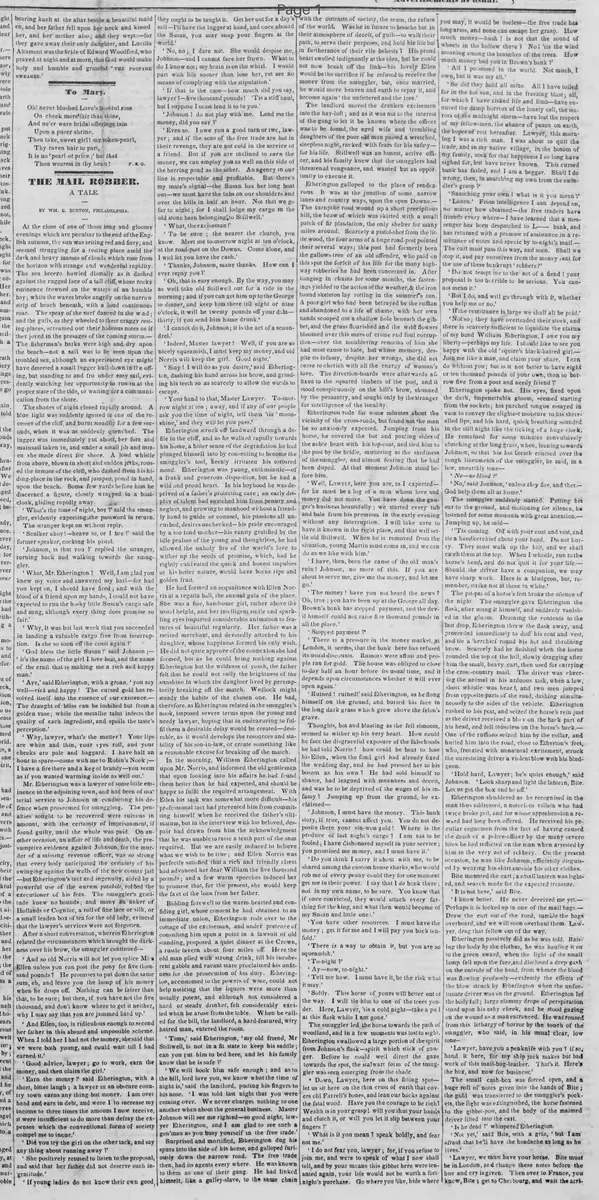
A TALE.
BY WM. E. BURTON, PHILADELPHIA.
At the close of one of those long and gloomy evenings which are peculiar to the end of the English autumn, the sun was setting red and fiery, and seemed struggling for a resting place amid the dark and heavy masses of clouds which rose from the horizon with strange and wonderful rapidity. The sea breeze howled dismally as it dashed against the rugged face of a tall cliff, whose rocky eminence frowned on the waters of a humble bay; while the waves broke angrily on the narrow strip of beach beneath, with a loud continuous roar. The spray of the surf danced in the wind; and the gulls, as they wheeled to their craggy resting-places, screamed out their hideous notes as if they joyed in the presages of the coming storm.— The fishermen's barks were high and dry upon the beach—not a sail was to be seen upon the troubled sea, although an experienced eye might have detected a small lugger hull-down in the offing, but standing to and fro under easy sail, evidently watching her opportunity to run in at the proper state of the tide, or waiting for a communication from the shore.
The shades of night closed rapidly around. A blue light was suddenly ignited in one of the recesses of the cliff and burnt steadily for a few seconds, when it was as suddenly quenched. The lugger was immediately put about, her fore and mainsail taken in, and under a small jib and mizen she made direct for shore. A loud whistle from above, blown in short and sudden jerks, roused the inmate of the cleft, who dashed from his hiding-place in the rock, and jumped, pistol in hand, upon the beach. Some few yards before him he discerned a figure, closely wrapped in a boat-cloak, gliding rapidly away.
'What's the time of night, boy?' said the smuggler, evidently expecting the password in return. The stranger kept on without reply. 'Skulker ahoy!—heave to, or I fire!' said the former speaker, cocking his pistol. 'Johnson, is that you?' replied the stranger, turning back and walking towards the smuggler. 'What, Mr. Etherington? Well, I am glad you knew my voice and answered my hail—for had you kept on, I should have fired; and with the blood of a friend upon my hands, I could not have expected to run the bosky little Susan's cargo safe and snug, although every thing does promise so fair. Why, it was but last week that you succeeded in landing a valuable cargo free from interruption. Is she so soon off the coast again?'
'God bless the little Susan!' said Johnson;—'it's the name of the girl I love best, and the name of the craft that is making me a rich and happy man.'
'Aye,' said Etherington, with a groan. 'you say well—rich and happy! The cursed gold has resolved itself into the essence of our existence.— The draught of bliss can be imbibed but from a golden vase; while the metallic taint infects the quality of each ingredient, and spoils the taste's perception.'
'Why, lawyer, what's the matter? Your lips are white and thin, your eyes roll, and your cheeks are pale and haggard. I have half an hour to spare—come with me to Robin's Nook;— I have a fire there and a keg of brandy—you seem as if you wanted warming inside as well as out.'
Mr. Etherington was a lawyer of some little eminence in the adjoining town, and had been of material service to Johnson in conducting his defence when prosecuted for smuggling. The penalties sought to be recovered were ruinous in amount, with the certainty of imprisonment, if found guilty, until the whole was paid. On another occasion, an affair of life and death, the presumptive evidence against Johnson, for the murder of a missing revenue officer, was so strong that every body anticipated the certainty of his swinging against the walls of the new county jail—but Etherington's tact and ingenuity, aided by a powerful use of the aurum potabile, robbed the executioner of his fees. The smuggler's gratitude knew no bounds; and many an anker of Hollands or Cognac, a roll of fine lace or silk, or a small leaden box of tea for the old lady, evinced that the lawyer's services were not forgotten.
After a short conversation, wherein Etherington related the circumstances which brought the darkness over his brow, the smuggler continued—
'And so old Norris will not let you splice Miss Ellen unless you can post the pony for five thousand pounds? He promises to put down the same sum, eh, and leave you the lump of his money when he drops off. Nothing can be fairer than that, to be sure; but then, if you have not the five thousand, and don't know where to get it neither, why I may say that you are jammed hard up. And Ellen, too, is ridiculous enough to second her father in this absurd and impossible scheme. When I told her I had not the money, she said that we were both young, and could wait till I had earned it.'
'Good advice, lawyer; go to work, earn the money, and then claim the girl.'
'Earn the money!' said Etherington, with a short, bitter laugh; 'a lawyer in an obscure country town earns any thing but money. I am over head and ears in debt, and were I to increase my income to three times the amount I now receive it were insufficient to do more than defray the expenses which the conventional forms of society compel me to incur.'
'Did you try the girl on the other tack, and say any thing about running away?'
'She positively refused to listen to the proposal, and said that her father did not deserve such ingratitude.'
'If young ladies do not know their own good they ought to be taught it. Get her out for a day's sail—I'll have the lugger at hand, and once aboard the Susan, you may snap your fingers at the world.'
'No, no: I dare not. She would despise me, Johnson—and I cannot face her frown. What to do I know not; my brain is on the whirl. I would part with life sooner than lose her, yet see no means of complying with the stipulation.'
'If that is the case—how much did you say lawyer?—five thousand pounds! 'Tis a stiff haul but I suppose I must lend it to you.'
'Johnson! do not play with me. Lend me the money, did you say?'
'Even so. I owe you a good turn or two, lawyer; and if the sons of the free trade are hot in their revenge, they are not cold in the service of a friend. But if you are inclined to earn the money, we can employ you as well on this side of the herring pond as the other. An agency in our line is respectable and profitable. But there's my mate's signal—the Susan has her long boat out—we must have the tubs on our shoulders and over the hills in half an hour. Not that we go far to night: for I shall lodge my cargo in the old stone barn belonging to Stillwell.'
'What, the exciseman!'
'To be sure; the nearer the church, you know. Meet me to-morrow night at ten o'clock, at the road-post on the Downs. Come alone, and I will let you have the cash.'
'Thanks, Johnson, many thanks. How can I ever repay you?'
'Oh, that is easy enough. By the way, you may as well take old Stillwell out for a ride in the morning; and if you can get him up to the George to dinner, and keep him there till eight or nine o'clock, it will be twenty pounds off your debt—thirty, if you send him home drunk.'
'I cannot do it, Johnson; it is the act of a scoundrel.'
'Indeed, Master lawyer! Well, if you are so nicely squeamish. I must keep my money, and old Norris will keep the girl. Good night.'
'Stay! I will do as you desire,' said Etherington, dashing his hand across his brow, and grinding his teeth so as scarcely to allow the words to escape.
'Your hand to that, Master Lawyer. To-morrow night at ten; away, and if any of our people ask you the time of night, tell them 'tis 'moonshine,' and they will let you pass.'
Etherington struck off landward through a defile in the cliff, and as he walked rapidly towards his home, a bitter sense of the degradation he had plunged himself into by consenting to become the smuggler's tool, keenly irritated his tortured mind. Etherington was young, enthusiastic—of a frank and generous disposition, but he had a wild and proud heart. In his boyhood he was deprived of a father's protecting care; an early display of talent had snatched him from penury and neglect, and growing to manhood without a friendly hand to guide or counsel, his passions all uncurbed, desires unchecked—his pride encouraged by a too fond mother—his vanity gratified by the idle praises of the young and thoughtless, he had allowed the unholy fire of the world's love to wither up the seeds of promise, which, had he rightly cultivated the quick and honest impulses of his better nature, would have borne ripe and golden fruit.
He had formed an acquaintance with Ellen Norris at a regatta ball, the annual gala of the place. She was a fine, handsome girl, rather above the usual height, and her intelligent smile and sparkling eyes imparted considerable animation to features of beautiful regularity. Her father was a retired merchant, and devotedly attached to his daughter, whose happiness formed his only wish. He did not quite approve of the connexion she had formed, but as he could bring nothing against Etherington but the wildness of youth, the father felt that he could not sully the brightness of the sunshine in which the daughter lived by peremptorily breaking off the match. Wedlock might steady the habits of the chosen one. He had, therefore, as Etherington related in the smuggler's nook, imposed severe terms upon the young and needy lawyer, hoping that in endeavoring to fulfil them a desirable delay would be created—desirable, as it would develope the resources and stability of his son-in-law, or create something like a reasonable excuse for breaking off the match.
In the morning, William Etherington called upon Mr. Norris, and informed the old gentleman that upon looking into his affairs he had found them better than he had expected, and should be happy to fulfil the required arrangement. With Ellen his task was somewhat more difficult—his professional tact had prevented him from committing himself when he received the father's ultimatum, but in the interview with his beloved, despair had drawn from him the acknowledgment that he was unable to raise a tenth part of the sum required. But we are easily induced to believe what we wish to be true; and Ellen Norris was perfectly satisfied that a rich and friendly client had advanced her dear William the five thousand pounds; and a few warm speeches induced her to promise that, for the present, she would keep the fact of the loan from her father.
Bidding farewell to the warm-hearted and confiding girl, whose consent he had obtained to an immediate union, Etherington rode over to the cottage of the exciseman, and under pretence of consulting him upon a point in a lawsuit of old standing, proposed a quiet dinner at the Crown, a rustic tavern about four miles off. Here the old man plied with strong drink, till his incoherent gabble and vacant stare proclaimed his unfitness for the prosecution of his duty. Etherington, accustomed to the powers of wine, could not help noticing that the liquors were more than usually potent, and although not considered a hard or steady drinker, felt considerably excited when he arose from the table. When he called for the bill, the landlord, a hard-featured, wiry haired man, entered the room.
'Tims,' said Etherington, 'my old friend, Mr Stillwell, is not in a fit state to keep his saddle; can you put him to bed here, and let his family know that he is safe?'
'We will book him safe enough; and as to the bill, lord love you, we know what the time o' night is,' said the landlord, putting his fingers to his nose. 'I was told last night that you were coming over. We never charges nothing to one another when about the general business. Master Johnson will see me righted—so good night, lawyer Etherington, and I am glad to see such a gen'man as you busy yourself in the free trade.'
Surprised and mortified, Etherington dug his spurs into the side of his horse, and galloped furiously down the narrow road. The free trade then, had its agents every where. He was known to them as one of their gang. He had linked himself, like a galley-slave, to the same chain with the outcasts of society, the scum, the refuse of the world. Was he in future to breathe but in their atmosphere of deceit, of guilt—to walk their path, to serve their purposes, and hold his life but in furtherance of their vile behests? His proud heart swelled indignantly at the idea, but he could not now break off the link—his lovely Ellen would be the sacrifice if he refused to receive the money from the smuggler, but, once married, he would move heaven and earth to repay it, and become again the unfettered and the free.'
The landlord moved the drunken exciseman into the hay-loft; and as it was not to the interest of the gang to let it be known where the officer was to be found, the aged wife and trembling daughters of the poor old man passed a wretched, sleepless night, racked with fears for his safety—for his life. Stillwell was an honest, active officer, and his family knew that the smugglers had threatened vengeance, and wanted but an opportunity to execute it.
Etherington galloped to the place of rendezvous. It was at the junction of some narrow lanes and country ways, upon the open Downs.— The turnpike road wound up a short precipitous hill, the brow of which was skirted with a small patch of fir plantation, the only shelter for many miles around. Scarcely a pistol-shot from the little wood, the four arms of a huge road-post pointed their several ways; this post had formerly been the gallows tree of an old offender, who paid on this spot the forfeit of his life for the many highway robberies he had been concerned in. After hanging in chains for some months, the fastenings yielded to the action of the weather, & the iron bound skeleton lay rotting in the summer's sun. A poor girl who had been betrayed by the ruffian and abandoned to a life of shame, with her own hands scooped out a shallow hole beneath the gibbet, and the grass flourished and the wild flowers bloomed over this mass of crime and foul corruption—over the mouldering remains of him she had most cause to hate, but whose memory, despite its infamy, despite her wrongs, she did not cease to cherish with all the energy of woman's love. The direction-boards were afterwards affixed to the squared timbers of the post, and it stood conspicuously on the hill's brow, shunned by the peasantry, and sought only by the stranger for intelligence of the locality.
Etherington rode for some minutes about the vicinity of the cross-roads, but found not the man he so anxiously expected. Jumping from his horse, he covered the hot and panting sides of the noble beast with his top-coat, and tied him to the post by the bridle, muttering at the tardiness of the smuggler, and almost fearing that he had been duped. At that moment Johnson stood before him.
'Well, Lawyer, here you are, as I expected for he must be a log of a man whom love and money did not move. You have done the gauger's business beautifully; we started every tub and bale from his premises in the early evening without any interruption. I will take care to have it known in the right place, and that will settle old Stillwell. When he is removed from the situation, young Martin must come in, and we can do as we like with him.'
'I have, then, been the cause of the old man's ruin! Johnson, no more of this. If you are about to serve me, give me the money, and let me go.'
'The money! have you not heard the news? Oh, true; you have been up at the George all day. Brown's bank has stopped payment, and the devil himself could not raise five thousand pounds in all the place.'
'Stopped payment?'
'There is a pressure in the money market, at London, it seems, that the bank here has refused its usual discounts. Rumors were afloat and people ran for gold. The house was obliged to close to-day half an hour before its usual time, and it depends upon circumstances whether it will ever open again.'
'Ruined! ruined!' said Etherington, as he flung himself on the ground, and buried his face in the long dark grass which grew above the felon's grave. Thoughts, hot and blasting as the fell simoom, seemed to wither up his very heart. How could he face the disgraceful exposure of the falsehoods he had told Norris! how could he bear to lose his Ellen, when the fond girl had already fixed the wedding day, and he had pressed her to his bosom as his own? He had sold himself to shame, had leagued with meanness and deceit, and was he to be deprived of the wages of his infamy? Jumping up from the ground, he exclaimed—
'Johnson, I must have the money. This bank story, if true, cannot affect you. You do not deposite there your sin-won gold! Where is the produce of last night's cargo? I am not to be fooled; I have dishonored myself in your service; you promised me money. and I must have it.'
'Do you think I carry it about with me, to be shared among the custom house sharks,who would rob me of every penny could they for one moment get me in their power. I say that I do bank there; not in my own name, to be sure. You know that if once convicted, they would attach every farthing for the king, and what then would become of my Susan and little ones. You have other resources.'
'I must have the money; get it for me and I will pay you back ten fold.'
'There is a way to obtain it, but you are so squeamish.'
'To-night?'
'Ay—now, to-night.'
'Tell me how. I must have it, be the risk what it may.'
'Softly. This horse of yours will be better out of the way. I will tie him to one of the trees yonder. Here, Lawyer, 'tis a cold night—take a pull at this flask while I am gone.'
The smuggler led the horse towards the path of woodland, and in a few moments was lost to sight. Etherington swallowed a large portion of the spirit from Johnson's flask—spirit which stunk of gauger. Before he could well direct the gaze towards the spot, the stalwart form of the smuggler was seen emerging from the shade.
'Down, Lawyer, here on this fitting spot— let us sit here on the thin crust of earth that covers old Farrell's bones, and lean our backs against the fatal wood. Have you the courage to be rich? Wealth is in your grasp! will you shut your hands and clutch it, or will you let it slip between your fingers?'
'What is it you mean? speak boldly, and fear not me.'
'I do not fear you, lawyer; for, if you refuse to join me, and were to speak of what I now shall tell, and by your means this gibbet here were tenanted again, your life would not be worth a fortnight's purchase. Go where you like, hide where you may. it would be useless—the free trade has long arms, and none can escape her grasp. How much money—hush! is not that the sound of wheels in the hollow there? No! 'tis the wind moaning among the branches of the trees. How much money had you in Brown's bank?'
'All I possessed in the world. Not much, I own, but it was my all.'
'So did they hold all mine All I have toiled for in the hot sun, and in the freezing blast; all, for which I have risked life and limb—have endured the damp horrors of the lonely cell, the terrors of the midnight storm—have lost the respect of my fellow-men, the chance of peace on earth, the hopes of rest hereafter. Lawyer. this morning I was a rich man. I was about to quit the trade, and in my native village, in the bosom of my family, seek for that happiness I so long have sighed for, but have never known, This cursed bank has failed, and I am a beggar. Shall I do wrong, then, in snatching my own from the swindler's grasp?'
'Snatching your own! what is it you mean?'
'Listen.' From intelligence I can depend on, no matter how obtained—the free traders have friends every where—I have learned that a messenger has been despatched to L- bank, and has returned with a promise of assistance in a remittance of notes and specie by to-night's mail.— The cart must pass this way, and soon. Shall we stop it, and pay ourselves from the money sent for the use of these bankrupt 'robbers?'
'Do not tempt me to the act of a fiend! your proposal is too horrible to be serious. You cannot mean it.'
'But I do, and will go through with it, whether you help me or no.'
'If the remittance is large we shall all be paid.'
'Not so; they have overtraded their stock, and there is scarcely sufficient to liquidate the claims of my band William Etherington, I owe you my liberty—perhaps my life. I should like to see you happy with the old 'squire's black-haired girl.— Join me like a man, and claim your share. I can do without you; but is it not better to have eight or ten thousand pounds of your own, than to borrow five from a poor and needy friend?'
Etherington spoke not. His eyes, fixed upon the dark, impenetrable gloom, seemed starting from the sockets; his parched tongue essayed in vain to convey the slightest moisture to his shrivelled lips, and his hard, quick breathing sounded in the still night like the ticking of a huge clock, He remained for some minutes convulsively clutching at the long grass, when, leaning towards Johnson, so that his hot breath coursed over the rough lineaments of the smuggler, he said, in a low, unearthly tone—
'No—no blood?'
'No,' said Johnson, 'unless they fire, and then.— God help them all at home.'
The smuggler suddenly started. Putting his ear to the ground, and motioning for silence, he listened for some moments with great attention.— Jumping up, he said—
"'Tis coming. Off with your coat and vest, and tie a handkerchief about your head. Do not hurry. They must walk up the hill, and we shall catch them at the top. When I whistle, run to the horse's head, and do not quit it for your life.— Should the driver have a companion, we may have sharp work. Here is a bludgeon, but, remember, strike not at those in white.'
The pit-pat of a horse's feet broke the silence of the night The smuggler gave Etherington the flask, after using it himself, and suddenly vanished in the gloom. Draining the contents to the last drop, Etherington threw the flask away, and proceeded immediately to doff his coat and vest, and tie a 'kerchief round his hat and throbbing brow. Scarcely had he finished when the horse rounded the top of the hill, slowly dragging after him the small, heavy cart, then used for carrying the cross-country mail. The driver was cheering the animal in his arduous task, when a low, short whistle was heard, and two men jumped from opposite parts of the road, dashing simultaneously to the sides of the vehicle. Etherington rushed to his post, and seized the horse's rein just as the driver received a blow on the back part of his head, and fell senseless on the horse's back.— One of the ruffians seized him by the collar, and hurled him into the road, close to Etherton's feet. who, frenzied with unnatural excitement, struck the unresisting driver a violent blow with his bludgeon.
'Hold hard, Lawyer; he's quiet enough.' said Johnson. 'Look sharp and light the lantern, Bite. Let us get the box and be off'
Etherington shuddered as he recognised in the man thus addressed, a notorious villain who had twice broke jail, and for whose apprehension a reward had long been offered. He received his peculiar cognomen from the fact of having caused the death of a police-officer by the many severe bites he had inflicted on the man when arrested by him in the very act of robbery. On the present occasion, he was like Johnson, efficiently disguised by wearing his shirt outside his other clothes. Bite mounted the cart; a small lantern was lighted, and search made for the expected treasure.
'It is not here,' said Bite.
'I know better. He never deceived me yet.— Perhaps it is locked up in one of the mail bags.— Draw the cart out of the road, tumble the bags overboard, and we will soon overhaul them. Lawyer, drag that fellow out of the way'
Etherington passively did as he was told. Raising the body by the clothes, he was hauling it on to the green sward. when the light of the small lamp fell upon the face,and disclosed a deep gash on the outside of the head, from whence the blood was flowing profusely—evidently the effects of the blow struck by Etherington when the unfortunate driver was on the ground. Etherington let the body fall; large clammy drops of perspiration stood upon his ashy cheek, and he stood gazing on the wound as a man entranced. He was roused from this lethargy of horror by the touch of the smuggler, who said, in his usual clear, low tone—
'Lawyer, have you a penknife with you? if so, hand it here, for my ship jack makes but bad work of this mail-bag-leather. That's it. Here the box, and now for business.'
The small cash-box was forced open, and a huge roll of notes given into the hands of Bite: the gold was transferred to the smuggler's pockets, the light was extinguished, the horse fastened to the gibbet-post, and the body of the maimed driver lifted into the cart.
'Is he dead?' whispered Etherington.
'Not yet,' said Bite, with a grin. 'but I am afraid that he'll have the headache as long as he lives.'
'Lawyer, we must have your horse. Bite must be in London, and change these notes before the hue and cry is given. Then over to France, you know, Bite; get to Cherbourg, and wait the arrival of the bosky Sue. Off with you, and don't let the grass grow beneath your feet, unless you wish to swing on the vacant stick here.
Bite walked off towards the fir-tree close, and in a few seconds the rapid gallop of a horse was heard proceeding down one of the obscure cross-roads.
'Now, then, for a short cut over the Downs, Lawyer; we have done the job well and may defy detection. We have enough here for our purposes till we get our share of Bite's notes. What is the matter with you? you have not spoken for an hour.'
'Is he dead?' said Etherington, fearfully.
'Let us hope for the best. I wish it had been otherwise. But we must now part—it would be dangerous to be seen together.'
Without any division of the booty, or a word in explanation, the smuggler darted across the fields and was soon lost to Etherington's sight. Jaded and heart-smitten, this wretched young man reached his own house, and betook himself to bed but not to sleep.
The next morning as Etherington was sitting at the breakfast table, gazing with blood shot eyes upon the untasted meal,—the principal partner in the banking-house was announced. Etherington jumped up wildly from his chair, and throwing open the window evidently meditated escape; but actuated by second thoughts, a faint smile overspread his ghastly features, and he returned to his chair. The gentleman entered the room.
'Mr. Etherington,' said he, 'I suppose you have heard of our double misfortune—robbery and consequent failure. I have called upon you as an active lawyer to solicit your co-operation with the magistrates in attempting every thing in the power of man to discover the scoundrels who last night robbed the mail. I am more interested in this affair than regards the actual loss. Our bank experienced a partial pressure, I had written on for funds. and this morning we could have met every demand with instant payment. I am now a ruined and disgraced old man. The people will not believe but that the robbery was planned by the bankers; and after a long life of honorable industry, my gray hairs are tinged with sorrow and with shame. Mr. Etherington, I care not for my sudden fall from affluence, could I have preserved my honor; but ruin is spread around—hundreds will point at me as the robber of the poor; and I shall descend to the grave with the burning execrations of the ruined tradesman, the impoverished widow, and the beggared orphan, ringing in my ears.'
The old man leaned his head upon the table and wept like a child. Etherington attempted to speak, but was frightened at the unearthly tone of his own voice. The banker. ashamed of his weakness, shortly rose, and left the house, earnestly requesting Etherington to use his utmost endeavor to bring the criminals to justice. After swallowing a larger stimulant than usual in a vain attempt to still the first sharp gnawings of the worm that never dies, Etherington was about to leave the house, when his aged and infirm parent entered into the room, and with the painful sorrow of extreme old age, garrulously lamented the ruin which the failure of the bank had brought upon her few remaining days. More falsehoods were used to quiet her fears. As he quitted the house, his groom requested to know where he had left his horse. He had lent it to a friend. The man retired with an expression of surprise, and Etherington felt that he was unable to look his servant in the face.
Crowds collected in the usually quiet streets of that little town. Agitation and excitement sat on every face, and knots of whisperers met at every corner, or before the doors of the principal tradesmen, who were all, more or less, sufferers by the banker's failure. Surmises, doubts, and open allegations were freely bandied about, and the expressions of vengeance and despair that broke from the various sufferers struck deeply into Etherington's heart as he walked through the excited throng. He wished to inquire how much they knew, where their suspicions pointed, and, above all, to ascertain the life or death of the driver— but he did not dare to trust himself with speech.
He found his Ellen in tears. Her father had lost heavily—in fact, all he possessed, except the house he lived in, and a life interest, of little value, in some property in the adjoining country Mr. Norris met Etherington with evident embarrassment; he wished the match to be broken off—his pride would not allow his daughter to go a beggar to that man's arms, who when, she was rich, had been refused consent unless he could command a certain sum. Etherington expostulated; absolved Mr. Norris from his part of his contract, but insisted upon its full performance as connected with his immediate marriage. The old gentleman's reserve immediately vanished; he seized the lawyer by the hand, and said that he regarded the loss of the money as nothing compared to the satisfaction of having found so honorable and generous a son in law. Etherington endeavored to smile, but was unable to return the cordial grasp of the man whose ruin he had caused.
Several days elapsed. but the excitement did not subside. Etherington suffered the worst of tortures in being compelled to hear the hourly statements of the wretchedness and suffering which the robbery had produced. Many of the small tradesmen declared themselves insolvent factories were stopped through want of money,and hundreds of workmen were discharged; panic and desolation ruled the day. The indignation of the working people assumed so threatening a shape that the bankers were compelled to fly the country. Etherington had been busily employed in drawing out depositions in evidence. and attending to the surmises of every thick-head, officious fellow who thought he could see further into the affair than his neighbors. The young man's soul sickened at this paltry practice of foul hypocrisy.
Johnson was not forthcoming, nor had the smallest appropriation of the booty been forwarded to the wretched Etherington, who now felt but too late that his participation in the fatal deed had not only destroyed his own prospects, but had ruined the happiness of all around.
The servant again inquired after the safety of the horse, a valuable and favorite animal. Etherington repeated his former statement, that he had lent him to a friend. The servant asked if he knew where his friend had taken the horse. and when was he expected back ; for Bill, the old ostler at the Red Lion, had gone to live at K—, a town some forty miles across the country, and he had sent word by the guard of the stage, that Lawyer Etherington's horse had been left there quite knocked up and over-worked. An ill-looking fellow rode him into the town, and had gone off by the early morning's coach to London.— He knew the horse by the star which he had in his forehead.
Etherington was unable to conceal his confusion The servant was ordered down stairs; but the story spread from mouth to mouth, and at the next meeting of magistrates, Etherington was questioned as to the truth of the report. He succeeded in lying—he tried to spread probability over the story he had coined about selling his horse to a stranger, but it was evidently disbelieved. Mistrust was aroused; there was no definite charge, but although he continued to attend, he was not again requested to assist in the mail-robbery investigation.
The marriage day arrived, and Ellen, who had insisted upon the performance of the ceremony in private, never looked more lovely than in the simple white dress she wore to grace this humble festival. The father's broken fortune admitted not of display, and Etherington, who had ruined a whole community to put himself into funds. had scarcely been able to raise the bare expenses of the day. Still he hoped that Johnson would keep his word, and though his soul loathed the crime he had committed, and he abhorred the foul train of consequences it had engendered, he could not give up his claim to the profits of his guilt.
The sun was gilding the fading leaves of the grave-yard trees as Etherington left the village church, his young bride hanging upon his arm. He had bought her at an awful price; but when he saw her animated countenance beaming with delight at their expected happiness, he felt that her smiles dissipated somewhat of the gloom of guilt, and his load of crime sat lighter on his heart in the presence of his beloved. He made an effort to be cheerful, and had succeeded in forcing a laugh at one of Mr. Norris's hearty sallies when a funeral procession, of the most humble pretension, entered the gates of the church yard as the bridal party endeavored to pass out. A young widow followed the coffin; she was weeping piteously, and dragging by the hand a curly-haired boy of tender age, whose round and innocent face reflected the sad impression of the place, while he was unable to appreciate the severity of his loss. Ellen's sympathy was affected at the sight of this poor mourning relict, and her orphan boy, and her husband found some little trouble in drying up her tears.
'It is indeed a dreadful case,' said Mr. Norris 'and the heavy difficulty which has fallen on our town prevents the possibility of doing any thing for her by subscription—although I trust that gov-
Who is she? what are her claims?' said Etherington.
'Do you not know? She is the widow of poor Semple, the driver, who was murdered by the robbers of the mail.'
Etherington did not fall, nor start, nor even change the color in his cheek. The blow struck to his heart, and was too deeply seated for external sign. He heard that his victim was severely hurt, but it was considered almost certain that he would recover. This sudden weight of murder stilled even the flutterings of hope ; and he looked upon its development at the portal of the church, where he had just pledged his vows to the innocent cause of all his guilt, and in the presence of the father whose cautious proposition forced him to the deed of sin, as a warning not to be misunderstood—a vivid presentiment of impending ill settled on his mind, and despair entered his soul
The walk home—the dinner—the desert—all passed gloomily and sad Ellen was pained to see her husband's melancholy; she had before observed the strange alteration in his manner, and had expostulated with him on the subject. Her inquiries were now pressed with more intensity, but they resulted in the same excuse—a headache of peculiar violence.
'Then the fresh breeze of the evening will blow it away.' said Mr. Norris. Do not sit there moping, and insulting your wife by looking as if you were sorry for what you had done; but jump up, like a joyous bridegroom, as you ought to be ; take half an hour's walk on the sands and when you come back. join with me in drinking the bride's health. I can find a bottle or two of choice old port, and no thanks to the scoundrels who robbed me.'
The remedy was tried, but without effect. The glories of the setting sun—the quiet splendor of the calm, bright sea—the murmuring of the evening breeze—the lively prattle of his young bride, or the devoted tenderness of her alarmed inquiries—all alike fell on a seared and scathed heart, occupied with but one thought of horror and despair. A young girl passed them, and Ellen as if suddenly recollecting, stepped back to speak to her, leaving Etherington alone upon the beach.
'It cannot be concealed,' he exclaimed aloud; 'nature, with her thousand tongues, proclaims her hatred of the deed. The gentle waves, that break in murmuring ripples at my feet, seem to recede in horror at my crime; the fresh breeze that fans my burning temples in its play, appears with trumpet violence to bellow 'murder' in my ear ; the orb of day is setting redly in the west— I cannot gaze upon its beauty—its rays seemed tinged with blood?'
A rough-looking fisherman stepped from behind an adjacent rock, thrust a dirty, ill-folded letter into Etherington's hands, and immediately disappeared. The note was from Johnson, and read as follows:-
'I did not dare, for all our sakes, to trust you with money. It would have bred suspicion. Now 'tis useless. We are both of us more than suspected. My flask has been found under the gallows, with my name upon it in full; and your penknife has been picked up in the grass. The tradesman who sold it to you has sworn to it. A warrant is already out for me, and you are to be secured in the morning when you attend the court. Bite has been taken in London, with all in his possession. They do not know this down here, but the morning's post will bring the news. He was seen on your horse, which the justices have sent for, and have now in the town. Death is here, but life is in another land. The Susan will be off the coast at dusk—seize any small boat from the beach—pull out beyond the floating light, and then keep it in a direct line with the lights of the town. I shall be afloat, and on the look-out at the proper time of night.'
Etherington had scarcely read this damning epistle ere the light and graceful form of his wife was at his side.
'My dear William can do me a favor, and as it is my wedding day request, I am sure he will not refuse me. You have some interest with the magistrates. Poor old Stillwell, the exciseman, has been superseded for neglect of duty. He has lost all the hard-earned savings of his long life by the failure of the bank, and his family must starve unless you interest yourself in his behalf. You will try to have him reinstated, will you not?
Etherington answered with an affirmative smile and kissed the blooming cheek of the fair petitioner. They returned towards home. There was a fire in Etherington's eye, an elasticity in his tread. that surprised and delighted his observant wife.— His conversation was cheerful and continuous, and Ellen looked upon this outbreak as the reaction of his natural spirits, which had been over-strained by a too rigid observance of his professional pursuits.
Let not the reader imagine this description of Etherington's conduct to be unnatural. He had lost the withering torture of uncertainty: the dreadful truth was full before him—he felt the necessity for instant action, and at once made up his mind to the course he should pursue.
Leaving his wife at the parlor door, he desired her, with a kiss, to tell her father to prepare the wine, while he retired to his room to make some little arrangement for a short journey he had soon to perform. The happy girl did not wait to inquire the meaning of his last words; but, full of desire to acquaint her parents with the joyous change in Etherington's behavior, bounded into the room where they were sitting, and delivered his request. Mr. Norris placed the decanters upon the table, and listened to the lively chatter of his darling child, who described, in animated language, the rich delights of the conversation with her handsome and sensible husband. She depicted the beauties of the evening scene, and the effects which she imagined had been produced by nature's glories on Etherington's sensitive mind With what eloquence did she paint the past—with what transport did she look forward to the future —with what fervor did she thank her Creator for removing the cloud which had hung over the mind of him she so devoutly adored. Her parents smiled at her enthusiasm, and her aged mother rose from her seat, and clasped her lovely daughter in her arms.
'Why, mamma, your dress is splashed all over with port wine. How could papa be so careless?'
'A drop has just fallen on your shoulder, Ellen There is another. This is not wine—it comes from above.'
All present cast their eyes to the ceiling. A large red stain appeared in the midst of the white plaster, through which a dark red liquid was rapidly oozing. Ellen uttered a shriek, and a dreadful thought, sudden and searing as the lightning's flash, fell upon her brain.
'It is my husband's blood!'
This horrible anticipation proved too true. The wretched man knew that, to preserve his life, he must give up all that rendered life desirable: and to shun the damning ignominy of the unavoidable exposure, with the certainty of meeting a violent and disgraceful death at the hands of the common hangman if he should be caught. be retired to his own room, and on the evening of the wedding day, and on his bridal bed. he closed his short but terrible career of guilt by cutting his throat from ear to ear.
A hole was dug in the centre of the cross-roads a few yards only from the foot of the gibbet on the downs. According to the English law, then in force the body of the suicide was hurled, like a dog, into his rude unhallowed grave. The officials of the jail placed the remains of the ill-fated Etherington in his narrow house, beneath the midnight sky. Foul jests and imprecations formed the service of the dead: and the earth closed over tha once proud, ungovernable heart, without the shedding of one pitying tear—without the utterance of one sad regret.
The horror of the death scene overpowered the senses of the wretched wife; she never recovered the shock. A few months closed the earthly sufferings of the widowed bride: and her bereaved and broken-hearted parents did not long survive.
Burton's Gent. Mag.
What sub-type of article is it?
What themes does it cover?
What keywords are associated?
What entities or persons were involved?
Where did it happen?
Story Details
Key Persons
Location
English Coastal Town, Cliffs, Bay, Downs
Story Details
Desperate lawyer Etherington, unable to meet dowry demands, aids smuggler Johnson in robbing the mail to fund his marriage to Ellen Norris, leading to the driver's death, bank failure, community ruin, his exposure, and eventual suicide on his wedding night.