Thank you for visiting SNEWPapers!
Sign up free
The Litchfield County Post
Litchfield, Litchfield County, Connecticut
What is this article about?
Excerpt from Timothy Flint's 'Ten Years in the Valley of the Mississippi' providing a vivid description of New Orleans, including its riverfront layout, American and French districts, cathedral, inhabitants' manners, bustling commerce with steamboats and cotton, diverse population, moral concerns, unhealthiness due to yellow fever, and the above-ground cemetery with notable inscriptions.
Merged-components note: Continuation of the same excerpt from 'Flint's Ten Years in the Valley of the Mississippi' describing New Orleans; text flows directly from one to the next in reading order.
Clippings
1 of 2
OCR Quality
Full Text
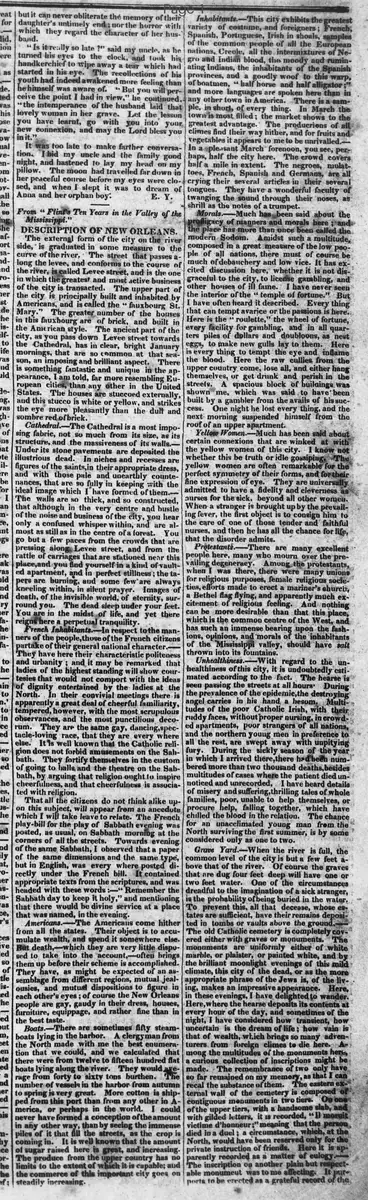
DESCRIPTION OF NEW ORLEANS.
The external form of the city on the river side, is graduated in some measure to the curve of the river. The street that passes along the levee, and conforms to the course of the river, is called Levee street, and is the one in which the greatest and most active business of the city is transacted. The upper part of the city is principally built and inhabited by Americans, and is called the "faubourg St. Mary." The greater number of the houses in this faubourg are of brick, and built in the American style. The ancient part of the city, as you pass down Levee street towards the Cathedral, has in clear, bright January mornings, that are so common at that season, an imposing and brilliant aspect. There is something fantastic and unique in the appearance, I am told, far more resembling European cities, than any other in the United States. The houses are stuccoed externally, and this stucco is white or yellow, and strikes the eye more pleasantly than the dull and sombre red of brick.
Cathedral.—The Cathedral is a most imposing fabric, not so much from its size, as its structure, and the massiveness of its walls.—Under its stone pavements are deposited the illustrious dead. In niches and recesses are figures of the saints, in their appropriate dress, and with those pale and unearthly countenances, that are so fully in keeping with the ideal image which I have formed of them.—The walls are so thick, and so constructed, that although in the very centre and bustle of the noise and business of the city, you hear only a confused whisper within, and are almost as still as in the centre of a forest. You go but a few paces from the crowds that are pressing along Levee street, and from the rattle of carriages that are stationed near this place, and you find yourself in a kind of vaulted apartment, and in perfect stillness; the tapers are burning, and some few are always kneeling within, in silent prayer. Images of death, of the invisible world, of eternity, surround you. The dead sleep under your feet. You are in the midst of life, and yet there reigns here a perpetual tranquility.
French Inhabitants.—In respect to the manners of the people, those of the French citizens partake of their general national character.—They have here their characteristic politeness and urbanity; and it may be remarked that ladies of the highest standing will show courtesies that would not comport with the ideas of dignity entertained by the ladies at the North. In their convivial meetings there is apparently a great deal of cheerful familiarity, tempered, however, with the most scrupulous observances, and the most punctilious decorum. They are the same gay, dancing, spectacle-loving race, that they are every where else. It is well known that the Catholic religion does not forbid amusements on the Sabbath. They fortify themselves in the custom of going to balls, and the theatre on the Sabbath, by arguing that religion ought to inspire cheerfulness, and that cheerfulness is associated with religion.
That all the citizens do not think alike upon this subject, will appear from an anecdote which I will take leave to relate. The French play-bill for the play of Sabbath evening was posted, as usual, on Sabbath morning at the corners of all the streets. Towards evening of the same Sabbath, I observed that a paper of the same dimensions and the same type, but in English, was every where posted directly under the French bill. It contained appropriate texts from the scriptures, and was headed with these words :—"Remember the Sabbath day to keep it holy," and mentioning that there would be divine service at a place that was named, in the evening.
Americans.—The Americans come hither from all the states. Their object is to accumulate wealth, and spend it somewhere else. But death,—which they are very little disposed to take into the account,—often brings them up before their scheme is accomplished. They have, as might be expected of an assemblage from different regions, mutual jealousies, and mutual dispositions to figure in each other's eyes; of course the New Orleans people are gay, gaudy in their dress, houses, furniture, equipage, and rather fine than in the best taste.
Boats. There are sometimes fifty steamboats lying in the harbor. A clergyman from the North made with me the best enumeration that we could, and we calculated that there were from twelve to fifteen hundred flat boats lying along the river. They would average from forty to sixty tons burthen. The number of vessels in the harbor from autumn to spring is very great. More cotton is shipped from this port than from any other in America, or perhaps in the world. I could never have formed a conception of the amount in any other way, than by seeing the immense piles of it that fill the streets, as the crop is coming in. It is well known that the amount of sugar raised here is great, and increasing. The produce from the upper country has no limits to the extent of which it is capable; and the commerce of this important city goes on steadily increasing.
Inhabitants.—This city exhibits the greatest variety of costume, and foreigners; French, Spanish, Portuguese, Irish in shoals, samples of the common people of all the European nations. Creole, all the intermixtures of Negro and Indian blood, the moody and ruminating Indians, the inhabitants of the Spanish provinces, and a goodly woof to this warp, of boatmen, "half horse and half alligator;" and more languages are spoken here than in any other town in America. There is a sample, in short, of every thing. In March the town is most filled; the market shows to the greatest advantage. The productions of all climes find their way hither, and for fruits and vegetables it appears to me to be unrivalled. In a pleasant March forenoon, you see, perhaps, half the city here. The crowd covers half a mile in extent. The negroes, mulattoes, French, Spanish and Germans, are all crying their several articles in their several tongues. They have a wonderful faculty of twanging the sound through their noses, as shrill as the notes of a trumpet.
Morals.—Much has been said about the profligacy of manners and morals here: and the place has more than once been called the modern Sodom. Amidst such a multitude, composed in a great measure of the low people of all nations, there must of course be much of debauchery and low vice. It has excited discussion here, whether it is not disgraceful to the city, to license gambling, and other houses of ill fame. I have never seen the interior of the "temple of fortune." But I have often heard it described. Every thing that can tempt avarice or the passions is here. Here is the "roulette," the wheel of fortune, every facility for gambling, and in all quarters piles of dollars and doubloons, as nest eggs, to make new gulls lay to them. Here is every thing to tempt the eye and inflame the blood. Here the raw cullies from the upper country come, lose all, and either hang themselves, or get drunk and perish in the streets. A spacious block of buildings was shown me, which was said to have been built by a gambler from the avails of his success. One night he lost every thing, and the next morning suspended himself from the roof of an upper apartment.
Yellow Women. Much has been said about certain connexions that are winked at with the yellow women of this city.—I know not whether this be truth or idle gossiping. The yellow women are often remarkable for the perfect symmetry of their forms, and for their fine expression of eye. They are universally admitted to have a fidelity and cleverness as nurses for the sick, beyond all other women. When a stranger is brought up by the prevailing fever, the first object is to consign him to the care of one of those tender and faithful nurses, and then he has all the chance for life, that the disorder admits.
Protestants.—There are many excellent people here, many who mourn over the prevailing degeneracy. Among the protestants, when I was there, there were many unions for religious purposes, female religious societies, efforts made to erect a mariner's church, a Bethel flag flying, and apparently much excitement of religious feeling. And nothing can be more desirable than that this place, which is the common centre of the West, and has such an immense bearing upon the fashions, opinions, and morals of the inhabitants of the Mississippi valley, should have salt thrown into its fountains.
Unhealthiness. With regard to the unhealthiness of this city, it is undoubtedly estimated according to the fact. The hearse is seen passing the streets at all hours. During the prevalence of the epidemic, the destroying angel carries in his hand, a besom. Multitudes of the poor Catholic Irish, with their ruddy faces, without proper nursing, in crowded apartments, poor strangers of all nations, and the northern young men in preference to all the rest, are swept away with unpitying fury. During the sickly season of the year in which I arrived there, there had been numbered more than two thousand deaths, besides multitudes of cases where the patient died unnoticed and unrecorded. I have heard details of misery and suffering, thrilling tales of whole families, poor, unable to help themselves, or procure help, falling together, which have chilled the blood in the relation. The chance for an unacclimated young man from the North surviving the first summer, is by some considered only as one to two.
Grave Yard.—When the river is full, the common level of the city is but a few feet above that of the river. Of course the graves that are dug four feet deep will have one or two feet water. One of the circumstances dreadful to the imagination of a sick stranger, is the probability of being buried in the water. To prevent this, all that decease, whose estates are sufficient, have their remains deposited in tombs or vaults above the ground. The old Catholic cemetery is completely covered either with graves or monuments. The monuments are uniformly either of white marble, or plaister, or painted white, and by the brilliant moonlight evenings of this mild climate, this city of the dead, or as the more appropriate phrase of the Jews is, of the living, makes an impressive appearance. Here in these evenings, I have delighted to wander. Here, where the hearse deposits its contents at every hour of the day, and sometimes of the night, I have considered how transient, how uncertain is the dream of life; how vain is that of wealth, which brings so many adventurers from foreign climes to die here—among the multitudes of the monuments here, a curious collection of inscriptions might be made. "The remembrance of two only have so far remained on my memory, as that I can recal the substance of them. The eastern external wall of the cemetery is composed of contiguous monuments in two tiers. On one of the upper tiers, with a handsome slab, and with gilded letters, it is recorded, "I moruit victime d'honneur;" meaning that the person died in a duel; a circumstance, which, at the North, would have been reserved only for the private instruction of friends. Here it is apparently recorded as a matter of eulogy. The inscription on another plain but respectable monument was to me affecting. It purports to be erected as a grateful record of the
Long, faithful, and affectionate services of a black slave. The whole inscription wears a delightful simplicity, and honors the master that erected it, as much as to the slave. In the Protestant burial grounds, I was affected to read great numbers of names of men who died in the prime of life, from Boston, Salem, and vicinity. Multitudes of the adventurous and promising young men from New England have there found rest, and it is generally recorded that they died 'du fièvre jaune,' of the yellow fever, or of the prevailing epidemic.
Steam-Boats.—The communications from this city with the interior, are easy, pleasant, and rapid by the steam-boats. More than a hundred are now on these waters. Some of them, for size, accommodation, and splendour, exceed any that I have seen on the Atlantic waters. I have also found the passengers obliging and friendly. Manners are not so distant or so stately as at the North; and it is much easier to become acquainted with your fellow passengers.
What sub-type of article is it?
What themes does it cover?
What keywords are associated?
What entities or persons were involved?
Literary Details
Title
Description Of New Orleans.
Author
From "Flint's Ten Years In The Valley Of The Mississippi."
Subject
Description Of New Orleans
Form / Style
Descriptive Prose Essay
Key Lines