Thank you for visiting SNEWPapers!
Sign up free
Springfield Weekly Republican
Springfield, Hampden County, Massachusetts
What is this article about?
Report on Massachusetts legislative proceedings in Boston on May 3: Senate debates bills on canals, paupers, fire insurance, street railway, and taxes; House discusses equalizing soldier bounties with lengthy debate, amendments rejected, and procedural issues on voting.
Clipping
OCR Quality
Full Text
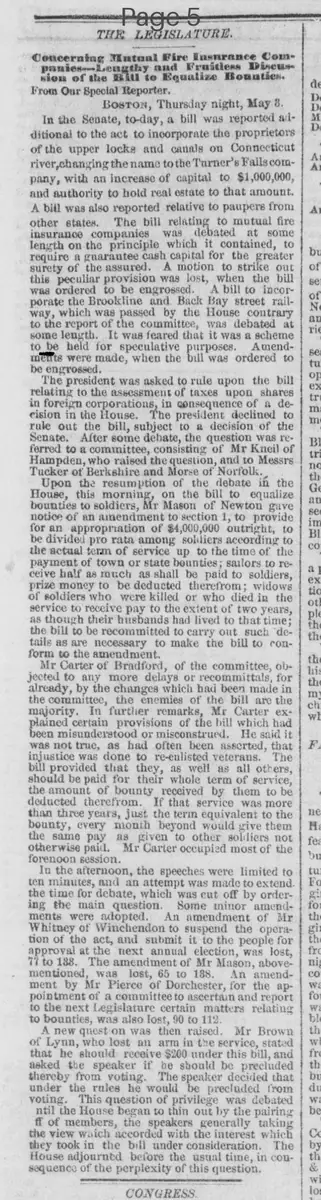
Concerning Mutual Fire Insurance Companies---Lengthy and Fruitless Discussion of the Bill to Equalize Bounties.
From Our Special Reporter,
Boston, Thursday night, May 3.
In the Senate, to-day, a bill was reported additional to the act to incorporate the proprietors of the upper locks and canals on Connecticut river, changing the name to the Turner's Falls company, with an increase of capital to $100,000, and authority to hold real estate to that amount.
A bill was also reported relative to paupers from other states. The bill relating to mutual fire insurance companies was debated at some length on the principle which it contained, to require a guarantee cash capital for the greater surety of the assured. A motion to strike out this peculiar provision was lost, when the bill was ordered to be engrossed. A bill to incorporate the Brookline and Back Bay street railway, which was passed by the House contrary to the report of the committee, was debated at some length. It was feared that it was a scheme to be held for speculative purposes. Amendments were made, when the bill was ordered to be engrossed.
The president was asked to rule upon the bill relating to the assessment of taxes upon shares in foreign corporations, in consequence of a decision in the House. The president declined to rule out the bill, subject to a decision of the Senate. After some debate, the question was referred to a committee, consisting of Mr. Knell of Hampden, who raised the question, and to Messrs. Tucker of Berkshire and Morse of Norfolk.
Upon the resumption of the debate in the House, this morning, on the bill to equalize bounties to soldiers, Mr. Mason of Newton gave notice of an amendment to section 1, to provide for an appropriation of $400,000 outright, to be divided pro rata among soldiers according to the actual term of service up to the time of the payment of town or state bounties; sailors to receive half as much as shall be paid to soldiers, prize money to be deducted therefrom; widows of soldiers who were killed or who died in the service to receive pay to the extent of two years, as though their husbands had lived to that time; the bill to be recommitted to carry out such details as are necessary to make the bill conform to the amendment.
Mr. Carter of Bradford, of the committee, objected to any more delays or recommittals, for already, by the changes which had been made in the committee, the enemies of the bill are the majority. In further remarks, Mr. Carter explained certain provisions of the bill which had been misunderstood or misconstrued. He said it was not true, as had often been asserted, that injustice was done to re-enlisted veterans. The bill provided that they, as well as all others, should be paid for their whole term of service, the amount of bounty received by them to be deducted therefrom. If that service was more than three years, just the term equivalent to the bounty, every month beyond would give them the same pay as given to other soldiers not otherwise paid. Mr. Carter occupied most of the forenoon session.
In the afternoon, the speeches were limited to ten minutes, and an attempt was made to extend the time for debate, which was cut off by ordering the main question. Some minor amendments were adopted. An amendment of Mr. Whitney of Winchendon to suspend the operation of the act, and submit it to the people for approval at the next annual election, was lost, 77 to 188. The amendment of Mr. Mason, above-mentioned, was lost, 65 to 188. An amendment by Mr. Pierce of Dorchester, for the appointment of a committee to ascertain and report to the next Legislature certain matters relating to bounties, was also lost, 90 to 112.
A new question was then raised. Mr. Brown of Lynn, who lost an arm in the service, stated that he should receive $200 under this bill, and asked the speaker if he should be precluded thereby from voting. The speaker decided that under the rules he would be precluded from voting. This question of privilege was debated until the House began to thin out by the pairing off of members, the speakers generally taking the view which accorded with the interest which they took in the bill under consideration. The House adjourned before the usual time, in consequence of the perplexity of this question.
What sub-type of article is it?
What themes does it cover?
What keywords are associated?
What entities or persons were involved?
Where did it happen?
Story Details
Key Persons
Location
Boston
Event Date
May 3
Story Details
Senate reports and debates bills on canals, paupers, fire insurance requiring cash capital, street railway with amendments, and refers tax assessment question to committee. House debates equalizing soldier bounties; amendments for direct appropriation, suspension for vote, and further committee rejected; procedural debate on veteran's voting eligibility leads to early adjournment.