Thank you for visiting SNEWPapers!
Sign up free
Farmers' Gazette, And Cheraw Advertiser
Cheraw, Chesterfield County, South Carolina
What is this article about?
A visitor describes John W. Gill's silk manufactory in Mount Pleasant, Ohio, started in 1838 with mulberry trees and producing $1,000 in fabrics by 1839. Now employing 20 workers including children, using steam-powered machinery costing $4,200, it generated over $9,000 in goods last year with 10% profit. Fabrics rival imported ones at lower prices. Advocates for legislative protection to boost the industry.
Clipping
OCR Quality
Full Text
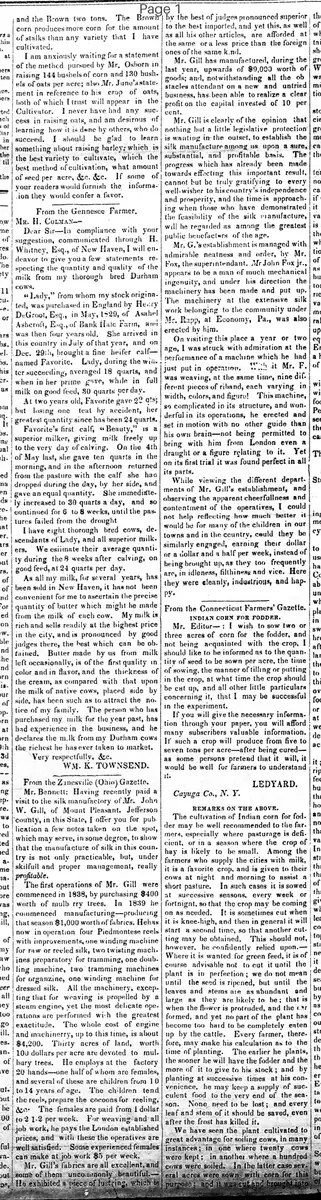
Mr. Bennett: Having recently paid a visit to the silk manufactory of Mr. John W. Gill, of Mount Pleasant, Jefferson county, in this State, I offer you for publication a few notes taken on the spot, which may serve, in some degree, to show that the manufacture of silk in this country is not only practicable, but, under skillful and proper management, really profitable.
The first operations of Mr. Gill were commenced in 1838, by purchasing $400 worth of mulberry trees. In 1839 he commenced manufacturing--producing that season $1,000 worth of fabrics. He has now in operation four Piedmontese reels with improvements, one winding machine for raw or reeled silk, two twisting machines preparatory for tramming, one doubling machine, two tramming machines for organzine, one winding machine for dressed silk. All the machinery, excepting that for weaving is propelled by a steam engine, yet the most delicate operations are performed with the greatest exactitude. The whole cost of engine and machinery, up to this time, is about $4,200. Thirty acres of land, worth $100 per acre are devoted to mulberry trees. He employs at the factory 20 hands--one half of whom are females, and several of these are children from 10 to 14 years of age. The children tend the reels, prepare the cocoons for reeling, &c. The females are paid from $1 to 2 1/2 per week. For weaving and all job work, he pays the London established prices, and with these the operatives are well satisfied. Some experienced females can make at job work $5 per week.
Mr. Gill's fabrics are all excellent, and some of them uncommonly beautiful. He exhibited a piece of lustring, which is by the best of judges pronounced superior to the best imported, and yet this, as well as all his other articles, are afforded at the same or a less price than the foreign ones of the same kind.
Mr. Gill has manufactured, during the last year, upwards of $9,000 worth of goods; and, notwithstanding all the obstacles attendant on a new and untried business, has been able to realize a clear profit on the capital invested of 10 per cent.
Mr. Gill is clearly of the opinion that nothing but a little legislative protection is wanting in the outset, to establish the silk manufacture among us upon a sure, substantial, and profitable basis. The progress which has already been made towards effecting this important result, cannot but be truly gratifying to every well-wisher to his country's independence and prosperity, and the time is approaching when those who have demonstrated the feasibility of the silk manufacture, will be regarded as among the greatest public benefactors of the age.
Mr. G.'s establishment is managed with admirable neatness and order, by Mr. Fox, the superintendent. Mr. John Fox jr. appears to be a man of much mechanical ingenuity, and under his direction the machinery has been made and put up. The machinery at the extensive silk work belonging to the community under Mr. Rapp, at Economy, Pa., was also erected by him.
On visiting this place a year or two ago, I was struck with admiration at the performance of a machine which he had just put in operation. With it Mr. F. was weaving, at the same time, nine different pieces of riband, each varying in width, colors, and figure! This machine, so complicated in its structure, and wonderful in its operations, he erected and set in motion with no other guide than his own brain--not being permitted to bring with him from London even a draught or a figure relating to it. Yet on its first trial it was found perfect in all its parts.
While viewing the different departments of Mr. Gill's establishment, and observing the apparent cheerfulness and contentment of the operatives, I could not help reflecting how much better it would be for many of the children in our towns and in the country, could they be similarly engaged, earning their dollar or a dollar and a half per week, instead of being brought up, as they too frequently are, in idleness, filthiness and vice. Here they were cleanly, industrious, and happy.
What sub-type of article is it?
What themes does it cover?
What keywords are associated?
What entities or persons were involved?
Where did it happen?
Story Details
Key Persons
Location
Mount Pleasant, Jefferson County, Ohio
Event Date
1838 1839, Last Year
Story Details
Visitor reports on John W. Gill's silk manufactory: started with mulberry trees in 1838, produced $1,000 fabrics in 1839; now uses steam-powered machinery, employs 20 including children paid $1-2.50/week; made $9,000 goods last year with 10% profit; fabrics superior to imports at same/lower price; managed by Mr. Fox, machinery by John Fox jr.; advocates legislative protection; notes benefits for child workers over idleness.