Thank you for visiting SNEWPapers!
Sign up free
National Gazette
Philadelphia, Philadelphia County, Pennsylvania
What is this article about?
In 1793, South Carolina Governor William Moultrie wrote to French Minister Citizen Genet seeking details on a reported dispute with U.S. President Washington over a French prize, amid concerns of insult. Genet replied from New York, denying falsehoods, affirming respect for Washington, and planning to submit all records to Congress for review.
Clipping
OCR Quality
Full Text
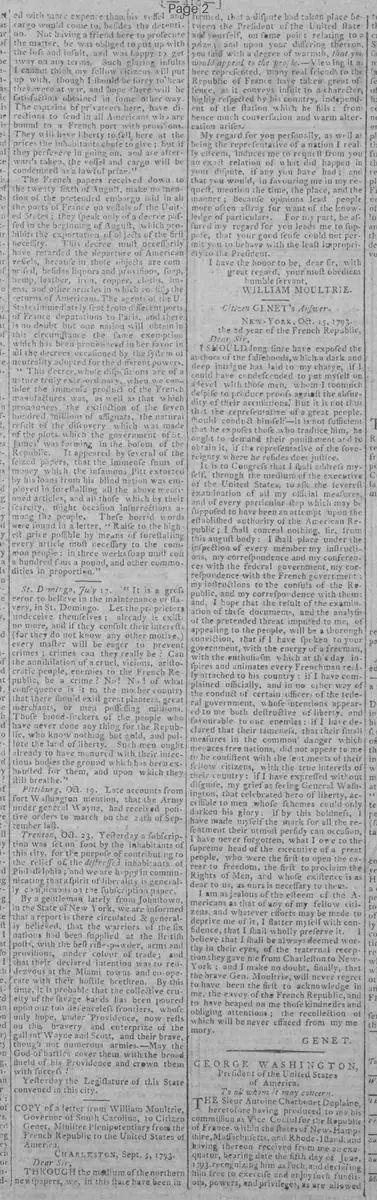
CHARLESTON, Sept. 5, 1793
Dear Sir,
THROUGH the medium of the northern news papers, we, in this state have been informed, that a dispute had taken place between the President of the United States and yourself, on some point relating to a prize; and upon your differing thereon, you said with a degree of warmth, that you would appeal to the people. - Viewing it as here represented, many real friends to the Republic of France have taken great offence, as it conveys insult to a character, highly respected by his country, independent of the station which he fills: from hence much conversation and warm altercation arises.
My regard for you personally, as well as being the representative of a nation I really esteem, induces me to request from you an exact relation of what did happen in your dispute, if any you have had; and that you would, in favouring me in my request, mention the time, the place, and the manner; because opinions lead people more often astray for want of the knowledge of particulars. For my part, be assured my regard for you leads me to suppose, that your good sense could not permit you to behave with the least impropriety to the President.
I have the honor to be, dear sir, with great regard, your most obedient humble servant,
WILLIAM MOULTRIE.
Citizen GENET's Answer.
New-York, Oct. 15, 1793. the 2d year of the French Republic.
Dear Sir,
I SHOULD long since have exposed the authors of the falsehoods, which a dark and deep intrigue has laid to my charge, if I could have condescended to put myself on a level with those men, whom I too much despise to produce proofs against the absurdity of their accusations. But it is not thus that the representative of a great people, should conduct himself - it is not sufficient that he exposes those who traduce him, he ought to demand their punishment and to obtain it, if the representative of the sovereignty where he resides does justice.
It is to Congress that I shall address myself, through the medium of the executive of the United States, to ask the severest examination of all my official measures, and of every particular step which may be supposed to have been an attempt upon the established authority of the American Republic; I shall conceal nothing, sir, from this august body: I shall place under the inspection of every member my instructions, my correspondence and my conferences with the federal government, my correspondence with the French government: my instructions to the consuls of the Republic, and my correspondence with them: and, I hope that the result of the examination of these documents, and the analysis of the pretended threat imputed to me, of appealing to the people, will be a thorough conviction, that if I have spoken to your government, with the energy of a freeman, with the enthusiasm which at this day inspires and animates every Frenchman really attached to his country: if I have complained officially, and in no other way of the conduct of certain officers of the federal government, whose intentions appeared to me both destructive of liberty, and favourable to our enemies: if I have declared that their tameness, that their ill measures in the common danger which menaces free nations, did not appear to me to be consistent with the sentiments of their fellow citizens, with the true interests of their country: if I have expressed without disguise, my grief at seeing General Washington, that celebrated hero of liberty, accessible to men whose schemes could only darken his glory; if by this boldness, I have made myself the mark for all the resentment their utmost perfidy can occasion, I have never forgotten, what I owe to the supreme head of the executive of a great people, who were the first to open the career to freedom, the first to proclaim the Rights of Man, and whose existence is as dear to us, as ours is necessary to them.
I am as jealous of the esteem of the Americans as that of any of my fellow citizens, and whatever efforts may be made to deprive me of it, I flatter myself with confidence, that I shall wholly preserve it. I believe that I shall be always deemed worthy in their eyes, of the fraternal reception they gave me from Charleston to New-York; and I make no doubt, finally, that the brave Gen. Moultrie, will never regret to have been the first to acknowledge in me, the envoy of the French Republic, and to have heaped on me those kindesses and obliging attentions: the recollection of which will be never effaced from my memory.
GENET.
What sub-type of article is it?
What keywords are associated?
What entities or persons were involved?
Where did it happen?
Foreign News Details
Primary Location
United States
Event Date
September 5, 1793 October 15, 1793
Key Persons
Outcome
genet plans to submit all official documents to congress for examination to refute accusations of impropriety and threat to appeal to the people.
Event Details
Governor Moultrie requests clarification from Genet on a reported dispute with the U.S. President over a prize, where Genet allegedly appealed to the people, causing offense among French supporters. Genet responds denying falsehoods, expressing respect for Washington, and intending to address Congress with full transparency on his actions and communications.