Thank you for visiting SNEWPapers!
Sign up free
Norfolk Gazette And Publick Ledger
Norfolk, Virginia
What is this article about?
An anonymous pro-Bourbon editorial argues that Jacobins, allied with the French army, will fail to prevent the Bourbon restoration after Napoleon's defeat. It claims public opinion favors the Bourbons, the army's influence is waning, and the recent rebellion will strengthen the monarchy. Written from a U.S. perspective in 1815.
Merged-components note: Continuation across pages of an opinion piece analyzing French politics post-Waterloo, signed by 'A BOURBONITE'; relabeled from foreign_news as it is partisan analysis rather than straight reporting.
Clippings
1 of 2
OCR Quality
Full Text
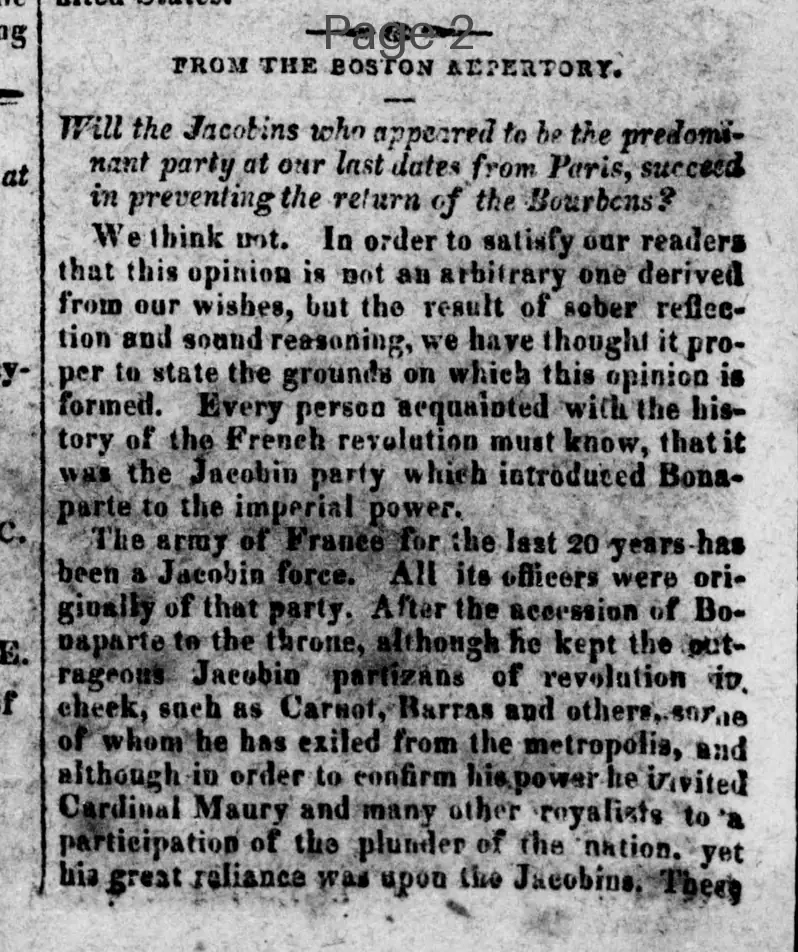
Will the Jacobins who appeared to be the predominant party at our last dates from Paris, succeed in preventing the return of the Bourbons?
We think not. In order to satisfy our readers that this opinion is not an arbitrary one derived from our wishes, but the result of sober reflection and sound reasoning, we have thought it proper to state the grounds on which this opinion is formed. Every person acquainted with the history of the French revolution must know, that it was the Jacobin party which introduced Bonaparte to the imperial power.
The army of France for the last 20 years--has been a Jacobin force. All its officers were originally of that party. After the accession of Bonaparte to the throne, although he kept the outrageous Jacobin partisans of revolution in check, such as Carnot, Barras and others, some of whom he has exiled from the metropolis, and although in order to confirm his power he invited Cardinal Maury and many other royalists to a participation of the plunder of the nation, yet his great reliance was upon the Jacobins. These
Men in France as well as in our country are no great republicans. They are utterly indifferent to the preservation of liberty, provided they can be admitted to a participation of power and profit. Never would you have seen a revolution in France from that quarter. They will cheerfully submit to the most odious despotism if they are duly rewarded and honoured.
When the late military revolution took place, which can only be compared to the constant usurpation of the Praetorian bands in the latter periods of the Roman history, or to the revolutions frequently effected by the body of Janizaries in Turkey, a coalition was formed between the army and the Jacobins.
Louis XVIII was too weak to put down the Jacobins. They were continued in their offices. They had the chief control of public measures.
The system which he tried to carry into effect of an amalgamation of all parties, though so honourable to his character, was perfectly absurd and Utopian.
Although the army in France was extremely powerful, yet such is the improved state of civil society, that no army can dictate laws to a great and populous nation without the aid of powerful parties in the state. Such an alliance was formed, and the condition of that compact was that the Jacobins should have in some degree the control of the state. Foolish expectation on their part! for as soon as by their aid, the tyrant should have been firmly seated, he would as he did before spurn the instruments of his elevation.
Still such was the fact. It was by their influence that the new constitution was proposed. It was under their auspices the peer elections were made. Every member who was chosen was previously designated in Paris, as we in our caucuses designate the man whom the people must choose as president. In that country it is not effected merely by the force of party passions, but by the aid of military authority.
Hence the new legislature resembles as nearly as possible one of the old Jacobin conventions. The people of France are no more represented than they are in the Turkish divan.
These men know that if the Bourbons return with the additional strength that governments always derive from suppressed rebellions, their fate is fixed. The greater part of them will be declared outlaws, and will be either exiled or capitally punished. There was no compromise possible as in the former instance. A revolution which had endured 20 years, under a government admitted as legal by all the European states, secured worn who had been active in it, from punishment. The case is now altered. All these persons have taken anew the oath of allegiance to the Bourbons, and they are the most distinguished traitors.
It may be asked why Paris was so quiet and permitted these men to elect a new sovereign over them, and to proceed without disturbance in perpetuating, as far as their acts could do it, the reign of Jacobinism and usurpation while the allies were at the gates of the city?
We answer that the city was almost at our very last dates in possession of the army. There were 40,000, (they say 70,000 men) in and before the city under leaders who were devoted to the usurper. The smallest attempt to overawe the convention of insurgents, called the legislature, would have been followed by a massacre, such as that of St. Roch, which first brought Bonaparte into notice.
You can, therefore, form an opinion of the feelings of the Parisians until the usurper's troops evacuated the city. Of his we have no accounts except general rumor, and certainly none since that event.
It is however evident that the people of Paris wish the unconditional return of the Bourbons. This is evident by the manner in which they treated them before. It is also evident, because Paris, which, in old Jacobinical times was the most active, is now perfectly dormant. The new rebels have been unable to excite any popular sensations in that city. But in all other parts of the empire where the military force was not so imposing the public feeling has appeared in favor of the old dynasty.
Let me simply consider, that the force in front of Paris was sufficient to keep even the victors in check and to command from them a capitulation, let them add to this that the assembly, called the legislature was composed of avowed Bonapartists or Jacobins, or at least in great part, that they had now nothing to offer to their sovereign who could not thank them for so late a submission which was utterly unavoidable, and then they will see that the voice of that tumultuous assembly amount to very little when we are estimating the force of public opinion in France.
One remark must strike every one. France in the year 1793, had been at peace for 9 years -- The nation was almost amused to war. Yet in a few months they had an army of one million combatants. In the late contest it does not appear that the people have afforded the smallest military aid to the government of the usurper.
This is strong and unanswerable language.
No. It may be depended upon that every part of France, as far as it is relieved from the threats and dangers of the usurper's army, will declare itself for the Bourbons.
They will be reinstated by the people of France. They will be strengthened and invigorated by the late rebellion.
The people will require, and will obtain the disbandment of that faithless army, and the punishment of those restless men in the army and in civil life who have caused France to lose so much blood, and to incur such disgraces as centuries of glory and honor, will scarcely wash away.
A BOURBONITE.
[Copied from the American Beacon of yesterday.]
What sub-type of article is it?
What keywords are associated?
What entities or persons were involved?
Editorial Details
Primary Topic
Prediction Of Bourbon Restoration Despite Jacobin Opposition
Stance / Tone
Strongly Pro Bourbon And Anti Jacobin
Key Figures
Key Arguments