Thank you for visiting SNEWPapers!
Sign up free
Domestic News
March 16, 1862
Memphis Daily Appeal
Memphis, Shelby County, Tennessee
What is this article about?
Editorial urges Southern planters to shift from cotton to food crops like grains, vegetables, and livestock due to Union blockade and war disrupting supplies from other states. Cites statistics from Georgia's Mr. B.H. Bingham showing need to feed Confederate armies and civilians.
Clipping
OCR Quality
75%
Good
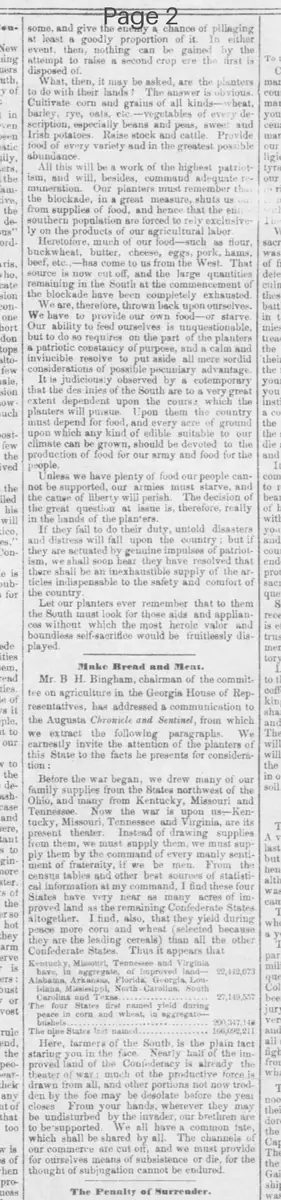
Full Text
some, and give the enemy a chance of pillaging
at least a goodly proportion of it. In either
event, then, nothing can be gained by the
attempt to raise a second crop ere the first is
disposed of.
What, then, it may be asked, are the planters
to do with their lands? The answer is obvious.
Cultivate corn and grains of all kinds - wheat,
barley, rye, oats, etc. - vegetables of every de-
scription, especially beans and peas, sweet and
Irish potatoes. Raise stock and cattle. Provide
food of every variety and in the greatest possible
abundance.
All this will be a work of the highest patriot-
ism, and will, besides, command adequate re-
muneration. Our planters must remember that
the blockade, in a great measure, shuts us
from supplies of food, and hence that the en-
tire southern population are forced to rely exclu-
sively on the products of our agricultural labor.
Heretofore, much of our food - such as flour,
buckwheat, butter, cheese, eggs, pork, hams,
beef, etc. - has come to us from the West. That
source is now cut off, and the large quantities
remaining in the South at the commencement of
the blockade have been completely exhausted.
We are, therefore, thrown back upon ourselves.
We have to provide our own food - or starve.
Our ability to feed ourselves is unquestionable,
but to do so requires on the part of the planters
a patriotic constancy of purpose, and a calm and
invincible resolve to put aside all mere sordid
considerations of possible pecuniary advantage.
It is judiciously observed by a contemporary
that the destinies of the South are to a very great
extent dependent upon the course which the
planters will pursue. Upon them the country
must depend for food, and every acre of ground
upon which any kind of edible suitable to our
climate can be grown, should be devoted to the
production of food for our army and food for the
people.
Unless we have plenty of food our people can-
not be supported, our armies must starve, and
the cause of liberty will perish. The decision of
the great question at issue is, therefore, really
in the hands of the planters.
If they fail to do their duty, untold disasters
and distress will fall upon the country; but if
they are actuated by genuine impulses of patriot-
ism, we shall soon hear they have resolved that
there shall be an inexhaustible supply of the ar-
ticles indispensable to the safety and comfort of
the country.
Let our planters ever remember that to them
the South must look for those aids and applian-
ces without which the most heroic valor and
boundless self-sacrifice would be fruitlessly dis-
played.
Make Bread and Meat.
Mr. B. H. Bingham, chairman of the commit-
tee on agriculture in the Georgia House of Rep-
resentatives, has addressed a communication to
the Augusta Chronicle and Sentinel, from which
we extract the following paragraphs. We
earnestly invite the attention of the planters of
this State to the facts he presents for considera-
tion:
Before the war began, we drew many of our
family supplies from the States northwest of the
Ohio, and many from Kentucky, Missouri and
Tennessee. Now the war is upon us - Ken-
tucky, Missouri, Tennessee and Virginia, are its
present theater. Instead of drawing supplies
from them, we must supply them, we must sup-
ply them by the command of every manly senti-
ment of fraternity, if we be men. From the
census tables and other best sources of statisti-
cal information at my command, I find these four
States have very near as many acres of im-
proved land as the remaining Confederate States
altogether. I find, also, that they yield during
peace more corn and wheat (selected because
they are the leading cereals) than all the other
Confederate States.
Thus it appears that
Kentucky, Missouri, Tennessee and Virginia
have, in aggregate, of improved land -
22,112,073
Alabama, Arkansas, Florida, Georgia, Lou-
isiana, Mississippi, North Carolina, South
Carolina and Texas .
27,195,557
The four States first named yield during
peace in corn and wheat, in aggregate
200,371,146
bushels.
The nine States last named
106,092,211
Here, farmers of the South, is the plain fact
staring you in the face. Nearly half of the im-
proved land of the Confederacy is already the
theater of war; much of the productive force is
drawn from all, and other portions not now trod-
den by the foe may be desolate before the year
closes. From your hands, wherever they may
be undisturbed by the invader, our brethren are
to be supported. We all have a common fate,
which shall be shared by all. The channels of
our commerce are cut off, and we must provide
for ourselves means of subsistence or die, for the
thought of subjugation cannot be endured.
at least a goodly proportion of it. In either
event, then, nothing can be gained by the
attempt to raise a second crop ere the first is
disposed of.
What, then, it may be asked, are the planters
to do with their lands? The answer is obvious.
Cultivate corn and grains of all kinds - wheat,
barley, rye, oats, etc. - vegetables of every de-
scription, especially beans and peas, sweet and
Irish potatoes. Raise stock and cattle. Provide
food of every variety and in the greatest possible
abundance.
All this will be a work of the highest patriot-
ism, and will, besides, command adequate re-
muneration. Our planters must remember that
the blockade, in a great measure, shuts us
from supplies of food, and hence that the en-
tire southern population are forced to rely exclu-
sively on the products of our agricultural labor.
Heretofore, much of our food - such as flour,
buckwheat, butter, cheese, eggs, pork, hams,
beef, etc. - has come to us from the West. That
source is now cut off, and the large quantities
remaining in the South at the commencement of
the blockade have been completely exhausted.
We are, therefore, thrown back upon ourselves.
We have to provide our own food - or starve.
Our ability to feed ourselves is unquestionable,
but to do so requires on the part of the planters
a patriotic constancy of purpose, and a calm and
invincible resolve to put aside all mere sordid
considerations of possible pecuniary advantage.
It is judiciously observed by a contemporary
that the destinies of the South are to a very great
extent dependent upon the course which the
planters will pursue. Upon them the country
must depend for food, and every acre of ground
upon which any kind of edible suitable to our
climate can be grown, should be devoted to the
production of food for our army and food for the
people.
Unless we have plenty of food our people can-
not be supported, our armies must starve, and
the cause of liberty will perish. The decision of
the great question at issue is, therefore, really
in the hands of the planters.
If they fail to do their duty, untold disasters
and distress will fall upon the country; but if
they are actuated by genuine impulses of patriot-
ism, we shall soon hear they have resolved that
there shall be an inexhaustible supply of the ar-
ticles indispensable to the safety and comfort of
the country.
Let our planters ever remember that to them
the South must look for those aids and applian-
ces without which the most heroic valor and
boundless self-sacrifice would be fruitlessly dis-
played.
Make Bread and Meat.
Mr. B. H. Bingham, chairman of the commit-
tee on agriculture in the Georgia House of Rep-
resentatives, has addressed a communication to
the Augusta Chronicle and Sentinel, from which
we extract the following paragraphs. We
earnestly invite the attention of the planters of
this State to the facts he presents for considera-
tion:
Before the war began, we drew many of our
family supplies from the States northwest of the
Ohio, and many from Kentucky, Missouri and
Tennessee. Now the war is upon us - Ken-
tucky, Missouri, Tennessee and Virginia, are its
present theater. Instead of drawing supplies
from them, we must supply them, we must sup-
ply them by the command of every manly senti-
ment of fraternity, if we be men. From the
census tables and other best sources of statisti-
cal information at my command, I find these four
States have very near as many acres of im-
proved land as the remaining Confederate States
altogether. I find, also, that they yield during
peace more corn and wheat (selected because
they are the leading cereals) than all the other
Confederate States.
Thus it appears that
Kentucky, Missouri, Tennessee and Virginia
have, in aggregate, of improved land -
22,112,073
Alabama, Arkansas, Florida, Georgia, Lou-
isiana, Mississippi, North Carolina, South
Carolina and Texas .
27,195,557
The four States first named yield during
peace in corn and wheat, in aggregate
200,371,146
bushels.
The nine States last named
106,092,211
Here, farmers of the South, is the plain fact
staring you in the face. Nearly half of the im-
proved land of the Confederacy is already the
theater of war; much of the productive force is
drawn from all, and other portions not now trod-
den by the foe may be desolate before the year
closes. From your hands, wherever they may
be undisturbed by the invader, our brethren are
to be supported. We all have a common fate,
which shall be shared by all. The channels of
our commerce are cut off, and we must provide
for ourselves means of subsistence or die, for the
thought of subjugation cannot be endured.
What sub-type of article is it?
Agriculture
Economic
Military
What keywords are associated?
Confederate Agriculture
Civil War Blockade
Food Production
Southern Planters
Corn Wheat Yields
What entities or persons were involved?
B. H. Bingham
Where did it happen?
Confederate States
Domestic News Details
Primary Location
Confederate States
Key Persons
B. H. Bingham
Event Details
Editorial advises Southern planters to cultivate food crops and raise livestock instead of cotton to counter the Union blockade and support the Confederate war effort, citing disrupted supplies from other states and including agricultural statistics from Mr. B.H. Bingham of Georgia.