Thank you for visiting SNEWPapers!
Sign up free
Story
January 23, 1838
Morning Herald
New York, New York County, New York
What is this article about?
Monsieur Marreppe's lifelike automaton violinist dazzles audience at Paris's Royal Conservatory with Paganini-like flourishes, symphonies, and fantasias, controlled by conductor or self-playing airs; creator details years of labor inspired by Vaucanson.
Clipping
OCR Quality
95%
Excellent
Full Text
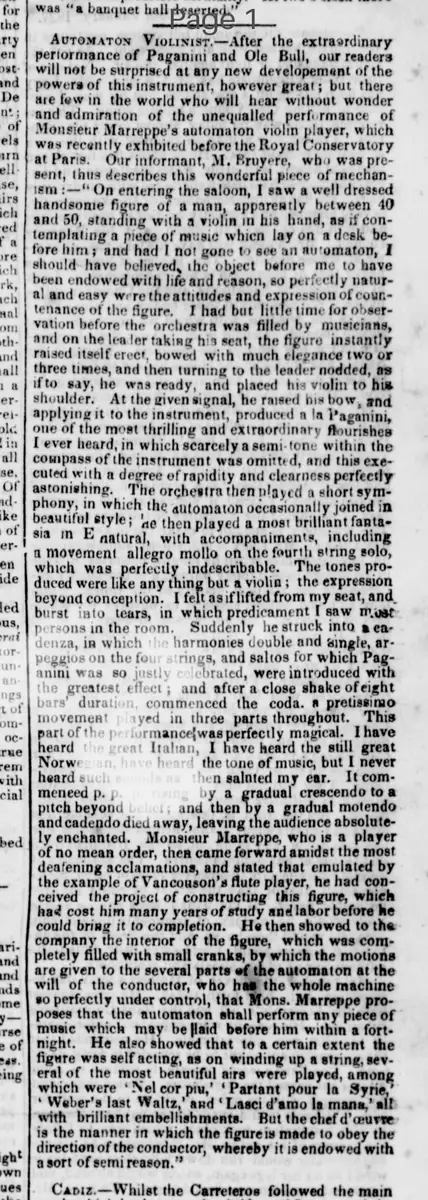
AUTOMATON VIOLINIST.-After the extraordinary performance of Paganini and Ole Bull, our readers will not be surprised at any new development of the powers of this instrument, however great; but there are few in the world who will hear without wonder and admiration of the unequalled performance of Monsieur Marreppe's automaton violin player, which was recently exhibited before the Royal Conservatory at Paris.
Our informant, M. Bruyere, who was present, thus describes this wonderful piece of mechanism :-" On entering the saloon, I saw a well dressed handsome figure of a man, apparently between 40 and 50, standing with a violin in his hand, as if contemplating a piece of music which lay on a desk before him; and had I not gone to see an automaton, I should have believed, the object before me to have been endowed with life and reason, so perfectly natural and easy were the attitudes and expression of countenance of the figure.
I had but little time for observation before the orchestra was filled by musicians, and on the leader taking his seat, the figure instantly raised itself erect, bowed with much elegance two or three times, and then turning to the leader nodded, as if to say, he was ready, and placed his violin to his shoulder. At the given signal, he raised his bow, and applying it to the instrument, produced a la Paganini, one of the most thrilling and extraordinary flourishes I ever heard, in which scarcely a semi-tone within the compass of the instrument was omitted, and this executed with a degree of rapidity and clearness perfectly astonishing.
The orchestra then played a short symphony, in which the automaton occasionally joined in beautiful style; he then played a most brilliant fantasia in E natural, with accompaniments, including a movement allegro mollo on the fourth string solo, which was perfectly indescribable. The tones produced were like any thing but a violin; the expression beyond conception. I felt as if lifted from my seat, and burst into tears, in which predicament I saw most persons in the room.
Suddenly he struck into eadenza, in which the harmonies double and single, arpeggios on the four strings, and saltos for which Paganini was so justly celebrated, were introduced with the greatest effect; and after a close shake of eight bars' duration, commenced the coda, a pretissimo movement played in three parts throughout. This part of the performance was perfectly magical. I have heard the great Italian, I have heard the still greater Norwegian, I have heard the tone of music, but I never heard such that saluted my ear. It commenced p. p. by a gradual crescendo to a pitch beyond, and then by a gradual motendo and cadendo died away, leaving the audience absolutely enchanted.
Monsieur Marreppe, who is a player of no mean order, then came forward amidst the most deafening acclamations, and stated that emulated by the example of Vaucanson's flute player, he had conceived the project of constructing this figure, which had cost him many years of study and labor before he could bring it to completion. He then showed to the company the interior of the figure, which was completely filled with small cranks, by which the motions are given to the several parts of the automaton at the will of the conductor, who has the whole machine so perfectly under control, that Mons. Marreppe proposes that the automaton shall perform any piece of music which may be laid before him within a fortnight.
He also showed that to a certain extent the figure was self acting, as on winding up a string, several of the most beautiful airs were played, among which were 'Nel cor piu,' 'Partant pour la Syrie,' Weber's last Waltz, and 'Lasci d'amo la mana,' all with brilliant embellishments. But the chef d'oeuvre is the manner in which the figure is made to obey the direction of the conductor, whereby it is endowed with a sort of semi reason."
Our informant, M. Bruyere, who was present, thus describes this wonderful piece of mechanism :-" On entering the saloon, I saw a well dressed handsome figure of a man, apparently between 40 and 50, standing with a violin in his hand, as if contemplating a piece of music which lay on a desk before him; and had I not gone to see an automaton, I should have believed, the object before me to have been endowed with life and reason, so perfectly natural and easy were the attitudes and expression of countenance of the figure.
I had but little time for observation before the orchestra was filled by musicians, and on the leader taking his seat, the figure instantly raised itself erect, bowed with much elegance two or three times, and then turning to the leader nodded, as if to say, he was ready, and placed his violin to his shoulder. At the given signal, he raised his bow, and applying it to the instrument, produced a la Paganini, one of the most thrilling and extraordinary flourishes I ever heard, in which scarcely a semi-tone within the compass of the instrument was omitted, and this executed with a degree of rapidity and clearness perfectly astonishing.
The orchestra then played a short symphony, in which the automaton occasionally joined in beautiful style; he then played a most brilliant fantasia in E natural, with accompaniments, including a movement allegro mollo on the fourth string solo, which was perfectly indescribable. The tones produced were like any thing but a violin; the expression beyond conception. I felt as if lifted from my seat, and burst into tears, in which predicament I saw most persons in the room.
Suddenly he struck into eadenza, in which the harmonies double and single, arpeggios on the four strings, and saltos for which Paganini was so justly celebrated, were introduced with the greatest effect; and after a close shake of eight bars' duration, commenced the coda, a pretissimo movement played in three parts throughout. This part of the performance was perfectly magical. I have heard the great Italian, I have heard the still greater Norwegian, I have heard the tone of music, but I never heard such that saluted my ear. It commenced p. p. by a gradual crescendo to a pitch beyond, and then by a gradual motendo and cadendo died away, leaving the audience absolutely enchanted.
Monsieur Marreppe, who is a player of no mean order, then came forward amidst the most deafening acclamations, and stated that emulated by the example of Vaucanson's flute player, he had conceived the project of constructing this figure, which had cost him many years of study and labor before he could bring it to completion. He then showed to the company the interior of the figure, which was completely filled with small cranks, by which the motions are given to the several parts of the automaton at the will of the conductor, who has the whole machine so perfectly under control, that Mons. Marreppe proposes that the automaton shall perform any piece of music which may be laid before him within a fortnight.
He also showed that to a certain extent the figure was self acting, as on winding up a string, several of the most beautiful airs were played, among which were 'Nel cor piu,' 'Partant pour la Syrie,' Weber's last Waltz, and 'Lasci d'amo la mana,' all with brilliant embellishments. But the chef d'oeuvre is the manner in which the figure is made to obey the direction of the conductor, whereby it is endowed with a sort of semi reason."
What sub-type of article is it?
Curiosity
Extraordinary Event
Prodigy
What themes does it cover?
Triumph
Moral Virtue
What keywords are associated?
Automaton Violinist
Marreppe
Paris Exhibition
Musical Performance
Mechanical Wonder
Paganini Style
What entities or persons were involved?
Monsieur Marreppe
M. Bruyere
Paganini
Ole Bull
Vaucanson
Where did it happen?
Royal Conservatory At Paris
Story Details
Key Persons
Monsieur Marreppe
M. Bruyere
Paganini
Ole Bull
Vaucanson
Location
Royal Conservatory At Paris
Story Details
Monsieur Marreppe's automaton violinist performs brilliantly before the Royal Conservatory at Paris, emulating Paganini with astonishing rapidity and expression, enchanting the audience; Marreppe reveals the mechanism's construction after years of labor, allowing conductor control and self-playing of airs.