Thank you for visiting SNEWPapers!
Sign up free
Story
June 15, 1901
Spirit Of The Age
Woodstock, Windsor County, Vermont
What is this article about?
An old peace officer shares anecdotes of courageous frontier lawmen with irrational fears: Capt. Edward Loomis dreaded thunder despite his bravery, and Jackson fainted at a snake prank but proved his nerve afterward. Lesson: Don't judge cowardice by one weakness.
Clipping
OCR Quality
95%
Excellent
Full Text
With Self-Setting Levers,
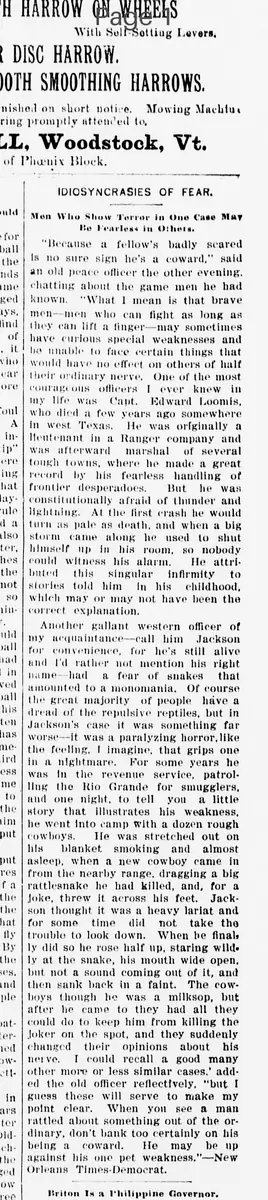
IDIOSYNCRASIES OF FEAR,
Men Who Show Terror in One Case May
Be Fearless in Others.
"Because a fellow's badly scared
Is no sure sign he's a coward," said
an old peace officer the other evening,
chatting about the game men he had
known.
"What I mean is that brave
men—men who can fight as long as
they can lift a finger—may sometimes
have curious special weaknesses and
be unable to face certain things that
would have no effect on others of half
their ordinary nerve. One of the most
courageous officers I ever knew in
my life was Capt. Edward Loomis,
who died a few years ago somewhere
in west Texas. He was originally a
lieutenant in a Ranger company and
was afterward marshal of several
tough towns, where he made a great
record by his fearless handling of
frontier desperadoes.
But he was
constitutionally afraid of thunder and
lightning. At the first crash he would
turn as pale as death, and when a big
storm came along he used to shut
himself up in his room, so nobody
could witness his alarm. He attri-
buted this singular infirmity to
stories told him in his childhood,
which may or may not have been the
correct explanation.
Another gallant western officer of
my acquaintance—call him Jackson
for convenience, for he's still alive
and I'd rather not mention his right
name—had a fear of snakes that
amounted to a monomania. Of course
the great majority of people have a
dread of the repulsive reptiles, but in
Jackson's case it was something far
worse—it was a paralyzing horror, like
the feeling, I imagine, that grips one
in a nightmare. For some years he
was in the revenue service, patrol-
ling the Rio Grande for smugglers,
and one night, to tell you a little
story that illustrates his weakness,
he went into camp with a dozen rough
cowboys.
He was stretched out on
his
blanket, smoking and almost
asleep, when a new cowboy came in
from the nearby range, dragging a big
rattlesnake he had killed, and, for a
joke, threw it across his feet. Jack-
son thought it was a heavy lariat and
for some time
did not take the
trouble to look down. When he finally
did so he rose half up, staring wildly
at the snake, his mouth wide open,
but not a sound coming out of it, and
then sank back in a faint. The cow-
boys thought he was a milksop, but
after he came to they had all they
could do to keep him from killing the
joker on the spot, and they suddenly
changed their opinions about his
nerve. I could recall a good many
other more or less similar cases," add-
ed the old officer reflectively, "but I
guess these will serve to make my
point clear.
When
you see a man
rattled about something out of the or-
dinary, don't bank too certainly on his
being a
coward.
He
may
be up
against his one pet weakness."—New
Orleans Times-Democrat.
IDIOSYNCRASIES OF FEAR,
Men Who Show Terror in One Case May
Be Fearless in Others.
"Because a fellow's badly scared
Is no sure sign he's a coward," said
an old peace officer the other evening,
chatting about the game men he had
known.
"What I mean is that brave
men—men who can fight as long as
they can lift a finger—may sometimes
have curious special weaknesses and
be unable to face certain things that
would have no effect on others of half
their ordinary nerve. One of the most
courageous officers I ever knew in
my life was Capt. Edward Loomis,
who died a few years ago somewhere
in west Texas. He was originally a
lieutenant in a Ranger company and
was afterward marshal of several
tough towns, where he made a great
record by his fearless handling of
frontier desperadoes.
But he was
constitutionally afraid of thunder and
lightning. At the first crash he would
turn as pale as death, and when a big
storm came along he used to shut
himself up in his room, so nobody
could witness his alarm. He attri-
buted this singular infirmity to
stories told him in his childhood,
which may or may not have been the
correct explanation.
Another gallant western officer of
my acquaintance—call him Jackson
for convenience, for he's still alive
and I'd rather not mention his right
name—had a fear of snakes that
amounted to a monomania. Of course
the great majority of people have a
dread of the repulsive reptiles, but in
Jackson's case it was something far
worse—it was a paralyzing horror, like
the feeling, I imagine, that grips one
in a nightmare. For some years he
was in the revenue service, patrol-
ling the Rio Grande for smugglers,
and one night, to tell you a little
story that illustrates his weakness,
he went into camp with a dozen rough
cowboys.
He was stretched out on
his
blanket, smoking and almost
asleep, when a new cowboy came in
from the nearby range, dragging a big
rattlesnake he had killed, and, for a
joke, threw it across his feet. Jack-
son thought it was a heavy lariat and
for some time
did not take the
trouble to look down. When he finally
did so he rose half up, staring wildly
at the snake, his mouth wide open,
but not a sound coming out of it, and
then sank back in a faint. The cow-
boys thought he was a milksop, but
after he came to they had all they
could do to keep him from killing the
joker on the spot, and they suddenly
changed their opinions about his
nerve. I could recall a good many
other more or less similar cases," add-
ed the old officer reflectively, "but I
guess these will serve to make my
point clear.
When
you see a man
rattled about something out of the or-
dinary, don't bank too certainly on his
being a
coward.
He
may
be up
against his one pet weakness."—New
Orleans Times-Democrat.
What sub-type of article is it?
Biography
Curiosity
What themes does it cover?
Bravery Heroism
Moral Virtue
What keywords are associated?
Brave Men
Specific Fears
Thunder Phobia
Snake Horror
Frontier Officers
What entities or persons were involved?
Capt. Edward Loomis
Jackson
Where did it happen?
West Texas, Rio Grande
Story Details
Key Persons
Capt. Edward Loomis
Jackson
Location
West Texas, Rio Grande
Event Date
A Few Years Ago
Story Details
An old peace officer recounts how brave men like Capt. Edward Loomis, fearless against desperadoes but terrified of thunder, and Jackson, paralyzed by fear of snakes despite his nerve, illustrate that specific fears do not indicate overall cowardice.