Thank you for visiting SNEWPapers!
Sign up free
Literary
July 23, 1834
The Hillsborough Recorder
Hillsboro, Orange County, North Carolina
What is this article about?
Young lawyer William Harding, after defending a ruined gambler, vows to avoid vice. On a Mississippi steamboat trip to Natchez, he succumbs to drink and gambles lightly. He settles his uncle's estate, falls in love with and marries cousin Emily Worthington, despite rivalry from gambler Augustus Vil, who plots revenge. (To be continued.)
Clipping
OCR Quality
95%
Excellent
Full Text
From the New-Yorker
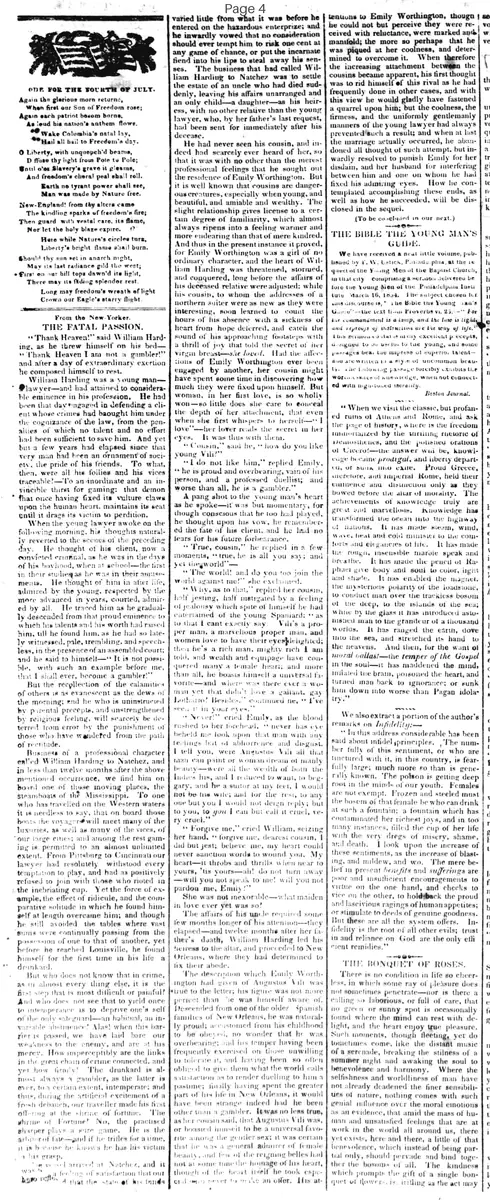
THE FATAL PASSION.
"Thank Heaven!" said William Harding, as he threw himself on his bed—
"Thank Heaven I am not a gambler!"
and after a day of extraordinary exertion he composed himself to rest.
William Harding was a young man—a lawyer—and had attained to considerable eminence in his profession. He had been that day engaged in defending a client whose crimes had brought him under the cognizance of the law, from the penalties of which no talent and no effort had been sufficient to save him. And yet but a few years had elapsed since that very man had been an ornament of society, the pride of his friends. To what, then, were all his follies and his vices traceable?—To an inordinate and an invincible thirst for gaming: that demon that once having fixed its vulture claws upon the human heart, maintains its seat until it drags its victim to perdition.
When the young lawyer awoke on the following morning, his thoughts naturally reverted to the scenes of the preceding day. He thought of his client, now a convicted criminal, as he was in the days of his boyhood, when at school—the first in their studies as he was in their amusements. He thought of him in after life, admired by the young, respected by the more advanced in years, courted, admired by all. He traced him as he gradually descended from that proud eminence to which his talents and his worth had raised him, till he found him, as he had so lately witnessed, pale, trembling, and speechless, in the presence of an assembled court; and he said to himself "It is not possible, with such an example before me, that I shall ever become a gambler!"
But the recollection of the calamities of others is as evanescent as the dews of the morning: and he who is uninstructed by parental precepts, and unstrengthened by religious feeling, will scarcely be deterred from error by the punishment of those who have wandered from the path of rectitude.
Business of a professional character called William Harding to Natchez, and in less than twelve months after the above mentioned occurrence, we find him on board one of those moving places, the steamboats of the Mississippi. To one who has travelled on the Western waters it is needless to say, that on board those boats the voyagers will meet many of the luxuries, as well as many of the vices, of our large cities; and among the rest gaming is permitted to an almost unlimited extent. From Pittsburgh to Cincinnati our lawyer had resolutely withstood every temptation to play, and had as positively refused to join with those who rioted in the inebriating cup. Yet the force of example, the effect of ridicule, and the comparative solitude in which he found himself at length overcame him; and though he still avoided the tables where vast sums were continually passing from the possession of one to that of another, yet before he reached Louisville, he found himself for the first time in his life a drunkard.
But who does not know that in crime, as in almost every thing else, it is the first step that is most difficult or painful? And who does not see that to yield once to intemperance is to deprive one's self of the only safeguard—an habitual, an invincible abstinence? Alas! when this barrier is passed, we have laid bare our weakness to the enemy, and are at his mercy. How imperceptibly are the links in the great chain of crime connected, and yet how firmly! The drunkard is almost always a gambler, as the latter is ever, to a certain extent, intemperate; and thus, during the artificial excitement of a fresh debauch, our traveller made his first offering at the shrine of fortune. The shrine of Fortune? No, the practised sharper plays a sure game. He is the arbiter of fate—and if he trifles for a time, it is because he knows he has his victim in his grasp.
He arrived at Natchez, and it was with a feeling of satisfaction that our hero reflected that the man of his lands varied little from what it was before he entered on the hazardous enterprize; and he inwardly vowed that no consideration should ever tempt him to risk one cent at any game of chance, or put the incarnate fiend into his life to steal away his senses. The business that had called William Harding to Natchez was to settle the estate of an uncle who had died suddenly, leaving his affairs unarranged and an only child—a daughter—as his heiress, with no other relative than the young lawyer, who, by her father's last request, had been sent for immediately after his decease.
He had never seen his cousin, and indeed had scarcely ever heard of her, so that it was with no other than the merest professional feelings that he sought out the residence of Emily Worthington. But it is well known that cousins are dangerous creatures, especially when young, and beautiful, and amiable and wealthy. The slight relationship gives license to a certain degree of familiarity, which almost always ripens into a feeling warmer and more endearing than that of mere kindred. And thus in the present instance it proved, for Emily Worthington was a girl of no ordinary character, and the heart of William Harding was threatened, stormed, and conquered, long before the affairs of his deceased relative were adjusted: while his cousin, to whom the addresses of a northern suitor were as new as they were interesting, soon learned to count the hours of his absence with a sickness of heart from hope deferred, and catch the sound of his approaching footsteps with a thrill of joy that told the secret of her virgin breast—she loved. Had the affections of Emily Worthington ever been engaged by another, her cousin might have spent some time in discovering how much they were fixed upon himself. But woman, in her first love, is so wholly won—so little does she care to conceal the depth of her attachment, that even when she first whispers to herself—"I love"—her lover reads the secret in her eyes. It was thus with them.
"Cousin," said he, "how do you like young Vil?"
"I do not like him," replied Emily, "he is proud and overbearing, vain of his person, and a professed duellist; and worse than all, he is a gambler."
A pang shot to the young man's heart as he spoke—it was but momentary, for though conscious that he too had played, he thought upon his vow, he remembered the fate of his client, and he had no fears for his future forbearance.
"True, cousin," he replied in a few moments, "true, he is all you say; and yet the world—"
"The world! and do you too join the world against me?" she exclaimed.
"Why, as to that," replied her cousin, half jesting, half instigated by a feeling of jealousy which spite of himself he had entertained of the young Spaniard: "as to that I can't exactly say. Vil's a proper man, a marvellous proper man, and women love to have their eyes delighted; then he's a rich man, mighty rich I am told, and wealth and equipage have conquered many a female heart: and more than all, he boasts himself a universal favorite—and where was there ever a woman yet that didn't love a gallant, gay Lothario? Besides," continued he, "I've seen it in your eyes."
"Never!" cried Emily, as the blood rushed to her forehead, "never has eye beheld me look upon that man with any feelings but of abhorrence and disgust. I tell you, were Augustus Vil all that man can paint or woman dream of manly beauty—were all the wealth of both the Indies his, and I reduced to want, to beggary, and he a suitor at my feet, I would not be his wife; and for the rest, to any one but you I would not deign reply; but to you, to you I can but call it cruel, very cruel."
"Forgive me," cried William, seizing her hand, "forgive me, dearest cousin, I did but jest; believe me, my heart could never sanction words to wound you. My heart—it throbs and thrills when near to yours, 'tis yours—ah! do not turn away—will you not speak to me! will you not pardon me, Emily?"
She was not inexorable—what maiden in love ever yet was so?
The affairs of his uncle required some few months longer of his attention—they elapsed—and twelve months after her father's death, William Harding led his heiress to the altar, and proceeded to New Orleans, where they had determined to fix their abode.
The description which Emily Worthington had given of Augustus Vil was true to the letter; his figure was not more perfect than he was himself aware of. Descended from one of the oldest Spanish families of New Orleans, he was naturally proud; accustomed from his childhood to be obeyed, no wonder that he was overbearing; and his temper having been frequently exercised on those unwilling to tolerate it, and having been so often obliged to give them what the world calls satisfaction as to render duelling to him a pastime; finally having spent the greater part of his life in New Orleans, it would have been strange indeed had he been other than a gambler. It was no less true, as her cousin said, that Augustus Vil was, or boasted himself to be a universal favorite among the gentler sex; it was certain that he was a general admirer of female beauty, and few of the reigning belles had not at some time the homage of his heart, though of this heart itself he took especial care never to make an offer. His attentions to Emily Worthington, though he could not but perceive they were received with reluctance, were marked and manifold; the more so perhaps that he was piqued at her coolness, and determined to overcome it. When therefore the increasing attachment between the cousins became apparent, his first thought was to rid himself of this rival as he had frequently done in other cases, and with this view he would gladly have fastened a quarrel upon him; but the coolness, the firmness, and the uniformly gentlemanly manners of the young lawyer had always prevented such a result; and when at last the marriage actually occurred, he abandoned all thought of such attempt, but inwardly resolved to punish Emily for her disdain, and her husband for interfering between him and one on whom he had fixed his admiring eyes. How he contemplated accomplishing these ends, as well as how he succeeded, will be disclosed in the sequel.
(To be continued in our next.)
THE FATAL PASSION.
"Thank Heaven!" said William Harding, as he threw himself on his bed—
"Thank Heaven I am not a gambler!"
and after a day of extraordinary exertion he composed himself to rest.
William Harding was a young man—a lawyer—and had attained to considerable eminence in his profession. He had been that day engaged in defending a client whose crimes had brought him under the cognizance of the law, from the penalties of which no talent and no effort had been sufficient to save him. And yet but a few years had elapsed since that very man had been an ornament of society, the pride of his friends. To what, then, were all his follies and his vices traceable?—To an inordinate and an invincible thirst for gaming: that demon that once having fixed its vulture claws upon the human heart, maintains its seat until it drags its victim to perdition.
When the young lawyer awoke on the following morning, his thoughts naturally reverted to the scenes of the preceding day. He thought of his client, now a convicted criminal, as he was in the days of his boyhood, when at school—the first in their studies as he was in their amusements. He thought of him in after life, admired by the young, respected by the more advanced in years, courted, admired by all. He traced him as he gradually descended from that proud eminence to which his talents and his worth had raised him, till he found him, as he had so lately witnessed, pale, trembling, and speechless, in the presence of an assembled court; and he said to himself "It is not possible, with such an example before me, that I shall ever become a gambler!"
But the recollection of the calamities of others is as evanescent as the dews of the morning: and he who is uninstructed by parental precepts, and unstrengthened by religious feeling, will scarcely be deterred from error by the punishment of those who have wandered from the path of rectitude.
Business of a professional character called William Harding to Natchez, and in less than twelve months after the above mentioned occurrence, we find him on board one of those moving places, the steamboats of the Mississippi. To one who has travelled on the Western waters it is needless to say, that on board those boats the voyagers will meet many of the luxuries, as well as many of the vices, of our large cities; and among the rest gaming is permitted to an almost unlimited extent. From Pittsburgh to Cincinnati our lawyer had resolutely withstood every temptation to play, and had as positively refused to join with those who rioted in the inebriating cup. Yet the force of example, the effect of ridicule, and the comparative solitude in which he found himself at length overcame him; and though he still avoided the tables where vast sums were continually passing from the possession of one to that of another, yet before he reached Louisville, he found himself for the first time in his life a drunkard.
But who does not know that in crime, as in almost every thing else, it is the first step that is most difficult or painful? And who does not see that to yield once to intemperance is to deprive one's self of the only safeguard—an habitual, an invincible abstinence? Alas! when this barrier is passed, we have laid bare our weakness to the enemy, and are at his mercy. How imperceptibly are the links in the great chain of crime connected, and yet how firmly! The drunkard is almost always a gambler, as the latter is ever, to a certain extent, intemperate; and thus, during the artificial excitement of a fresh debauch, our traveller made his first offering at the shrine of fortune. The shrine of Fortune? No, the practised sharper plays a sure game. He is the arbiter of fate—and if he trifles for a time, it is because he knows he has his victim in his grasp.
He arrived at Natchez, and it was with a feeling of satisfaction that our hero reflected that the man of his lands varied little from what it was before he entered on the hazardous enterprize; and he inwardly vowed that no consideration should ever tempt him to risk one cent at any game of chance, or put the incarnate fiend into his life to steal away his senses. The business that had called William Harding to Natchez was to settle the estate of an uncle who had died suddenly, leaving his affairs unarranged and an only child—a daughter—as his heiress, with no other relative than the young lawyer, who, by her father's last request, had been sent for immediately after his decease.
He had never seen his cousin, and indeed had scarcely ever heard of her, so that it was with no other than the merest professional feelings that he sought out the residence of Emily Worthington. But it is well known that cousins are dangerous creatures, especially when young, and beautiful, and amiable and wealthy. The slight relationship gives license to a certain degree of familiarity, which almost always ripens into a feeling warmer and more endearing than that of mere kindred. And thus in the present instance it proved, for Emily Worthington was a girl of no ordinary character, and the heart of William Harding was threatened, stormed, and conquered, long before the affairs of his deceased relative were adjusted: while his cousin, to whom the addresses of a northern suitor were as new as they were interesting, soon learned to count the hours of his absence with a sickness of heart from hope deferred, and catch the sound of his approaching footsteps with a thrill of joy that told the secret of her virgin breast—she loved. Had the affections of Emily Worthington ever been engaged by another, her cousin might have spent some time in discovering how much they were fixed upon himself. But woman, in her first love, is so wholly won—so little does she care to conceal the depth of her attachment, that even when she first whispers to herself—"I love"—her lover reads the secret in her eyes. It was thus with them.
"Cousin," said he, "how do you like young Vil?"
"I do not like him," replied Emily, "he is proud and overbearing, vain of his person, and a professed duellist; and worse than all, he is a gambler."
A pang shot to the young man's heart as he spoke—it was but momentary, for though conscious that he too had played, he thought upon his vow, he remembered the fate of his client, and he had no fears for his future forbearance.
"True, cousin," he replied in a few moments, "true, he is all you say; and yet the world—"
"The world! and do you too join the world against me?" she exclaimed.
"Why, as to that," replied her cousin, half jesting, half instigated by a feeling of jealousy which spite of himself he had entertained of the young Spaniard: "as to that I can't exactly say. Vil's a proper man, a marvellous proper man, and women love to have their eyes delighted; then he's a rich man, mighty rich I am told, and wealth and equipage have conquered many a female heart: and more than all, he boasts himself a universal favorite—and where was there ever a woman yet that didn't love a gallant, gay Lothario? Besides," continued he, "I've seen it in your eyes."
"Never!" cried Emily, as the blood rushed to her forehead, "never has eye beheld me look upon that man with any feelings but of abhorrence and disgust. I tell you, were Augustus Vil all that man can paint or woman dream of manly beauty—were all the wealth of both the Indies his, and I reduced to want, to beggary, and he a suitor at my feet, I would not be his wife; and for the rest, to any one but you I would not deign reply; but to you, to you I can but call it cruel, very cruel."
"Forgive me," cried William, seizing her hand, "forgive me, dearest cousin, I did but jest; believe me, my heart could never sanction words to wound you. My heart—it throbs and thrills when near to yours, 'tis yours—ah! do not turn away—will you not speak to me! will you not pardon me, Emily?"
She was not inexorable—what maiden in love ever yet was so?
The affairs of his uncle required some few months longer of his attention—they elapsed—and twelve months after her father's death, William Harding led his heiress to the altar, and proceeded to New Orleans, where they had determined to fix their abode.
The description which Emily Worthington had given of Augustus Vil was true to the letter; his figure was not more perfect than he was himself aware of. Descended from one of the oldest Spanish families of New Orleans, he was naturally proud; accustomed from his childhood to be obeyed, no wonder that he was overbearing; and his temper having been frequently exercised on those unwilling to tolerate it, and having been so often obliged to give them what the world calls satisfaction as to render duelling to him a pastime; finally having spent the greater part of his life in New Orleans, it would have been strange indeed had he been other than a gambler. It was no less true, as her cousin said, that Augustus Vil was, or boasted himself to be a universal favorite among the gentler sex; it was certain that he was a general admirer of female beauty, and few of the reigning belles had not at some time the homage of his heart, though of this heart itself he took especial care never to make an offer. His attentions to Emily Worthington, though he could not but perceive they were received with reluctance, were marked and manifold; the more so perhaps that he was piqued at her coolness, and determined to overcome it. When therefore the increasing attachment between the cousins became apparent, his first thought was to rid himself of this rival as he had frequently done in other cases, and with this view he would gladly have fastened a quarrel upon him; but the coolness, the firmness, and the uniformly gentlemanly manners of the young lawyer had always prevented such a result; and when at last the marriage actually occurred, he abandoned all thought of such attempt, but inwardly resolved to punish Emily for her disdain, and her husband for interfering between him and one on whom he had fixed his admiring eyes. How he contemplated accomplishing these ends, as well as how he succeeded, will be disclosed in the sequel.
(To be continued in our next.)
What sub-type of article is it?
Prose Fiction
What themes does it cover?
Moral Virtue
Temperance
What keywords are associated?
Gambling
Vice
Moral Tale
Intemperance
Lawyer
Marriage
Rival
Perdition
Literary Details
Title
The Fatal Passion.
Subject
Warning Against The Vices Of Gambling And Intemperance
Key Lines
"Thank Heaven!" Said William Harding, As He Threw Himself On His Bed—
"Thank Heaven I Am Not A Gambler!"
To An Inordinate And An Invincible Thirst For Gaming: That Demon That Once Having Fixed Its Vulture Claws Upon The Human Heart, Maintains Its Seat Until It Drags Its Victim To Perdition.
It Is Not Possible, With Such An Example Before Me, That I Shall Ever Become A Gambler!
The Drunkard Is Almost Always A Gambler, As The Latter Is Ever, To A Certain Extent, Intemperate;