Thank you for visiting SNEWPapers!
Sign up free
Herald Of The United States
Warren, Bristol County, Rhode Island
What is this article about?
From Petersburg, August 13-25, 1806: Russian envoy Peter D'Oubril signed a peace convention with France on July 20, 1806, but the Russian Imperial Council unanimously rejected it for deviating from instructions and conflicting with Russia's dignity and alliances. Russia expresses willingness to negotiate on honorable terms.
Merged-components note: Continuation of the detailed report on the Russia-France treaty across pages, forming a single focused foreign news article.
Clippings
1 of 2
OCR Quality
Full Text
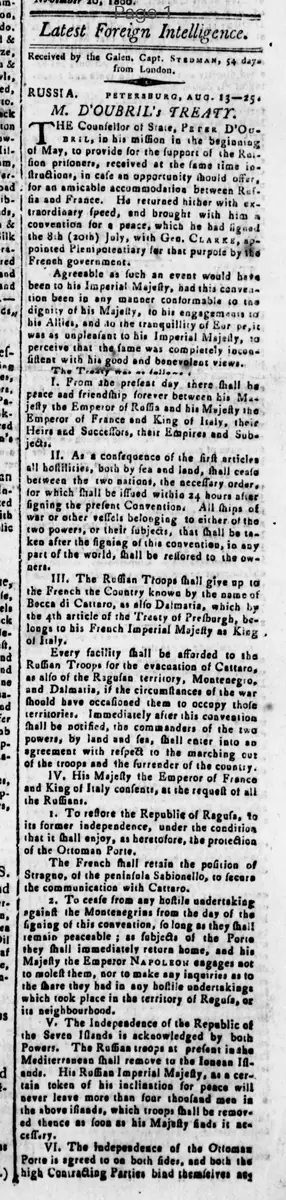
Received by the Galen, Capt. Sherman, 54 days from London.
RUSSIA.
PETERSBURG, AUG. 13-25
M. D'OUBRIL's TREATY.
The Counsellor of State, Peter D'Oubril, in his mission in the beginning of May, to provide for the support of the Russian prisoners, received at the same time instructions, in case an opportunity should offer, for an amicable accommodation between Russia and France. He returned hither with extraordinary speed, and brought with him a convention for a peace, which he had signed the 8th (20th) July, with Geo. Clarke, appointed Plenipotentiary for that purpose by the French government.
Agreeable as such an event would have been to his Imperial Majesty, had this convention been in any manner conformable to the dignity of his Majesty, to his engagements to his Allies, and to the tranquility of Europe, it was as unpleasant to his Imperial Majesty, as to perceive that the same was completely inconsistent with his good and benevolent views.
The Treaty was as follows:
I. From the present day there shall be peace and friendship forever between his Majesty the Emperor of Russia and his Majesty the Emperor of France and King of Italy, their Heirs and Successors, their Empires and Subjects.
II. As a consequence of the first articles all hostilities, both by sea and land, shall cease between the two nations, the necessary orders for which shall be issued within 24 hours after signing the present Convention. All ships of war or other vessels belonging to either of the two powers, or their subjects, that shall be taken after the signing of this convention, in any part of the world, shall be restored to the owners.
III. The Russian Troops shall give up to the French the Country known by the name of Bocca di Cattaro, as also Dalmatia, which by the 4th article of the Treaty of Presburgh, belongs to his French Imperial Majesty as King of Italy.
Every facility shall be afforded to the Russian Troops for the evacuation of Cattaro, as also of the Ragusan territory, Montenegro, and Dalmatia, if the circumstances of the war should have occasioned them to occupy those territories. Immediately after this convention shall be notified, the commanders of the two powers, by land and sea, shall enter into an agreement with respect to the marching out of the troops and the surrender of the country.
IV. His Majesty the Emperor of France and King of Italy consents, at the request of all the Russians.
1. To restore the Republic of Ragusa, to its former independence, under the condition that it shall enjoy, as heretofore, the protection of the Ottoman Porte.
The French shall retain the position of Ragusa, of the peninsula Sabionello, to secure the communication with Cattaro.
2. To cease from any hostile undertaking against the Montenegrins from the day of the signing of this convention, so long as they shall remain peaceable; as subjects of the Porte they shall immediately return home, and his Majesty the Emperor Napoleon engages not to molest them, nor to make any inquiries as to the part they had in any hostile undertakings which took place in the territory of Ragusa, or its neighbourhood.
V. The Independence of the Republic of the Seven Islands is acknowledged by both Powers. The Russian troops at present in the Mediterranean shall remove to the Ionian Islands. His Russian Imperial Majesty, as a certain token of his inclination for peace will never leave more than four thousand men in the above islands, which troops shall be removed thence as soon as his Majesty finds it necessary.
VI. The independence of the Ottoman Porte is agreed to on both sides, and both the high Contracting Parties bind themselves as
VI. As soon as, in conformity to the Articles of the present convention, orders are issued for the troops to evacuate the mouths of the Cattaro, the French troops shall quit Germany, and stop all preparations for hostilities.
His Majesty the Emperor Napoleon declares, that not later than three months, to be reckoned from the signing of the treaty, all his troops shall have returned to France.
VII. The two high Contracting Powers promise to employ all their good offices to terminate the war between Prussia and Sweden.
IX. As the two high Contracting Parties wish, as much as in their power, to accelerate peace upon the Seas, his French Imperial Majesty will cheerfully accept of the good offices of the Emperor of Russia for this purpose.
X. The commercial regulations between the subjects of the two Empires, shall be established upon the same footing as they were before the breaking out of hostilities.
XI. All prisoners of both nations shall be delivered to the agents of their respective governments without ransom, as soon as the ratifications are exchanged.
XII. The ceremonials respecting embassies, &c. between the high Contracting Powers, shall be placed upon the same footing as before the war.
XIII. The ratifications of this Convention shall be exchanged within twenty-five days in St. Petersburgh, between the Plenipotentiaries of both Empires.
Executed at Paris this 20th July, 1806.
(Signed)
PETER D'OUBRIL.
CLARKE.
C.
His Imperial Majesty has been pleased to lay this instrument before an extraordinary meeting of his Council, where it was compared with the instructions given here to M. D'Oubril, and with the orders sent to him at Vienna, and it appeared that M. D'Oubril, in signing the above convention, has not only deviated from his instructions, but has acted directly contrary to the sense and meaning of his commission.
The Imperial Council, with common feelings for the honor of the Empire, and following the well known principles of his Imperial Majesty, which are founded on the ancient love of justice, has unanimously declared that this act, in no points conformable to the views of his Imperial Majesty, cannot by any means receive his ratification; and his Imperial Majesty has given orders that the same be notified to the French government, declaring his willingness to renew the Negotiations for Peace, but only upon such a basis as is conformable with his Majesty's dignity.
What sub-type of article is it?
What keywords are associated?
What entities or persons were involved?
Where did it happen?
Foreign News Details
Primary Location
Petersburg
Event Date
Aug. 13 25, 1806
Key Persons
Outcome
the convention was unanimously rejected by the russian imperial council for deviating from instructions and conflicting with russia's dignity, engagements to allies, and europe's tranquility. russia notifies france of willingness to renew negotiations on a dignified basis.
Event Details
Russian envoy Peter D'Oubril, on a mission for prisoner support, signed a peace convention with French plenipotentiary Geo. Clarke on July 20, 1806, in Paris. The treaty outlined peace, cessation of hostilities, territorial concessions including Bocca di Cattaro and Dalmatia to France, restoration of Ragusa's independence, protections for Montenegrins, acknowledgment of Seven Islands' independence, Ottoman Porte independence, French withdrawal from Germany, mediation for Prussia-Sweden war, sea peace efforts, commercial regulations, prisoner release, embassy ceremonials, and ratification in St. Petersburg. Upon review, the Russian Council found it contrary to instructions and rejected ratification.