Thank you for visiting SNEWPapers!
Sign up free
Letter to Editor
June 12, 1882
The Sun
New York, New York County, New York
What is this article about?
A letter urges Governor Cornell to sign a bill authorizing a bridge across the Hudson River at Newburgh, arguing it will not hinder navigation, connect major railroads, and reduce coal transportation costs to New York City and the East.
Clipping
OCR Quality
88%
Good
Full Text
THE BRIDGE ACROSS THE HUDSON.
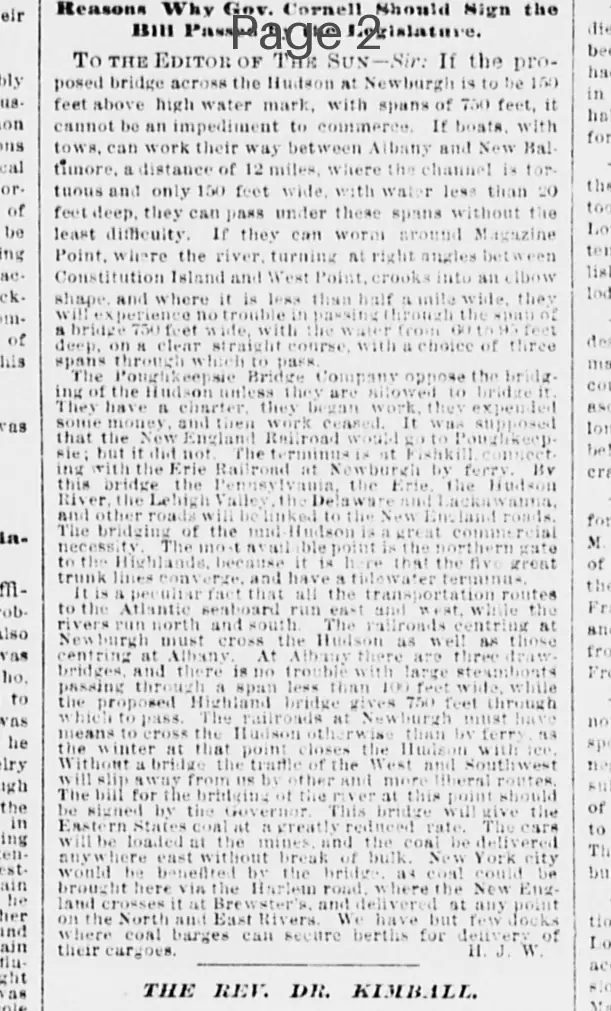
Reasons Why Gov. Cornell Should Sign the Bill Passed by the Legislature.
To the Editor of The Sun—Sir: If the proposed bridge across the Hudson at Newburgh is to be 150 feet above high water mark, with spans of 200 feet, it cannot be an impediment to commerce. If boats, with tows, can work their way between Albany and New Baltimore, a distance of 120 miles, where the channel is tortuous and only 100 feet wide with water less than 20 feet deep, they can pass under these spans without the least difficulty. If they can work around Magazine Point, where the river, turning at right angles between Constitution Island and West Point, crooks into an elbow shape, and where it is less than half a mile wide, they will experience no trouble in passing through the spans of a bridge 700 feet wide, with the water 150 feet deep, on a clear straight course with a choice of three spans through which to pass. The Poughkeepsie Bridge Company oppose the building of the Hudson unless they are allowed to build it. They have a charter they say worth $1,000,000. They have worked it for some money, and then work ceased. It was supposed that the New England Railroad would stop at Poughkeepsie, but it did not. The terminus is at Fishkill Landing, connecting with the Erie Railroad at Newburgh by ferry. By this bridge the Pennsylvania, the Erie, the Hudson River, the Lehigh Valley, the Delaware and Lackawanna, and other roads will be linked to the New England roads. The bridging of the mid Hudson is a great commercial necessity. The most available point is the northern gate to the Highlands, because it is here that the five great trunk lines converge, and have a tidewater terminus. It is a peculiar fact that all the transportation routes to the Atlantic seaboard run east and west, while the rivers run north and south. The railroads centering at Newburgh must cross the Hudson as well as those centering at Albany. At Albany there are three day bridges and there is no trouble with large steamboats passing through a span less than 100 feet wide, while the proposed Highland bridge gives 750 feet through which to pass. The railroads at Newburgh must have means to cross the Hudson otherwise than by ferry as the winter at that point closes the Hudson with ice. Without a bridge the traffic of the West and southwest will slip away from us by other and nearer central routes. The bill for the bridging of the river at this point should be signed by the Governor. This bridge will give the Eastern States coal at a greatly reduced rate. The cars will be loaded at the mines and the coal be delivered anywhere east without break of bulk. New York city would be benefited by the bridge as coal could be brought here via the Harlem road, where the New England crosses it at Brewster's, and delivered at any point on the North and East Rivers. We have but few docks where coal barges can secure berths for delivery of their cargoes.
J. W.
Reasons Why Gov. Cornell Should Sign the Bill Passed by the Legislature.
To the Editor of The Sun—Sir: If the proposed bridge across the Hudson at Newburgh is to be 150 feet above high water mark, with spans of 200 feet, it cannot be an impediment to commerce. If boats, with tows, can work their way between Albany and New Baltimore, a distance of 120 miles, where the channel is tortuous and only 100 feet wide with water less than 20 feet deep, they can pass under these spans without the least difficulty. If they can work around Magazine Point, where the river, turning at right angles between Constitution Island and West Point, crooks into an elbow shape, and where it is less than half a mile wide, they will experience no trouble in passing through the spans of a bridge 700 feet wide, with the water 150 feet deep, on a clear straight course with a choice of three spans through which to pass. The Poughkeepsie Bridge Company oppose the building of the Hudson unless they are allowed to build it. They have a charter they say worth $1,000,000. They have worked it for some money, and then work ceased. It was supposed that the New England Railroad would stop at Poughkeepsie, but it did not. The terminus is at Fishkill Landing, connecting with the Erie Railroad at Newburgh by ferry. By this bridge the Pennsylvania, the Erie, the Hudson River, the Lehigh Valley, the Delaware and Lackawanna, and other roads will be linked to the New England roads. The bridging of the mid Hudson is a great commercial necessity. The most available point is the northern gate to the Highlands, because it is here that the five great trunk lines converge, and have a tidewater terminus. It is a peculiar fact that all the transportation routes to the Atlantic seaboard run east and west, while the rivers run north and south. The railroads centering at Newburgh must cross the Hudson as well as those centering at Albany. At Albany there are three day bridges and there is no trouble with large steamboats passing through a span less than 100 feet wide, while the proposed Highland bridge gives 750 feet through which to pass. The railroads at Newburgh must have means to cross the Hudson otherwise than by ferry as the winter at that point closes the Hudson with ice. Without a bridge the traffic of the West and southwest will slip away from us by other and nearer central routes. The bill for the bridging of the river at this point should be signed by the Governor. This bridge will give the Eastern States coal at a greatly reduced rate. The cars will be loaded at the mines and the coal be delivered anywhere east without break of bulk. New York city would be benefited by the bridge as coal could be brought here via the Harlem road, where the New England crosses it at Brewster's, and delivered at any point on the North and East Rivers. We have but few docks where coal barges can secure berths for delivery of their cargoes.
J. W.
What sub-type of article is it?
Persuasive
Informative
Political
What themes does it cover?
Commerce Trade
Infrastructure
Economic Policy
What keywords are associated?
Hudson Bridge
Newburgh
Governor Cornell
Railroads
Commerce
Coal Delivery
Poughkeepsie Bridge
Highlands
Navigation
What entities or persons were involved?
J. W.
To The Editor Of The Sun—Sir
Letter to Editor Details
Author
J. W.
Recipient
To The Editor Of The Sun—Sir
Main Argument
governor cornell should sign the bill for a bridge across the hudson at newburgh because it will not impede navigation, connect major railroads for commercial necessity, and enable cheaper coal delivery to the east without breaking bulk.
Notable Details
Comparison To Navigation Challenges Between Albany And New Baltimore
Opposition From Poughkeepsie Bridge Company With $1,000,000 Charter
Connection Of Railroads: Pennsylvania, Erie, Hudson River, Lehigh Valley, Delaware And Lackawanna To New England Roads
Winter Ice Closure At Newburgh Necessitating Bridge Over Ferry
Benefits To New York City Via Harlem Road At Brewster's