Thank you for visiting SNEWPapers!
Sign up free
Literary
December 30, 1894
The Indianapolis Journal
Indianapolis, Marion County, Indiana
What is this article about?
Article from New York Mail and Express describes writers producing lowbrow serial stories for profit, using efficient tools like phonograph and typewriter to churn out formulaic tales without originality, earning $5,000 yearly by writing under multiple names.
Clipping
OCR Quality
95%
Excellent
Full Text
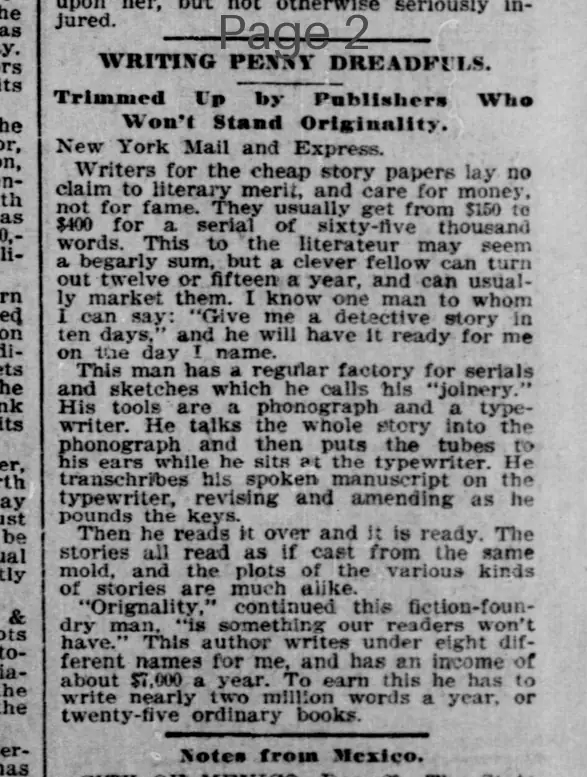
WRITING DREADFULS.
Trimmed Up Publishers Who Won't Stand Originality.
New York Mail and Express.
Writers for the cheap story papers lay no claim to literary merit, and care for money, not for fame. They usually get from $150 to $400 for a serial of sixty-five thousand words. This to the literateur may seem a beggarly sum, but a clever fellow can turn out twelve or fifteen a year, and can usually market them. I know one man to whom I can say: "Give me a detective story in ten days," and he will have it ready for me on the day I name.
This man has a regular factory for serials and sketches which he calls his "joinery." His tools are a phonograph and a typewriter. He talks the whole story into the phonograph and then puts the tubes to his ears while he sits at the typewriter. He transcribes his spoken manuscript on the typewriter, revising and amending as he pounds the keys. Then he reads it over and it is ready. The stories all read as if cast from the same mold, and the plots of the various kinds of stories are much alike.
"Originality," continued this fiction-foundry man, "is something our readers won't have." This author writes under eight different names for me, and has an income of about $5,000 a year. To earn this he has to write nearly two million words a year, or twenty-five ordinary books.
Trimmed Up Publishers Who Won't Stand Originality.
New York Mail and Express.
Writers for the cheap story papers lay no claim to literary merit, and care for money, not for fame. They usually get from $150 to $400 for a serial of sixty-five thousand words. This to the literateur may seem a beggarly sum, but a clever fellow can turn out twelve or fifteen a year, and can usually market them. I know one man to whom I can say: "Give me a detective story in ten days," and he will have it ready for me on the day I name.
This man has a regular factory for serials and sketches which he calls his "joinery." His tools are a phonograph and a typewriter. He talks the whole story into the phonograph and then puts the tubes to his ears while he sits at the typewriter. He transcribes his spoken manuscript on the typewriter, revising and amending as he pounds the keys. Then he reads it over and it is ready. The stories all read as if cast from the same mold, and the plots of the various kinds of stories are much alike.
"Originality," continued this fiction-foundry man, "is something our readers won't have." This author writes under eight different names for me, and has an income of about $5,000 a year. To earn this he has to write nearly two million words a year, or twenty-five ordinary books.
What sub-type of article is it?
Essay
What themes does it cover?
Commerce Trade
What keywords are associated?
Cheap Stories
Serial Writers
Fiction Factory
Originality
Phonograph Method
Literary Details
Title
Writing Dreadfuls. Trimmed Up Publishers Who Won't Stand Originality.
Subject
Writers For Cheap Story Papers And Their Production Methods
Form / Style
Prose Article On The Business Of Cheap Fiction
Key Lines
Writers For The Cheap Story Papers Lay No Claim To Literary Merit, And Care For Money, Not For Fame.
This Man Has A Regular Factory For Serials And Sketches Which He Calls His "Joinery." His Tools Are A Phonograph And A Typewriter.
"Originality," Continued This Fiction Foundry Man, "Is Something Our Readers Won't Have."