Thank you for visiting SNEWPapers!
Sign up free
Editorial
November 8, 1802
Jenks' Portland Gazette. Maine Advertiser
Portland, Cumberland County, Maine
What is this article about?
This final installment defends former Treasury Secretary Oliver Wolcott against a congressional investigating committee's charges, accusing the committee of partisanship, malice, and legal errors, especially on secret service expenditures in the War Department during wartime.
Clipping
OCR Quality
95%
Excellent
Full Text
From the Centinel.
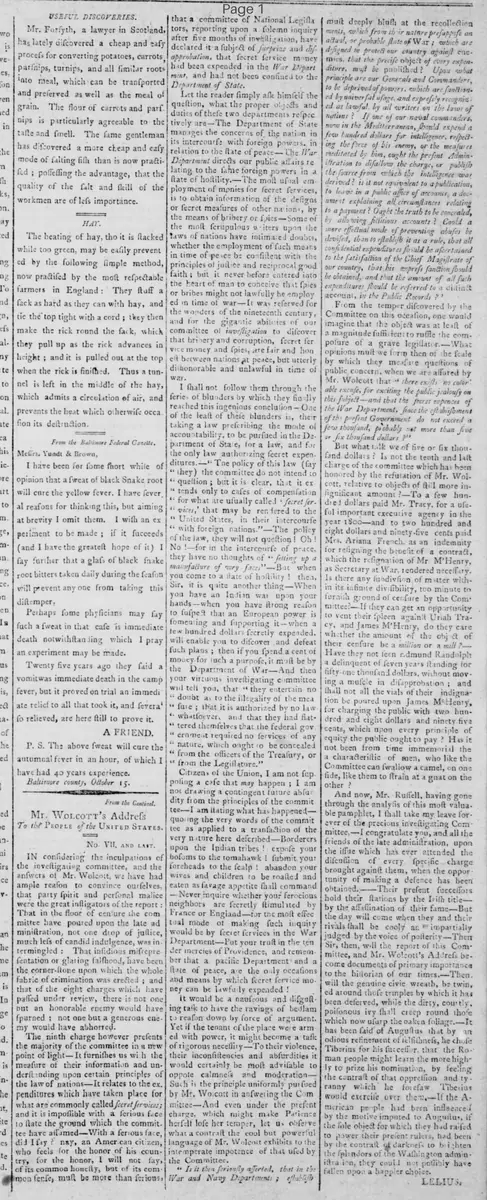
Mr. Wolcott's Address To the People of the United States.
No. VII, AND LAST.
IN considering the inculpations of the investigating committee, and the answers of Mr. Wolcott, we have had ample reason to convince ourselves that party spirit and personal malice were the great instigators of the report: That in the flood of censure the committee have poured upon the late administration, not one drop of justice, much less of candid indulgence, was intermixed: That insidious misrepresentation or glaring falsehood, have been the corner-stone upon which the whole fabric of crimination was erected: and that of the eight charges which have passed under review, there is not one but an honorable enemy would have spurned; not one but a generous enemy would have abhorred.
The ninth charge however presents the majority of the committee in a new point of light— It furnishes us with the measure of their information and understanding upon certain principles of the law of nations—It relates to the expenditures which have taken place for what are commonly called secret services: and it is impossible with a serious face to state the ground which the committee have assumed—With a serious face, did I say? nay, an American citizen, who feels for the honor of his country, for the honor, I will not say, of its common honesty, but of its common sense, must be more than serious;
that a committee of National Legislators, reporting upon a solemn inquiry after five months of investigation, have declared it a subject of surprise and disapprobation, that secret service money had been expended in the War Department, and had not been confined to the Department of State.
Let the reader simply ask himself the question, what the proper objects and duties of these two departments respectively are—The Department of State manages the concerns of the nation in its intercourse with foreign powers. in relation to the state of peace— The War Department directs our public affairs relating to the same foreign powers in a state of hostility.—The most usual employment of monies for secret services, is to obtain information of the designs or secret measures of other nations, by the means of bribery or spies—Some of the most scrupulous writers upon the Laws of nations have intimated doubts, whether the employment of such means in time of peace be consistent with the principles of justice and reciprocal good faith: but it never before entered into the heart of man to conceive that spies or bribes might not lawfully be employed in time of war—It was reserved for the wonders of the nineteenth century, and for the gigantic abilities of our committee of investigation to discover that bribery and corruption, secret service money and spies, are fair and honest between nations at peace, but utterly dishonorable and unlawful in time of war.
I shall not follow them through the series of blunders by which they finally reached this ingenious conclusion—One of the least of these blunders is, their taking a law prescribing the mode of accountability, to be pursued in the Department of State, for a law, and for the only law authorizing secret expenditures.—" The policy of this law(say they) the committee do not intend to question; but it is clear, that it extends only to cases of compensation for what are usually called secret services,' that may be rendered to the United States, in their intercourse with foreign nations."The policy of the law, they will not question! Oh! No!—for in the intercourse of peace. they have no thoughts of " setting up a manufacture of wry faces"—But when you come to a state of hostility! then, Sir, it is quite another thing—When you have an Indian war upon your hands—when you have strong reason to suspect that an European power is fomenting and supporting it—when a few hundred dollars secretly expended, will enable you to discover and defeat such plans; then if you send a cent of money for such a purpose, it must be by the Department of War—And then your virtuous, investigating committee will tell you, that " they entertain no doubt as to the illegality of the measure: that it is authorized by no law whatsoever, and that they had flattered themselves that the federal government required no services of any nature, which ought to be concealed from the officers of the Treasury, or from the Legislature."
Citizens of the Union, I am not supposing a case that may happen; I am not drawing a contingent future absurdity from the principles of the committee—I am stating what has happened—quoting the very words of the committee as applied to a transaction of the very nature here described—Borderers upon the Indian tribes! expose your bosoms to the tomahawk! submit your foreheads to the scalp! abandon your wives and children to be roasted and eaten as savage appetite shall command—Never inquire whether your ferocious neighbors are secretly stimulated by France or England—for the most effectual mode of making such inquiry would be by secret services in the War Department—Put your trust in the tender mercies of Providence, and remember that a pacific Department and a state of peace, are the only occasions and means by which secret service money can be lawfully expended!
It would be a nauseous and disgusting task to have the ravings of bedlam to reason down by force of argument. Yet if the tenant of the place were armed with power, it might become a task of rigorous necessity—To their violence, their inconsistencies and absurdities it would certainly be most advisable to oppose calmness and moderation—
Such is the principle uniformly pursued by Mr. Wolcott in answering the Committee—And even under the present charge, which might make Patience herself lose her temper. let us, observe what a contrast the cool but powerful language of Mr. Wolcott exhibits to the intemperate impotence of that used by the Committee.
" Is it then seriously asserted, that in the War and Navy Departments; establishments, which from their nature presuppose an actual, or probable state of War; which are designed to protect our country against enemies, that the precise object of every expenditure, must be published? Upon what principle are our Generals and Commanders, to be deprived of powers, which are sanctioned. by universal usage, and expressly recognized as lawful, by all writers on the laws of nations? If one of our naval commanders, now in the Mediterranean, should expend a few hundred dollars for intelligence, respecting the force of his enemy, or the measures meditated by him, ought the present Administration to disallow the charge, or publish the source from which the intelligence was derived? is it not equivalent to a publication. to leave in a public office of accounts, a document explaining all circumstances relating to a payment? Ought the truth to be concealed. by allowing fictitious accounts? Could a more effectual mode of preventing abuses be devised, than to establish it as a rule, that all confidential expenditures should be ascertained to the satisfaction of the Chief Magistrate of our country, that his express sanction should be obtained, and that the amount of all such expenditures should be referred to a distinct account, in the Public Records?"
From the temper discovered by the Committee on this occasion, one would imagine that the object was at least of a magnitude sufficient to rule the composure of a grave legislator.—What opinions must we form then of the scale by which they measure questions of public concern, when we are assured by Mr. Wolcott that " there exists no colorable excuse, for exciting the public jealousy on this subject—and that the secret expenses of the War Department, since the establishment of the present Government do not exceed a few thousand, probably not more than five or six thousand dollars?"
But what talk we of five or six thousand dollars? Is not the tenth and last charge of the committee which has been honored by the refutation of Mr. Wolcott, relative to objects of still more insignificant amount?—To a few hundred dollars paid Mr. Tracy, for a useful important executive agency in the year 1800—and to two hundred and eight dollars and ninety-five cents paid Mrs. Ariana French, as an indemnity for resigning the benefit of a contract, which the resignation of Mr M'Henry, as Secretary at War, rendered necessary.
Is there any subdivision of matter within its infinite divisibility, too minute to furnish ground of censure by the Committee?— If they can get an opportunity to vent their spleen against Uriah Tracy, and James M'Henry, do they care whether the amount of the object of their censure be a million or a mill?— Have they not seen Edmund Randolph a delinquent of seven years standing for fifty-one thousand dollars, without moving a muscle in disapprobation; and shall not all the vials of their indignation be poured upon James M'Henry, for charging the public with two hundred and eight dollars and ninety five cents, which upon every principle of equity the public ought to pay? Has it not been from time immemorial the characteristic of men, who like the Committee can swallow a camel, on one side, like them to strain at a gnat on the other?
And now, Mr. Russell, having gone through the analysis of this most valuable pamphlet, I shall take my leave for- ever of the precious investigating Committee,—I congratulate you, and all the friends of the late administration, upon the issue which has ever attended the discussion of every specific charge brought against them, when the opportunity of making a defence has been obtained.—Their present successors hold their stations by the Irish title— by the assassination of their fame—But the day will come when they and their rivals shall be coolly impartially judged by the voice of posterity—Then Sir, then, will the report of this Committee, and Mr. Wolcott's Address become documents of primary importance to the historian of our times.—Then. will the genuine civic wreath, be twined around those temples by which it has been deserved, while the dirty, courtly, poisonous ivy shall creep round those which now usurp the oaken foliage.—It has been said of Augustus that by an odious refinement of selfishness, he chose Tiberius for his successor, that the Roman people might learn the more highly to prize his own administration, by feeling the contrast of that oppression and tyranny which he foresaw Tiberius would exercise over them,—If the American people had been influenced by the motive imputed to Augustus, if the sole object for which they had raised to power their present rulers, had been by the contrast of darkness to brighten the splendors of the Washington administration, they could not possibly have fallen upon a happier choice.
LELIUS
Mr. Wolcott's Address To the People of the United States.
No. VII, AND LAST.
IN considering the inculpations of the investigating committee, and the answers of Mr. Wolcott, we have had ample reason to convince ourselves that party spirit and personal malice were the great instigators of the report: That in the flood of censure the committee have poured upon the late administration, not one drop of justice, much less of candid indulgence, was intermixed: That insidious misrepresentation or glaring falsehood, have been the corner-stone upon which the whole fabric of crimination was erected: and that of the eight charges which have passed under review, there is not one but an honorable enemy would have spurned; not one but a generous enemy would have abhorred.
The ninth charge however presents the majority of the committee in a new point of light— It furnishes us with the measure of their information and understanding upon certain principles of the law of nations—It relates to the expenditures which have taken place for what are commonly called secret services: and it is impossible with a serious face to state the ground which the committee have assumed—With a serious face, did I say? nay, an American citizen, who feels for the honor of his country, for the honor, I will not say, of its common honesty, but of its common sense, must be more than serious;
that a committee of National Legislators, reporting upon a solemn inquiry after five months of investigation, have declared it a subject of surprise and disapprobation, that secret service money had been expended in the War Department, and had not been confined to the Department of State.
Let the reader simply ask himself the question, what the proper objects and duties of these two departments respectively are—The Department of State manages the concerns of the nation in its intercourse with foreign powers. in relation to the state of peace— The War Department directs our public affairs relating to the same foreign powers in a state of hostility.—The most usual employment of monies for secret services, is to obtain information of the designs or secret measures of other nations, by the means of bribery or spies—Some of the most scrupulous writers upon the Laws of nations have intimated doubts, whether the employment of such means in time of peace be consistent with the principles of justice and reciprocal good faith: but it never before entered into the heart of man to conceive that spies or bribes might not lawfully be employed in time of war—It was reserved for the wonders of the nineteenth century, and for the gigantic abilities of our committee of investigation to discover that bribery and corruption, secret service money and spies, are fair and honest between nations at peace, but utterly dishonorable and unlawful in time of war.
I shall not follow them through the series of blunders by which they finally reached this ingenious conclusion—One of the least of these blunders is, their taking a law prescribing the mode of accountability, to be pursued in the Department of State, for a law, and for the only law authorizing secret expenditures.—" The policy of this law(say they) the committee do not intend to question; but it is clear, that it extends only to cases of compensation for what are usually called secret services,' that may be rendered to the United States, in their intercourse with foreign nations."The policy of the law, they will not question! Oh! No!—for in the intercourse of peace. they have no thoughts of " setting up a manufacture of wry faces"—But when you come to a state of hostility! then, Sir, it is quite another thing—When you have an Indian war upon your hands—when you have strong reason to suspect that an European power is fomenting and supporting it—when a few hundred dollars secretly expended, will enable you to discover and defeat such plans; then if you send a cent of money for such a purpose, it must be by the Department of War—And then your virtuous, investigating committee will tell you, that " they entertain no doubt as to the illegality of the measure: that it is authorized by no law whatsoever, and that they had flattered themselves that the federal government required no services of any nature, which ought to be concealed from the officers of the Treasury, or from the Legislature."
Citizens of the Union, I am not supposing a case that may happen; I am not drawing a contingent future absurdity from the principles of the committee—I am stating what has happened—quoting the very words of the committee as applied to a transaction of the very nature here described—Borderers upon the Indian tribes! expose your bosoms to the tomahawk! submit your foreheads to the scalp! abandon your wives and children to be roasted and eaten as savage appetite shall command—Never inquire whether your ferocious neighbors are secretly stimulated by France or England—for the most effectual mode of making such inquiry would be by secret services in the War Department—Put your trust in the tender mercies of Providence, and remember that a pacific Department and a state of peace, are the only occasions and means by which secret service money can be lawfully expended!
It would be a nauseous and disgusting task to have the ravings of bedlam to reason down by force of argument. Yet if the tenant of the place were armed with power, it might become a task of rigorous necessity—To their violence, their inconsistencies and absurdities it would certainly be most advisable to oppose calmness and moderation—
Such is the principle uniformly pursued by Mr. Wolcott in answering the Committee—And even under the present charge, which might make Patience herself lose her temper. let us, observe what a contrast the cool but powerful language of Mr. Wolcott exhibits to the intemperate impotence of that used by the Committee.
" Is it then seriously asserted, that in the War and Navy Departments; establishments, which from their nature presuppose an actual, or probable state of War; which are designed to protect our country against enemies, that the precise object of every expenditure, must be published? Upon what principle are our Generals and Commanders, to be deprived of powers, which are sanctioned. by universal usage, and expressly recognized as lawful, by all writers on the laws of nations? If one of our naval commanders, now in the Mediterranean, should expend a few hundred dollars for intelligence, respecting the force of his enemy, or the measures meditated by him, ought the present Administration to disallow the charge, or publish the source from which the intelligence was derived? is it not equivalent to a publication. to leave in a public office of accounts, a document explaining all circumstances relating to a payment? Ought the truth to be concealed. by allowing fictitious accounts? Could a more effectual mode of preventing abuses be devised, than to establish it as a rule, that all confidential expenditures should be ascertained to the satisfaction of the Chief Magistrate of our country, that his express sanction should be obtained, and that the amount of all such expenditures should be referred to a distinct account, in the Public Records?"
From the temper discovered by the Committee on this occasion, one would imagine that the object was at least of a magnitude sufficient to rule the composure of a grave legislator.—What opinions must we form then of the scale by which they measure questions of public concern, when we are assured by Mr. Wolcott that " there exists no colorable excuse, for exciting the public jealousy on this subject—and that the secret expenses of the War Department, since the establishment of the present Government do not exceed a few thousand, probably not more than five or six thousand dollars?"
But what talk we of five or six thousand dollars? Is not the tenth and last charge of the committee which has been honored by the refutation of Mr. Wolcott, relative to objects of still more insignificant amount?—To a few hundred dollars paid Mr. Tracy, for a useful important executive agency in the year 1800—and to two hundred and eight dollars and ninety-five cents paid Mrs. Ariana French, as an indemnity for resigning the benefit of a contract, which the resignation of Mr M'Henry, as Secretary at War, rendered necessary.
Is there any subdivision of matter within its infinite divisibility, too minute to furnish ground of censure by the Committee?— If they can get an opportunity to vent their spleen against Uriah Tracy, and James M'Henry, do they care whether the amount of the object of their censure be a million or a mill?— Have they not seen Edmund Randolph a delinquent of seven years standing for fifty-one thousand dollars, without moving a muscle in disapprobation; and shall not all the vials of their indignation be poured upon James M'Henry, for charging the public with two hundred and eight dollars and ninety five cents, which upon every principle of equity the public ought to pay? Has it not been from time immemorial the characteristic of men, who like the Committee can swallow a camel, on one side, like them to strain at a gnat on the other?
And now, Mr. Russell, having gone through the analysis of this most valuable pamphlet, I shall take my leave for- ever of the precious investigating Committee,—I congratulate you, and all the friends of the late administration, upon the issue which has ever attended the discussion of every specific charge brought against them, when the opportunity of making a defence has been obtained.—Their present successors hold their stations by the Irish title— by the assassination of their fame—But the day will come when they and their rivals shall be coolly impartially judged by the voice of posterity—Then Sir, then, will the report of this Committee, and Mr. Wolcott's Address become documents of primary importance to the historian of our times.—Then. will the genuine civic wreath, be twined around those temples by which it has been deserved, while the dirty, courtly, poisonous ivy shall creep round those which now usurp the oaken foliage.—It has been said of Augustus that by an odious refinement of selfishness, he chose Tiberius for his successor, that the Roman people might learn the more highly to prize his own administration, by feeling the contrast of that oppression and tyranny which he foresaw Tiberius would exercise over them,—If the American people had been influenced by the motive imputed to Augustus, if the sole object for which they had raised to power their present rulers, had been by the contrast of darkness to brighten the splendors of the Washington administration, they could not possibly have fallen upon a happier choice.
LELIUS
What sub-type of article is it?
Partisan Politics
Military Affairs
Legal Reform
What keywords are associated?
Wolcott Defense
Investigating Committee
Secret Services
War Department
Partisan Malice
Federal Expenditures
Indian Wars
What entities or persons were involved?
Oliver Wolcott
Investigating Committee
Uriah Tracy
James M'henry
Edmund Randolph
Washington Administration
Editorial Details
Primary Topic
Defense Of Oliver Wolcott Against Congressional Investigating Committee Charges On Secret Services And Minor Expenditures
Stance / Tone
Strongly Partisan Defense Of Wolcott And The Late Administration, Harshly Critical Of The Investigating Committee's Motives And Errors
Key Figures
Oliver Wolcott
Investigating Committee
Uriah Tracy
James M'henry
Edmund Randolph
Washington Administration
Key Arguments
Committee Driven By Party Spirit And Personal Malice Rather Than Justice
Charges Rely On Misrepresentation And Falsehood
Secret Service Expenditures Lawful In War Department During War, Contrary To Committee's View
Committee Misunderstands Law Of Nations And Applicable Laws
Wolcott's Responses Are Calm And Logical, Contrasting Committee's Intemperance
Minor Payments To Tracy And French Unwarranted Grounds For Censure
Hypocrisy In Ignoring Larger Delinquencies Like Randolph's
Posterity Will Vindicate The Late Administration Over Current Rulers