Thank you for visiting SNEWPapers!
Sign up free
The Rhode Island Republican
Newport, Newport County, Rhode Island
What is this article about?
Biography of Zerah Colburn, a Vermont child born September 1, 1804, initially thought to be an idiot but discovered at age 7 to possess unparalleled mathematical skills, performing advanced calculations mentally without education. (Boston Monthly Anthology)
Clipping
OCR Quality
Full Text
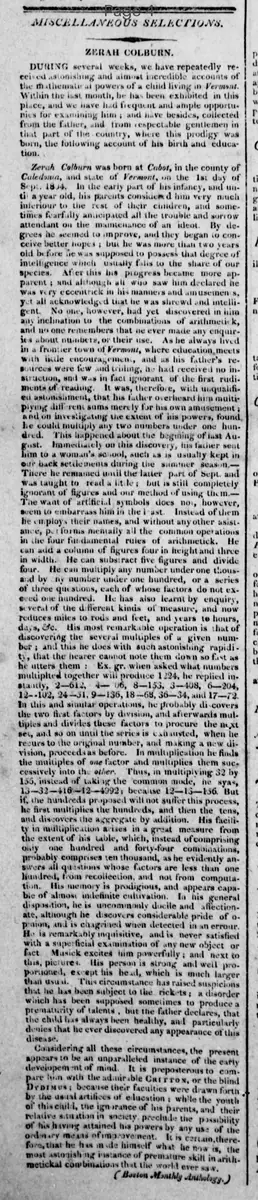
ZERAH COLBURN.
DURING several weeks, we have repeatedly received astonishing and almost incredible accounts of the mathematical powers of a child living in Vermont. Within the last month, he has been exhibited in this place, and we have had frequent and ample opportunities for examining him; and have besides, collected from the father, and from respectable gentlemen in that part of the country, where this prodigy was born, the following account of his birth and education.
Zerah Colburn was born at Cabot, in the county of Caledonia, and state of Vermont, on the 1st day of Sept. 1804. In the early part of his infancy, and until a year old, his parents considered him very much inferior to the rest of their children, and sometimes fearfully anticipated all the trouble and sorrow attendant on the maintenance of an idiot. By degrees he seemed to improve, and they began to conceive better hopes; but he was more than two years old before he was supposed to possess that degree of intelligence which usually falls to the share of our species. After this his progress became more apparent; and although all who saw him declared he was very eccentric in his manners and amusements, yet all acknowledged that he was shrewd and intelligent. No one, however, had yet discovered in him any inclination to the combinations of arithmetick, and no one remembers that he ever made any enquiries about numbers, or their use. As he always lived in a frontier town of Vermont, where education meets with little encouragement, and as his father's resources were few and trifling, he had received no instruction, and was in fact ignorant of the first rudiments of reading. It was, therefore, with unqualified astonishment, that his father overheard him multiplying different sums merely for his own amusement; and on investigating the extent of his powers, found he could multiply any two numbers under one hundred. This happened about the beginning of last August. Immediately on this discovery, his father sent him to a woman's school, such as is usually kept in our back settlements during the summer season. There he remained until the latter part of Sept. and was taught to read a little; but is still completely ignorant of figures and our method of using them. The want of artificial symbols does not, however, seem to embarrass him in the least. Instead of them he employs their names, and without any other assistance, performs mentally all the common operations in the four fundamental rules of arithmetick. He can add a column of figures four in height and three in width. He can subtract five figures and divide four. He can multiply any number under one thousand by any number under one hundred, or a series of three questions, each of whose factors do not exceed one hundred. He has also learnt by enquiry, several of the different kinds of measure, and now reduces miles to rods and feet, and years to hours, days, &c. His most remarkable operation is that of discovering the several multiples of a given number: and this he does with such astonishing rapidity, that the hearer cannot note them down so fast as he utters them: Ex. gr. when asked what numbers multiplied together will produce 12,224, he replied instantly, 26×12, 4×06, 8×153, 34×08, 62×04, 12×102, 24×51, 9×136, 18×68, 36×34, and 17×72. In this and similar operations, he probably discovers the two first factors by division, and afterwards multiplies and divides these factors to procure the next set, and so on until the series is exhausted, when he recurs to the original number, and making a new division, proceeds as before. In multiplication he finds the multiples of one factor and multiplies them successively into the other. Thus, in multiplying 32 by 156, instead of taking the common mode, he says, 13×32=416, 12×416=4992, because 12+13=156. But if, the hundreds proposed will not suffer this process, he first multiplies the hundreds, and then the tens, and discovers the aggregate by addition. His facility in multiplication arises in a great measure from the extent of his table, which, instead of comprising only one hundred and forty-four combinations, probably comprises ten thousand, as he evidently answers all questions whose factors are less than one hundred, from recollection, and not from computation. His memory is prodigious, and appears capable of almost indefinite cultivation. In his general disposition, he is uncommonly docile and affectionate, although he discovers considerable pride of opinion, and is chagrined when detected in an error. He is remarkably inquisitive, and is never satisfied with a superficial examination of any new object or fact. Musick excites him powerfully: and next to this, pictures. His person is strong and well proportioned, except his head, which is much larger than usual. This circumstance has raised suspicions that he has been subject to the rickets; a disorder which has been supposed sometimes to produce a prematurity of talents, but the father declares, that the child has always been healthy, and particularly denies that he ever discovered any appearance of this disease.
Considering all these circumstances, the present appears to be an unparalleled instance of the early development of mind. It is preposterous to compare him with the admirable Catton, or the blind Depramus; because their faculties were drawn forth by the usual artifices of education: while the youth of this child, the ignorance of his parents, and their relative situation in society, preclude the possibility of his having attained his powers by any use of the ordinary means of improvement. It is certain, therefore, that he has made himself what he now is, the most astonishing instance of premature skill in arithmetical combinations that the world ever saw.
(Boston Monthly Anthology.)
What sub-type of article is it?
What themes does it cover?
What keywords are associated?
What entities or persons were involved?
Where did it happen?
Story Details
Key Persons
Location
Cabot, County Of Caledonia, State Of Vermont
Event Date
1st Day Of Sept. 1804
Story Details
Zerah Colburn, born in 1804 in Vermont, was initially considered intellectually inferior and possibly an idiot by his parents. At around age 7, without any formal education in arithmetic, he demonstrated extraordinary mental mathematical abilities, performing complex multiplications, divisions, and factorizations rapidly.