Thank you for visiting SNEWPapers!
Sign up free
The New Hampshire Gazette
Portsmouth, Rockingham County, New Hampshire
What is this article about?
Citizen Arnould publishes 'Systeme Maritime et Politique des Europeans' in Paris, analyzing 18th-century maritime powers of Europe based on treaties. The book details naval strengths of Spain, Portugal, Sardinia, Tuscany, Naples, Genoa, Sweden, Russia, Venice, Turkey, Batavia, Austria, Prussia, Denmark, Britain, and France, proposing a French-led coalition against British naval dominance.
Clipping
OCR Quality
Full Text
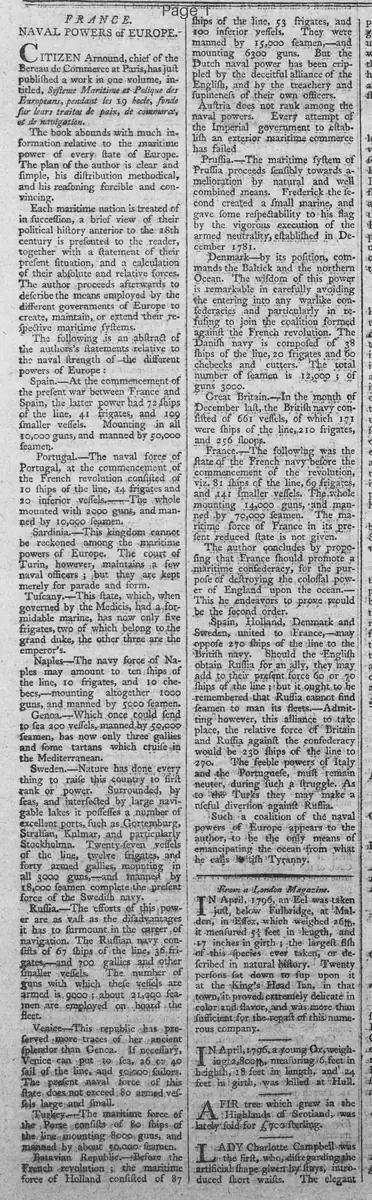
CITIZEN Arnould, chief of the Bureau de Commerce at Paris, has just published a work in one volume, entitled, Systeme Maritime et Politique des Europeans, pendant les 18th century, founded sur leurs traites de paix, de commerce, et de navigation.
The book abounds with much information relative to the maritime power of every state of Europe.
The plan of the author is clear and simple, his distribution methodical, and his reasoning forcible and convincing.
Each maritime nation is treated of in succession, a brief view of their political history anterior to the 18th century is presented to the reader, together with a statement of their present situation, and a calculation of their absolute and relative forces.
The author proceeds afterwards to describe the means employed by the different governments of Europe to create, maintain, or extend their respective maritime systems.
The following is an abstract of the author's statements relative to the naval strength of the different powers of Europe:
Spain.--At the commencement of the present war between France and Spain, the latter power had 72 ships of the line, 41 frigates, and 199 smaller vessels. Mounting in all 10,000 guns, and manned by 50,000 seamen.
Portugal.--The naval force of Portugal, at the commencement of the French revolution consisted of 10 ships of the line, 14 frigates and 20 inferior vessels. The whole mounted with 2000 guns, and manned by 10,000 seamen.
Sardinia.--This kingdom cannot be reckoned among the maritime powers of Europe, The court of Turin, however, maintains a few naval officers ; but they are kept merely for parade and form.
Tuscany.--This state, which, when governed by the Medicis, had a formidable marine, has now only five frigates, two of which belong to the grand duke, the other three are the emperor's.
Naples--The navy force of Naples may amount to ten ships of the line, 10 frigates, and 10 chebecs,--mounting altogether 1000 guns, and manned by 5000 seamen.
Genoa.--Which once could send to sea 200 vessels, manned by 50,000 seamen, has now only three gallies and some tartans which cruise in the Mediterranean.
Sweden.--Nature has done every thing to raise this country to first rank or power. Surrounded, by seas, and intersected by large navigable lakes it possesses a number of excellent ports, such as Gothenburg, Stralsund, Culmar, and particularly Stockholm. Twenty-seven vessels of the line, twelve frigates, and forty armed gallies, mounting in all 3000 guns,-and manned by 18,000 seamen complete the present force of the Swedish navy.
Russia.--The efforts of this power are as vast as the disadvantages it has to surmount in the career of navigation. The Russian navy consists of 67 ships of the line, 36 frigates,--and 100 gallies and other smaller vessels The number of guns with which these vessels are armed is 6000 ; about 21,000 seamen are employed on board the fleet.
Venice--This republic has preserved more traces of her ancient splendor than Genoa. If necessary, Venice can put to sea, 26 or 40 ships of the line, and 5000 sailors. The present naval force of this state, does not exceed 80 armed vessels large and small.
Turkey-- The maritime force. of the Porte consists -of 80 ships of the line mounting 8000 guns, and manned by about 50,000 seamen.
Batavian Republic:-Before the French revolution ; the maritime force of Holland consisted of 87 ships of the line, 53 frigates, and 100 inferior vessels, They were manned by 15,000 seamen,-and mounting 6300 guns. But the Dutch naval power has been crippled by the deceitful alliance of the English, and by the treachery and supineness of their own officers.
Austria does not rank among the naval powers. Every attempt of the Imperial government to establish an exterior maritime commerce has failed
Prussia.-The maritime system of Prussia proceeds sensibly towards a melioration by natural and well combined means. Frederick the second created a small marine, and gave some respectability to his flag by the vigorous execution of the armed neutrality, established in December 1781.
Denmark--by its position, commands the Baltic and the northern Ocean. The wisdom of this power is remarkable in carefully avoiding the entering into any warlike confederacies and particularly in refusing to join the coalition formed against the French revolution. The Danish navy is composed of 38 ships of the line, 20 frigates and 60 chebecks and cutters. The total number of seamen is 12,000 ; of guns 3000.
Great Britain.--In the month of December last, the British navy consisted of 661 vessels, of which 171 were ships of the line, 210 frigates, and 256 sloops.
France.--The following was the state of the French navy before the commencement of the revolution, viz. 81 ships of the line, 69 frigates, and 141 smaller vessels. The whole mounting 14,000 guns, and manned by 70,000 seamen. The maritime force of France in its present reduced state is not given.
The author concludes by proposing that France should promote a maritime confederacy, for the purpose of destroying the colossal power of England "upon the ocean.-- This he endeavors to prove would be the second order.
Spain, Holland, Denmark and Sweden, united to France,--may oppose 270 ships of the line to the British navy. Should the English obtain Russia for an ally, they may add to their present force 60 or 70 ships of the line ;'but it ought to be remembered that Russia cannot find Seamen to man its fleets.--Admitting however, this alliance to take place, the relative force of Britain and Russia against the confederacy would be 230 ships of the line to 270. The feeble powers of Italy and the Portuguese, must remain neuter, during such a struggle. As to the Turks they -may make a useful diversion against Russia.
Such a coalition of the naval powers of Europe appears to the author, -to be the only means of emancipating -the ocean from what he calls British Tyranny.
From a London Magazine.
What sub-type of article is it?
What keywords are associated?
What entities or persons were involved?
Where did it happen?
Foreign News Details
Primary Location
Paris
Key Persons
Event Details
Citizen Arnould, chief of the Bureau de Commerce at Paris, publishes 'Systeme Maritime et Politique des Europeans, pendant les 18th century', detailing maritime powers of European states, their histories, current situations, forces, and means to maintain systems. Abstract includes naval strengths: Spain (72 ships of line, 41 frigates, 199 smaller, 10,000 guns, 50,000 seamen); Portugal (10 ships, 14 frigates, 20 inferior, 2000 guns, 10,000 seamen); Sardinia (minimal); Tuscany (5 frigates); Naples (10 ships, 10 frigates, 10 chebecs, 1000 guns, 5000 seamen); Genoa (3 gallies, tartans); Sweden (27 ships, 12 frigates, 40 gallies, 3000 guns, 18,000 seamen); Russia (67 ships, 36 frigates, 100 gallies/smaller, 6000 guns, 21,000 seamen); Venice (80 armed vessels); Turkey (80 ships, 8000 guns, 50,000 seamen); Batavian Republic (pre-revolution: 87 ships, 53 frigates, 100 inferior, 6300 guns, 15,000 seamen, now crippled); Austria (none); Prussia (small marine); Denmark (38 ships, 20 frigates, 60 chebecks/cutters, 3000 guns, 12,000 seamen); Great Britain (December last: 661 vessels, 171 ships, 210 frigates, 256 sloops); France (pre-revolution: 81 ships, 69 frigates, 141 smaller, 14,000 guns, 70,000 seamen; current reduced state not given). Proposes French-led confederacy with Spain, Holland, Denmark, Sweden (270 ships) against Britain (possibly +Russia 230 ships) to end British tyranny; Italy/Portugal neutral; Turkey diverts Russia.