Thank you for visiting SNEWPapers!
Sign up free
Virginia Argus
Richmond, Virginia
What is this article about?
Continuation of George Nicholas's correspondence critiquing Rep. Robert G. Harper's defense of the Sedition Act as declaratory of common law, arguing it's novel legislation; opposing salary increases for federal officers amid war preparations; and asserting French sincerity in peace overtures based on Gerry's reports and presidential assurances.
Merged-components note: Continuation of the correspondence between George Nicholas and Robert G. Harper across pages 1 and 2.
Clippings
1 of 2
OCR Quality
Full Text
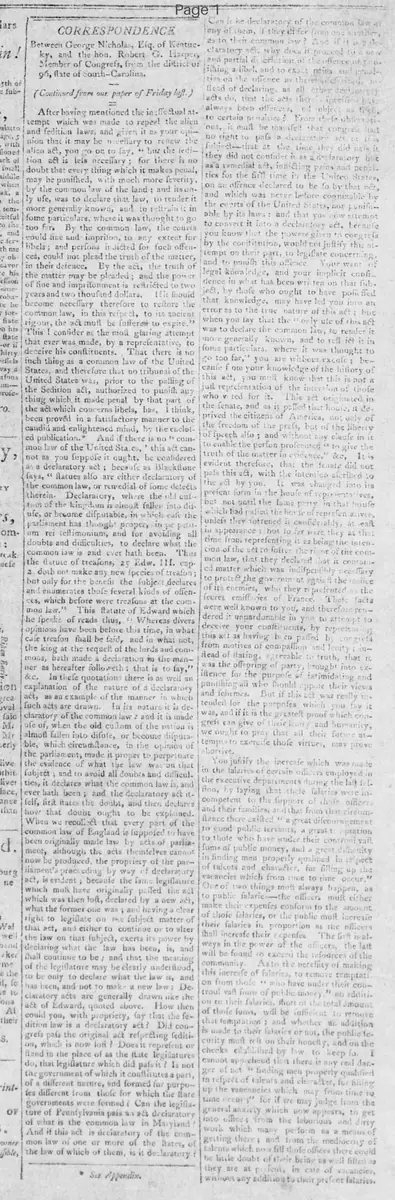
Between George Nicholas, Esq. of Kentucky,
and the hon. Robert G. Harper,
Member of Congress, from the district of
96, state of South-Carolina.
(Continued from our paper of Friday last.)
After having mentioned the indirect attempt which was made to repeal the alien
and sedition laws, and given it as your opinion that it may be necessary to renew the
alien act, you go on to say, " but the sedition
act is less necessary; for there is no
doubt that every thing which it makes penal,
may be punished, with much more severity,
by the common law of the land : and its only
use, was to declare that law, to render it
more generally known, and to restrain it in
some particulars, wherein it was thought to go
too far. By the common law, the courts
could fine and imprison, to any extent for
libels; and persons indicted for such offences,
could not plead the truth of the matter,
in their defence. By the act, the truth of
the matter may be pleaded; and the power
of fine and imprisonment is restricted to two
years and two thousand dollars. If it should
become necessary therefore to restore the
common law, in this respect, to its ancient
rigour, the act must be suffered to expire."
This I consider as the most glaring attempt
that ever was made, by a representative, to
deceive his constituents. That there is no
such thing as a common law of the United
States, and therefore that no tribunal of the
United States was, prior to the passing of
the Sedition act, authorized to punish any-
thing which it made penal by that part of
the act which concerns libels, has, I think,
been proved in a satisfactory manner to the
candid and enlightened mind, by the enclosed
publication.* And if there is no " common
law of the United States, ' this act cannot
as you suppose it ought, be considered
as a declaratory act ; because as Blackstone
says, " statutes also are either declaratory of
the common law, or remedial of some defects
therein. Declaratory, where the old cus-
tom of the kingdom is almost fallen into dis-
use, or become disputable, in which case the
parliament has thought proper, in perpetuam
rei testamentum, and for avoiding all
doubts and difficulties, to declare what the
common law is and ever hath been. Thus
the statute of treasons, 25 Edw. III. cap.
2. doth not make any new species of treason;
but only for the benefit the subject declares
and enumerates those several kinds of offen-
ces, which before were treasons at the com-
mon law." This Statute of Edward which
he speaks of reads thus, ". Whereas divers
opinions have been before this time, in what
case treason shall be said, and in what not,
the king at the request of the lords and com-
mons, hath made a declaration in the man-
ner as hereafter followeth : that is to say,"
&c. In these quotations there is as well an
explanation of the nature of a declaratory
act, as an example of the manner in which
such acts are drawn. In its nature it is de-
claratory of the common law : and it is made
use of, when the old custom of the nation is
almost fallen into disuse, or become disputa-
ble. which circumstance, in the opinion of
the parliament, made it proper to perpetuate
the evidence of what the law was on that
subject ; and to avoid all doubts and difficul-
ties, it declares what the common law is, and
ever hath been ; and the declaratory act it-
self, first states the doubt, and then declares
how that doubt ought to be explained.
When we recollect that every part of the
common law of England is supposed to have
been originally made law by acts of parlia-
ment, although the acts themselves cannot
now be produced, the propriety of the par-
liament's proceeding by way of declaratory
act, is evident; because the same legislature
which must have originally passed the act
which was then lost, declared by a new act,
what the former one was ; and having a clear
right to legislate on the subject matter of
that act, and either to continue or to alter
the law on that subject, exerts its power by
declaring what the law has been, is, and
shall continue to be ; and that the meaning
of the legislature may be clearly understood,
to be only to declare what the law is, and
has been, and not to make a new law : De-
claratory acts are generally drawn like the
act of Edward, quoted above. How then
could you, with propriety, say that the se-
dition law is a declaratory act? Did con-
gress pass the original act respecting sedi-
tion, which is now lost ? Does it represent or
stand in the place of as the State legislatures
do, that legislature which did pass it ? Is not
the government of which it constitutes a part,
of a different nature, and formed for purpo-
ses different from those for which the state
governments were formed ? Can the legisla-
ture of Pennsylvania pass an act declaratory
of what is the common law in Maryland?
And if this act is declaratory of the com-
mon law of one or more of the states, of
the law of which of them, is it declaratory?
Can it be declaratory of the common law
of any of them, if they differ from one an-
other as to their common law ? And if it is a de
claratory act, why does it proceed to a full
and partial description of the offence of pub-
lishing a libel, and to exact pains and penal-
ties on the offence as thereby described, in-
stead of declaring. as all other declaratory
acts do that the acts therein specified have
always been offences, and subject to certain penalties ? From these observations, it must be manifest that congress had
no right to pass a declaratory act on its
subject-matter at the time they did pass it
or that they did not consider it as a declaratory but
as a remedial act, inflicting pains and penalt.
ies for the first time in the United States,
on an offence declared to be so by that act,
and which was never before cognizable by
the courts of the United States, nor punish-
able by its law. : and that you now attempt
to convert it into a declaratory act, because
you know that the powers given to congress
by the constitution, would not justify this at-
tempt on their part, to legislate concerning.
and to punish this offence Your want of
legal knowledge, and your implicit confi-
dence in what has been written on that sub-
ject, by those who ought to have possessed
that knowledge, may have led you into an
error as to the true nature of this act ; but
when you say that the " only use of this a
was to declare the common law, to render it
more generally known, and to restrain it in
some particulars. where it was thought to
go too far," you are without excuse; be-
cause from your knowledge of the history of
this act, you must know that this is not a
just representation of the intention of those
who voted for it. This act originated in
the senate, and as it passed that house, it de.
prived the citizens of America, not only of
the freedom of the press, but of the liberty
of speech also; and without any clause in it
to enable the person prosecuted to give the
truth of the matter in evidence,"&c, It is
evident therefore, that the senate did not
pass this act, with the intention ascribed to
the act by you. It was changed into its
present form in the house of representatives,
but not until the same party in that house
which had raised the hue and cry of treason,
unless they softened it considerably. at least
in appearance ; but to her were they at that
time from representing it as being the inten-
tion of the act to foster the rigor of the com-
mon law, that they declared that it contain-
ed matter which was indispensably necessa-
ry to protect the government against the malice
of its enemies, who they represented as the
secret emissaries of France. These facts
were well known to you, and therefore ren-
dered it unpardonable in you to attempt to
deceive your constituents, by representing
this act as having been passed by votes
from motives of compassion and lenity ; in-
stead of stating, as agreeable to truth, that it
was the offspring of party, brought into ex-
istence for the purpose of intimidating and
punishing all who should oppose their views
and schemes. But if this act was really in-
tended for the purposes which you say it
was, and if it is the greatest proof which con-
gress can give of their lenity and humanity,
we ought to pray that all their future at-
tempts to exercise those virtues, may prove
abortive.
You justify the increase which was made
in the salaries of certain officers employed in
the executive departments during the last ses-
sion, by saying that these salaries were in-
competent to the support of those officers
and their families, and that from that circum-
stance there existed " a great discouragement
to good public servants, a great temptation
to those who have under their control vast
sums of public money, and a great difficulty
in finding men properly qualified in respect
of talents and character, for filling up the
vacancies which from time to time occur."
One of two things must always happen, as
to public salary-the officer. must either
make their expenses conform to the amount
of those salaries, or the public must increase
their salaries in proportion as the officers
shall increase their expenses The first is al-
ways in the power of the officers, the last
will be found to exceed the resources of the
community. As to the necessity of making
this increase of salaries, to remove tempta-
tion from those " who have under their con-
troul vast sums of public money." no additi-
on to their salaries, short of the total amount
of those sums, will be sufficient to remove
that temptation ; and whether as addition
is made to their salaries or not, the public se-
curity must rest on their honesty, and on the
checks established by law to keep it so. I
cannot apprehend that there is any real dan-
ger of not " finding men properly qualified
in respect of talents and character, for filling
up the vacancies which may from time to
time occur ;" for if we may judge from the
general anxiety which now appears, to get
into office; from the laborious and dirty
work which many perform as a means of
getting there; and from the mediocrity of
talents which now fill those offices there could
be little doubt of their being as well filled as
they are at present, in case of vacancies,
without any addition to their present salaries.
I think you might easily be convinced that if such vacancies could happen, they might readily be filled with great advantage to the community, by yourself and some of your friends in Congress, who would be willing to undertake the duties of these offices, even for their late inadequate salaries, either from patriotism, or from other considerations. But you endeavour to give us some consolation under this increase of expense, by saying that "as the public has at present great occasion for money, the increase was small, and confined solely to those officers whose duties oblige them to reside constantly at the seat of government."
When we reflect that these officers have been the most active, in bringing the United States into such a situation, as will probably make it the duty of all good citizens to stake their last shilling in the defence of their country; it might have been reasonably expected, that they would not have called for an increase of their salaries, during the existence of that critical situation of public affairs. For even if they did serve the community for something less than the real value of their services, it was the easiest way in which they could pay their proportion of those extraordinary exertions, which they were stimulating all to make, during a contest, which they have had no inconsiderable hand in bringing on their country. But "the increase was small," you say. If I am not mistaken, these salaries have been augmented three sevenths of their former amount, in some instances half, & then instead of the inconsiderable sum which you say the present augmentation amounts to, we ought to calculate, what the same proportion, when added to the salaries of all the officers of government will come to; because although it has been given to a few only at present, the thing can never stop until it is necessarily extended to all: and if the principles you state to justify the increase in these particular cases are just, they will make it so in all others. Nay, as long as such men as voted for this increase, have the power of making it, the longer it is postponed as to the others, the more it will be; because in two years time it may be boldly asserted in Congress that every necessary in life had risen nearly double from this time although in fact the markets should fall considerably: and then another addition would not only be made to the salaries of these favourite officers, but the rest would all be increased in the same proportion that theirs would be, when the second addition was made to them. For God's sake then, have the increase to the other salaries made, before new assertions and new combinations can be brought forward, to prove the necessity of doubling that increase.
You make me smile when you say "the augmentation is for three years only; to be continued or not at the end of that period, according to circumstances," for I cannot conceive any possible situation in which a country would be less able to pay high salaries, than this is at present-supposed to be just entering into war without a shilling on hand, her citizens taxed beyond the compass of their common resources-and her first loan made at eight per cent. interest? but independent of those circumstances which render it certain that if this addition to these salaries had been made properly now, that no change in our situation can ever take place, which will hereafter render it proper to take away that addition; I ask you, how many instances you have either read or heard, of salaries being reduced? and I wish you to calculate on the probability of its being done, when those by whom it must be done, are anxiously waiting the time when they and some of their nearest connections shall fill some of those offices: and when the completion of this their favourite wish depends on the pleasure of some of those, whose salaries are to be increased or diminished, by their votes.
After having informed us of the communication made by the French minister, thro' our minister in Holland, which contained a declaration "that the French government was ready to receive in a proper and becoming manner any minister whom the president might authorize to treat respecting an accommodation." and that "the president thought it proper to meet this advance, and for that purpose had appointed three ministers who were approved by the senate," you give it as your opinion "that the whole was a trick concerted and executed for the sole purpose of producing an effect upon the people of America, of lulling this country, by the hopes of peace and accommodation, into a fatal repose, of increasing our divisions, of hurrying the defence and preparation, and of raising a clamour against the government, if it could refuse to hearken to this insidious overture."
One of the causes of our present dispute with France was her refusal to receive in a proper manner, our public ministers; and the president has declared that he considered this part of her conduct as more injurious to the honor and independence of America, than all her other improper acts; and that he never would "send another minister to France, without assurances that he would be received, respected and honored, as the representative of a great, sovereign, powerful and independent nation."
In consequence of this declaration of the president, the French minister gave the assurances in the very terms prescribed by the president, and directed his agent to carry to our minister in Holland "those positive expressions, in order to convince him of the sincerity of the French government, and prevail upon him to transmit them to his government." The president in his message to the senate, considered this as a compliance with the condition, on the performance of which, he had always been determined to send another minister to France; and in consequence of that condition having been complied with, nominated a minister for that purpose. That the French government was sincere in this proposition for entering into a negotiation for peace, is greatly confirmed by Mr Gerry's communication to our government, after his return to America. His known and good experience of sentiment, have at all times, carried every thing which came from him, to the greatest degree of credit; and this should more particularly be the case now, when we find that he has brought upon himself the odium and reproaches of a party, who had heretofore represented him, as one of the most virtuous and best informed of the American citizens, merely because, when in France he did not take such steps as would certainly have involved his country to a war with that nation; and because, since his return to America, he has contrary to the wishes of that party, expressed his conviction that the government of France was seriously disposed to accommodate all the existing disputes between France and the United States. In this letter of Mr Gerry he uses the following expressions - "This I consider as my duty; for whilst the government manifested in their instructions, a just indignation at the treatment which their envoys had received, it evinced a disposition for peace; and as far as I could judge, the same temper now existed on the part of France." Again he says- "The fact was as I ascertained, to my satisfaction, that after the arrival of the dispatches and other intelligence from the United States, the executive directory apprehended, if a minister was sent there that he would not be accredited; and that overtures, or any plan unaccompanied by a minister would meet a similar fate." "Before the arrival of the dispatches of the envoys, the minister appeared to me sincere and anxious to obtain a reconciliation. He had proposed by his secretary, an assumption of the debts due to American citizens, which I rejected; but he had made no other proposition of a loan whatever, and never renewed that. Indeed his views in general as far as I could then ascertain them, were liberal in regard to a treaty; it is nevertheless impossible for me to determine, whether we should have united in opinion, in every point of dispute between the republics." And he adds-"On the 26th of July I left Paris; and from the best information which I could obtain, relative to the disposition of the executive directory (for I never had any direct communication with them) they were very desirous of a reconciliation between the two republics. Every impediment to my departure had been adopted by the French minister: and he would have prevented it, had he succeeded in his plan of an epistolary discussion: his object was, as I conceived, to gain time for ascertaining whether the U. States were then disposed to a treaty: of this he manifested doubt, being persuaded that their resentment was too great to admit of it. He seemed also to apprehend, that in consequence of the incredible exertions of Great Britain, and the unequivocal evidences she had given of her ability to defend herself they were inclined to avenge their injuries, by an alliance with her and that should France come forward with overtures, or the plan of a treaty, she would fail therein and compromise her honor." As it ought to require something more than assertions on your part, to do away the strong impressions which these documents must make on the public mind, of the sincerity of the French government in these overtures for a reconciliation, I will examine the reasons by which you endeavour to justify that assertion; but will not take any notice of the illiberal abuse that your letter contains of the French nation: which would be unjustifiable in any man, but is much more so, when it proceeds from a man in a public character, under a government whose real interest it is to preserve peace and harmony between the two republics.
The first thing you rely on to support your opinion is, that this declaration on the part of the French, of a wish to bring about a reconciliation, "was accompanied by no substantial change of measures towards America." To judge of the force which this argument ought to carry with it, it should be recollected, that material complaints between the two nations, had preceded the present state of things: and that each justified her present conduct by what she called the former improper conduct of the other. This being the case, it ought not to have been expected, that either nation would, by a total change of that part of her conduct which was complained of by the other, make an acknowledgment prior to the discussion of their complaints, that she had been the party giving just cause of complaint: this was all that could be expected in a treaty, proceeding from the most liberal and dispassionate consideration of the matters in dispute. If our government feels a consciousness of having acted properly towards France, it ought to admit it to be possible at least, that the government of France, entertains the same idea of its conduct towards America, and if this is really the case, America had no more right to suppose that France ought to change her present hostile conduct towards America, than France had to expect, that America would abandon her hostile measures towards her, prior to a discussion and settlement of their existing disputes. And if America has relinquished none of those measures, since the appointment of ministers to treat with France, her not having done so may be urged at least with as much plausibility to prove the want of sincerity on the part of our government, as the persisting in their former line of conduct has been argued by you, to prove that the French government was not sincere in its professions of a wish to bring about peace. The next piece of evidence which you bring to support your opinion is, that "the correspondence between Mr. Talleyrand's clerk, and our minister in Holland, which was carried on with the greatest apparent mystery, and transmitted to the president with particular and unusual precautions," was nevertheless sent, doubtless by Mr. Talleyrand's order, for his clerk would not of himself have ventured on such a step to a Gazette in this city, which is notoriously in the interest and suspected on good grounds of being in the pay of the French government; and in that Gazette it was published." Admit the whole of this statement to be true, and what does it prove? that the French government being sincerely desirous of bringing about a reconciliation between the two republics, and fearing that a similar disposition did not exist in the American government, published to the people of America its disposition and its offer, on that subject. If you and your neighbour had been engaged in a quarrel by your servants, who had charged each other with improper conduct, would you consider it as an evidence of a want of sincerity in your neighbour's servant, if, besides making an offer of accommodation to your servant, he was to inform you, that he had made this offer, lest your servant, by withholding from you all information of the offer having been made, might, contrary to your true interest and inclination, keep up the quarrel between you and your neighbour. This conduct was peculiarly proper in the French government at that time, because the American government had been for twelve months in the habit of publishing to the people of America, whatever they thought had a tendency to justify their conduct towards France, and to make them believe that France was averse to peace.
Whether the government of France had any just cause to apprehend, that our government would withhold from the people of America this offer to bring about a real peace, may be judged of from a fact, which cannot be controverted: and which cannot be accounted for but by a supposition that it was not their wish that the people of America should have full information on the subject. From March 1798, our government had been in the habit of publishing the communications received from our ministers to France; Mr. Gerry's letter, from which I have already made extracts was written in America the 1st of October 1798, and therefore, must have reached the secretary of state within a few days of that time. The president in his address to congress on the 23d day of November, referred to this letter, and promised to lay it before that body, but did not do it until the 18th of January, and not then until after a motion had been repeatedly threatened, and at last made, in the house of representatives desiring that he would do it: & very soon after he had sent them the letter he laid before them a report of the secretary of state, intended to prove that Mr. Gerry was mistaken in his ideas expressed in that letter of the sincerity of the French government, when they declared their wishes for peace: and containing such reflections on that nation, as must have gone a great way in preventing a reconciliation taking place, if any thing proceeding from him, could have had that effect. What makes the suppressing this information the more remarkable is, that the members of congress, who were in the secrets of the cabinet and who must therefore have known the contents of Mr. Gerry's letter, made every exertion to carry their war measures through congress, before this communication was made to them.
(To be continued.)
What sub-type of article is it?
What themes does it cover?
What keywords are associated?
What entities or persons were involved?
Letter to Editor Details
Author
George Nicholas, Esq. Of Kentucky
Recipient
The Hon. Robert G. Harper, Member Of Congress
Main Argument
the sedition act is not declaratory of common law but new punitive legislation beyond congress's constitutional powers; salary increases for officials are unjustified amid war preparations; french overtures for peace are sincere, as confirmed by gerry, contrary to harper's claims of deception.
Notable Details