Thank you for visiting SNEWPapers!
Sign up free
Domestic News
February 28, 1903
The Corvallis Times
Corvallis, Benton County, Oregon
What is this article about?
John Bowles Flannagan of King and Queen County, Virginia, inherits valuable Omaha property from former slave John Flannagan, whose land claim was upheld in court after the city grew around his cabin.
Clipping
OCR Quality
100%
Excellent
Full Text
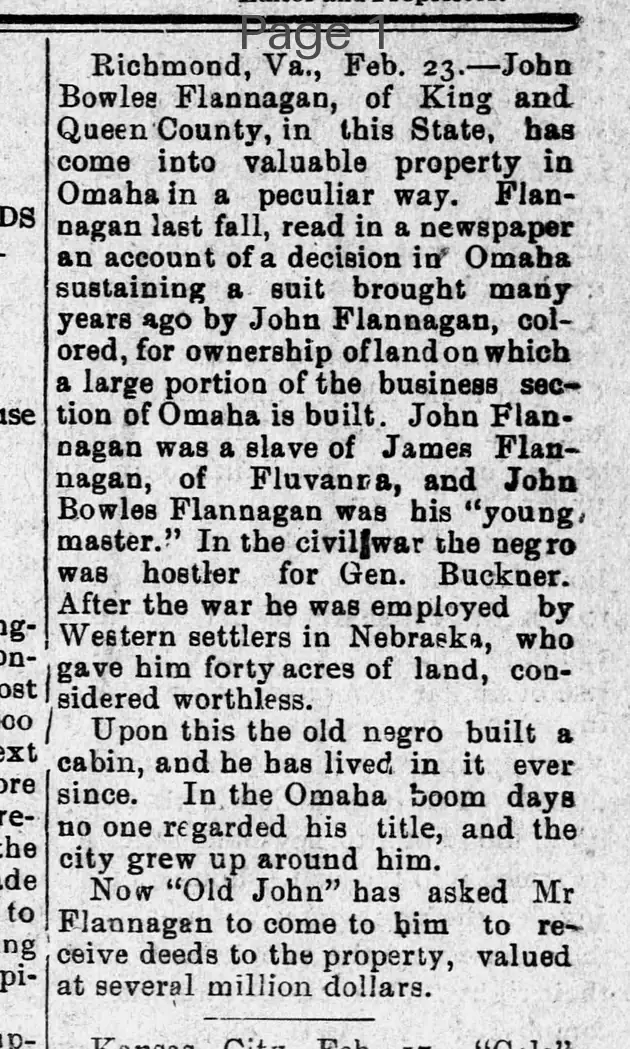
Richmond, Va., Feb. 23.—John Bowles Flannagan, of King and Queen County, in this State, has come into valuable property in Omaha in a peculiar way. Flannagan last fall, read in a newspaper an account of a decision in Omaha sustaining a suit brought many years ago by John Flannagan, colored, for ownership of land on which a large portion of the business section of Omaha is built. John Flannagan was a slave of James Flannagan, of Fluvanna, and John Bowles Flannagan was his "young master." In the civil war the negro was hostler for Gen. Buckner.
After the war he was employed by Western settlers in Nebraska, who gave him forty acres of land, considered worthless.
Upon this the old negro built a cabin, and he has lived in it ever since. In the Omaha boom days no one regarded his title, and the city grew up around him.
Now "Old John" has asked Mr. Flannagan to come to him to receive deeds to the property, valued at several million dollars.
After the war he was employed by Western settlers in Nebraska, who gave him forty acres of land, considered worthless.
Upon this the old negro built a cabin, and he has lived in it ever since. In the Omaha boom days no one regarded his title, and the city grew up around him.
Now "Old John" has asked Mr. Flannagan to come to him to receive deeds to the property, valued at several million dollars.
What sub-type of article is it?
Legal Or Court
Economic
Slave Related
What keywords are associated?
Omaha Property
Slave Inheritance
Court Decision
Flannagan
Nebraska Land
What entities or persons were involved?
John Bowles Flannagan
John Flannagan
James Flannagan
Gen. Buckner
Where did it happen?
Omaha
Domestic News Details
Primary Location
Omaha
Key Persons
John Bowles Flannagan
John Flannagan
James Flannagan
Gen. Buckner
Outcome
inheritance of property valued at several million dollars via upheld court decision and deeds.
Event Details
John Bowles Flannagan inherits Omaha land from former slave John Flannagan, who received 40 acres post-Civil War, built a cabin, and whose title was sustained in a long-standing suit as the city developed around it.