Thank you for visiting SNEWPapers!
Sign up free
Editorial
October 27, 1909
The Bridgeport Evening Farmer
Bridgeport, Fairfield County, Connecticut
What is this article about?
Editorial praises Democratic platform and candidate Buckingham's clear positions on taxation equity, reduced expenditures, street improvements, harbor protection, utility regulation in Bridgeport, contrasting with vague Republican stances under Mayor Lee.
Clipping
OCR Quality
98%
Excellent
Full Text
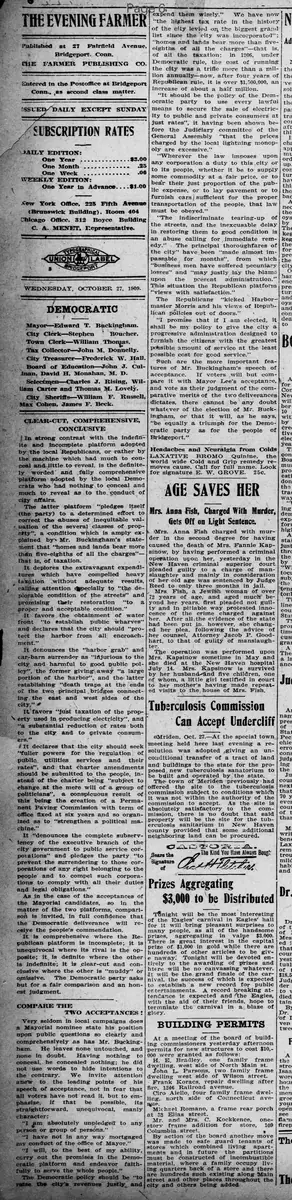
CLEAR-CUT, COMPREHENSIVE, CONCLUSIVE
In strong contrast with the indefinite and incomplete platform adopted by the local Republicans, or rather by the machine which had much to conceal and little to reveal, is the definitely worded and fully comprehensive platform adopted by the local Democrats who 'had nothing to conceal and much to reveal as to the conduct of city affairs.
The latter platform 'pledges itself (the party) to a determined effort to correct the abuses of inequitable valuation of the several classes of property', a condition which is amply explained by Mr. Buckingham's statement that 'homes and lands bear more than five-eighths of all the charges'—that is, of taxation.
It deplores the extravagant expenditures which have compelled heavy taxation without adequate results, calling attention especially to the deplorable condition of the streets and promising their restoration 'to a proper and acceptable condition.'
It favors the obtainment of water front 'to establish public wharves' and declares that the city should 'protect the harbor from all encroachment.'
It denounces the 'harbor grab' and car-barn surrender as 'injurious to the city and harmful to good public policy', the former giving away 'a large portion of the harbor', and the latter establishing 'death traps at the ends of the two principal bridges connecting the east and west sides of the city.'
It favors 'just taxation of the property used in producing electricity', and 'a substantial reduction of rates both to the city and to private consumers.'
It declares that the city should seek 'fuller powers for the regulation of public utilities services and their rates', and that charter amendments should be submitted to the people, instead of the charter being 'subject to change at the mere will of a group of politicians', a conspicuous result of this being the creation of a Permanent Paving Commission with term of office fixed at six years and so organized as to 'strengthen a political machine.'
It 'denounces the complete subserviency of the executive branch of the city government to public service corporations' and pledges the party 'to prevent the surrendering to those corporations of any right belonging to the people and to compel such corporations to comply with all their duties and legal obligations.'
As in the case of the acceptances of the Mayoral candidates, so in the matter of the two platforms, comparison is invited, in full confidence that the Democratic deliverance will receive the people's commendation.
It is comprehensive where the Republican platform is incomplete; it is unequivocal where its rival is the opposite; it is definite where the other is indefinite; it is clear-cut and conclusive where the other is 'muddy' or omissive. The Democratic party asks but for a fair comparison and an honest judgment.
COMPARE THE TWO ACCEPTANCES!
Very seldom in local campaigns does a Mayoral nominee state his position upon public questions so clearly and comprehensively as has Mr. Buckingham. He leaves none untouched, and none in doubt. Having nothing to conceal, he concealed nothing; he did not use words to hide intentions to the contrary.
We invite attention anew to the leading points of his speech of acceptance, not in fear that all voters have not read it, but to emphasize, if that be possible, its straightforward, unequivocal, manly character:
'I am absolutely unpledged to any person or group of persons.'
'I have not in any way mortgaged my conduct of the office of Mayor.'
'I will, to the best of my ability, carry out the promises in the Democratic platform and endeavor faithfully to serve the whole people.'
The Democratic policy should be 'to raise the city's revenues justly and expend them wisely.'
expend them wisely.
the highest tax rate in the history of the city levied on the biggest grand list since the city was incorporated'; 'homes and lands bear more than five-eighths of all the charges'—that is, of all the taxation; in 1906, under Democratic rule, the cost of running the city was a trifle more than a million annually—now, after four years of Republican rule, it is over $1,500,000, an increase of about a half million.
'It should be the policy of the Democratic party to use every lawful means to secure the sale of electricity to public and private consumers at just rates', it having been shown before the Judiciary committee of the General Assembly 'that the prices charged by the local lightning monopoly are excessive.'
'Wherever the law imposes upon any corporation a duty to this city or to its people, whether it be to supply some commodity at a fair price, or to bear their just proportion of the public expense, or to lay pavement or to furnish cars sufficient for the proper transportation of the people, that law must be obeyed.'
'The indiscriminate tearing-up of the streets, and the inexcusable delay in restoring them to good condition is an abuse calling for immediate remedy.' The principal thoroughfares of the city 'have been made almost impassable for months', from which 'business men have suffered pecuniary losses' and 'may justly lay the blame upon the present administration.'
This situation the Republican platform 'views with satisfaction.'
The Republicans 'kicked Harbormaster Morris and his views of Republican policies out of doors.'
'I promise that if I am elected, it shall be my policy to give the city a progressive administration designed to furnish the citizens with the greatest possible amount of service at the least possible cost for good service.'
Such are the more important features of Mr. Buckingham's speech of acceptance. If voters will but compare it with Mayor Lee's acceptance, and vote as their judgment of the comparative merits of the two deliverances dictates, there cannot be any doubt whatever of the election of Mr. Buckingham, or that it will, as he says, 'be equally a triumph for the Democratic party as for the people of Bridgeport.'
In strong contrast with the indefinite and incomplete platform adopted by the local Republicans, or rather by the machine which had much to conceal and little to reveal, is the definitely worded and fully comprehensive platform adopted by the local Democrats who 'had nothing to conceal and much to reveal as to the conduct of city affairs.
The latter platform 'pledges itself (the party) to a determined effort to correct the abuses of inequitable valuation of the several classes of property', a condition which is amply explained by Mr. Buckingham's statement that 'homes and lands bear more than five-eighths of all the charges'—that is, of taxation.
It deplores the extravagant expenditures which have compelled heavy taxation without adequate results, calling attention especially to the deplorable condition of the streets and promising their restoration 'to a proper and acceptable condition.'
It favors the obtainment of water front 'to establish public wharves' and declares that the city should 'protect the harbor from all encroachment.'
It denounces the 'harbor grab' and car-barn surrender as 'injurious to the city and harmful to good public policy', the former giving away 'a large portion of the harbor', and the latter establishing 'death traps at the ends of the two principal bridges connecting the east and west sides of the city.'
It favors 'just taxation of the property used in producing electricity', and 'a substantial reduction of rates both to the city and to private consumers.'
It declares that the city should seek 'fuller powers for the regulation of public utilities services and their rates', and that charter amendments should be submitted to the people, instead of the charter being 'subject to change at the mere will of a group of politicians', a conspicuous result of this being the creation of a Permanent Paving Commission with term of office fixed at six years and so organized as to 'strengthen a political machine.'
It 'denounces the complete subserviency of the executive branch of the city government to public service corporations' and pledges the party 'to prevent the surrendering to those corporations of any right belonging to the people and to compel such corporations to comply with all their duties and legal obligations.'
As in the case of the acceptances of the Mayoral candidates, so in the matter of the two platforms, comparison is invited, in full confidence that the Democratic deliverance will receive the people's commendation.
It is comprehensive where the Republican platform is incomplete; it is unequivocal where its rival is the opposite; it is definite where the other is indefinite; it is clear-cut and conclusive where the other is 'muddy' or omissive. The Democratic party asks but for a fair comparison and an honest judgment.
COMPARE THE TWO ACCEPTANCES!
Very seldom in local campaigns does a Mayoral nominee state his position upon public questions so clearly and comprehensively as has Mr. Buckingham. He leaves none untouched, and none in doubt. Having nothing to conceal, he concealed nothing; he did not use words to hide intentions to the contrary.
We invite attention anew to the leading points of his speech of acceptance, not in fear that all voters have not read it, but to emphasize, if that be possible, its straightforward, unequivocal, manly character:
'I am absolutely unpledged to any person or group of persons.'
'I have not in any way mortgaged my conduct of the office of Mayor.'
'I will, to the best of my ability, carry out the promises in the Democratic platform and endeavor faithfully to serve the whole people.'
The Democratic policy should be 'to raise the city's revenues justly and expend them wisely.'
expend them wisely.
the highest tax rate in the history of the city levied on the biggest grand list since the city was incorporated'; 'homes and lands bear more than five-eighths of all the charges'—that is, of all the taxation; in 1906, under Democratic rule, the cost of running the city was a trifle more than a million annually—now, after four years of Republican rule, it is over $1,500,000, an increase of about a half million.
'It should be the policy of the Democratic party to use every lawful means to secure the sale of electricity to public and private consumers at just rates', it having been shown before the Judiciary committee of the General Assembly 'that the prices charged by the local lightning monopoly are excessive.'
'Wherever the law imposes upon any corporation a duty to this city or to its people, whether it be to supply some commodity at a fair price, or to bear their just proportion of the public expense, or to lay pavement or to furnish cars sufficient for the proper transportation of the people, that law must be obeyed.'
'The indiscriminate tearing-up of the streets, and the inexcusable delay in restoring them to good condition is an abuse calling for immediate remedy.' The principal thoroughfares of the city 'have been made almost impassable for months', from which 'business men have suffered pecuniary losses' and 'may justly lay the blame upon the present administration.'
This situation the Republican platform 'views with satisfaction.'
The Republicans 'kicked Harbormaster Morris and his views of Republican policies out of doors.'
'I promise that if I am elected, it shall be my policy to give the city a progressive administration designed to furnish the citizens with the greatest possible amount of service at the least possible cost for good service.'
Such are the more important features of Mr. Buckingham's speech of acceptance. If voters will but compare it with Mayor Lee's acceptance, and vote as their judgment of the comparative merits of the two deliverances dictates, there cannot be any doubt whatever of the election of Mr. Buckingham, or that it will, as he says, 'be equally a triumph for the Democratic party as for the people of Bridgeport.'
What sub-type of article is it?
Partisan Politics
Taxation
Infrastructure
What keywords are associated?
Democratic Platform
Republican Criticism
Bridgeport Election
Taxation Reform
Harbor Protection
Street Conditions
Public Utilities
Mayoral Acceptance
What entities or persons were involved?
Mr. Buckingham
Mayor Lee
Democrats
Republicans
Harbormaster Morris
Editorial Details
Primary Topic
Support For Democratic Platform And Buckingham In Bridgeport Mayoral Election
Stance / Tone
Strongly Pro Democratic And Anti Republican
Key Figures
Mr. Buckingham
Mayor Lee
Democrats
Republicans
Harbormaster Morris
Key Arguments
Democratic Platform Is Clear And Comprehensive Unlike Republican's Indefinite One
Pledge To Correct Inequitable Property Valuation Where Homes And Lands Bear Over Five Eighths Of Taxation
Deplore Extravagant Expenditures And Promise Street Restoration
Favor Public Wharves And Harbor Protection Against Encroachments
Denounce Harbor Grab And Car Barn Surrender As Injurious
Advocate Just Taxation Of Electricity Production And Rate Reductions
Seek Fuller Regulation Of Public Utilities And Submit Charter Amendments To People
Denounce Subserviency To Public Service Corporations And Pledge To Protect Public Rights
Buckingham's Acceptance Speech Is Straightforward And Unpledged
Criticize Republican Administration For High Taxes, Increased Costs, Street Conditions, And Harbor Policies