Thank you for visiting SNEWPapers!
Sign up free
Alexandria Gazette & Daily Advertiser
Alexandria, Virginia
What is this article about?
Reflections on the western U.S. territories between the Allegheny and Rocky Mountains, north of the Ohio-Mississippi junction. Describes diverse landscapes, prairie formation by annual fires, water sources, and future prospects including settlement, independence sentiments, and canals to connect east and west for unity and trade.
Clipping
OCR Quality
Full Text
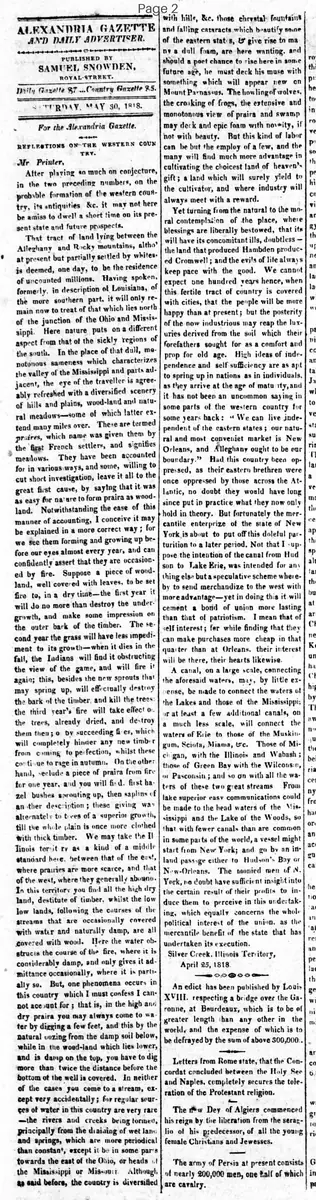
REFLECTIONS ON THE WESTERN COUNTRY.
Mr. Printer,
After having so much on conjecture, in the two preceding numbers, on the probable formation of the western country, its antiquities, etc., it may not here be amiss to dwell a short time on its present state and future prospects.
That tract of land lying between the Alleghany and Rocky mountains, although at present but partially settled by whites, is deemed one day to be the residence of uncounted millions. Having spoken formerly, in description of Louisiana, of the more southern part, it will only remain now to treat of that which lies north of the junction of the Ohio and Mississippi. Here nature puts on a different aspect from that of the sickly regions of the south. In the place of that dull, monotonous sameness which characterizes the valley of the Mississippi and parts adjacent, the eye of the traveller is agreeably refreshed with a diversified scenery of hills and plains, woodland and natural meadows—some of which latter extend many miles over. These are termed prairies, which name was given them by the first French settlers, and signifies meadows. They have been accounted for in various ways, and some, willing to cut short investigation, leave it all to the great first cause, by saying that it was as easy for nature to form prairie as woodland. Notwithstanding the ease of this manner of accounting, I conceive it may be explained in a more correct way; for we see them forming and growing up before our eyes almost every year, and can confidently assert that they are occasioned by fire. Suppose a piece of woodland, well covered with leaves, to be set fire to, in a dry time—the first year it will do no more than destroy the undergrowth, and make some impression on the outer bark of the timber. The second year the grass will have less impediment to its growth—when it dies in the fall, the Indians will find it obstructing the view of the game, and will fire it again; this, besides the new sprouts that may spring up, will effectually destroy the bark of the timber, and kill the trees: the third year's fire will take effect on the trees, already dried, and destroy them then; or by succeeding fires, which will completely hinder any new timber from coming to perfection, whilst these continue to rage in autumn. On the other hand, seclude a piece of prairie from fire for one year, and you will find first hazel bushes sprouting up, then saplings of another description; these giving way alternately to trees of a superior growth, till the whole plain is once more clothed with thick timber. We may take the Illinois territory as a kind of a middle standard here, between that of the east, where prairies are more scarce, and that of the west, where they generally abound. In this territory you find all the high dry land, destitute of timber, whilst the lowlands, following the courses of the streams that are occasionally covered with water and naturally damp, are all covered with wood. Here the water obstructs the course of the fire, where it is considerably damp, and only gives it admittance occasionally, where it is partially so. But one phenomenon occurs in this country which I must confess I cannot account for; that is, in the high and dry prairie you may always come to water by digging a few feet, and this by the natural oozing from the damp soil below, while in the woodland which lies lower, and is damp on the top, you have to dig more than twice the distance before the bottom of the well is covered. In neither of the cases you come to a stream, except very accidentally; for regular sources of water in this country are very rare—the rivers and creeks being formed, principally from the draining of wet lands and springs, which are more periodical than constant, except it be in some parts towards the east of the Ohio, or heads of the Mississippi or Missouri. Although, as said before, the country is diversified with hills, etc., those crystal fountains and falling cataracts which beautify some of the eastern states, give rise to many a dull foam, are here wanting, and should a poet chance to rise here in some future age, he must deck his muse with something which will appear new on Mount Parnassus. The howling of wolves, the croaking of frogs, the extensive and monotonous view of prairie and swamp may deck an epic poem with novelty, if not with beauty. But this kind of labor can be but the employ of a few, and the many will find much more advantage in cultivating the choicest land of heaven's gift; a land which will surely yield to the cultivator, and where industry will always meet with a reward.
Yet turning from the natural to the moral contemplation of the place, where blessings are liberally bestowed, that it will have its concomitant ills, doubtless—the land that produced Hampden produced Cromwell; and the evils of life always keep pace with the good. We cannot expect one hundred years hence, when this fertile tract of country is covered with cities, that the people will be more happy than at present; but the posterity of the now industrious may reap the luxuries derived from the soil which their forefathers sought for as a comfort and prop for old age. High ideas of independence and self-sufficiency are as apt to spring up in nations as in individuals, as they arrive at the age of maturity, and it has not been an uncommon saying in some parts of the western country for some years back: "We can live independent of the eastern states; our natural and most convenient market is New Orleans, and Alleghany ought to be our boundary." Had this country been oppressed, as their eastern brethren were once oppressed by those across the Atlantic, no doubt they would have long since put in practice what they now only hold in theory. But fortunately the mercantile enterprise of the state of New York is about to put off this doleful parturition to a later period. Not that I suppose the intention of the canal from Hudson to Lake Erie, was intended for anything else but a speculative scheme whereby to send merchandise to the west with more advantage—yet in doing this it will cement a bond of union more lasting than that of patriotism. I mean that of self-interest; for while finding that they can make purchases more cheap in that quarter than at Orleans, their interest will be there, their hearts likewise.
A canal, on a large scale, connecting the aforesaid waters, may, by little expense, be made to connect the waters of the Lakes and those of the Mississippi: or at least a few additional canals, on a much less scale, will connect the waters of Erie to those of the Muskingum, Scioto, Miami, etc. Those of Michigan, with the Illinois and Wabash; those of Green Bay with the Wisconsin, or Ouisconsin; and so on with all the waters of these two great streams. From Lake Superior easy communications could be made to the head waters of the Mississippi and the Lake of the Woods. So that with fewer canals than are common in some parts of the world, a vessel might start from New York; and go by an inland passage either to Hudson's Bay or New Orleans. The monied men of N. York, no doubt have sufficient insight into the certain result of their profits to induce them to perceive in this undertaking, which equally concerns the whole political interest of the union, as the mercantile benefit of the state that has undertaken its execution.
Silver Creek, Illinois Territory,
April 25, 1818.
What sub-type of article is it?
What themes does it cover?
What keywords are associated?
Where did it happen?
Story Details
Location
Between The Alleghany And Rocky Mountains, North Of The Junction Of The Ohio And Mississippi; Illinois Territory; Silver Creek
Event Date
April 25, 1818
Story Details
Essay describing the present state and future prospects of the western country, including explanations of prairie formation by fires, water availability in prairies versus woodlands, lack of springs, and discussions on settlement, independence from eastern states, and canals to connect waterways for trade and union.