Thank you for visiting SNEWPapers!
Sign up free
Story
July 6, 1841
The Middlebury People's Press
Middlebury, Addison County, Vermont
What is this article about?
Practical advice on haymaking techniques, including selecting scythes, using horse rakes, optimal cutting times, curing methods, salting hay, and a personal anecdote on curing damp clover successfully with salt.
Clipping
OCR Quality
95%
Excellent
Full Text
AGRICULTURAL.
HAYMAKING
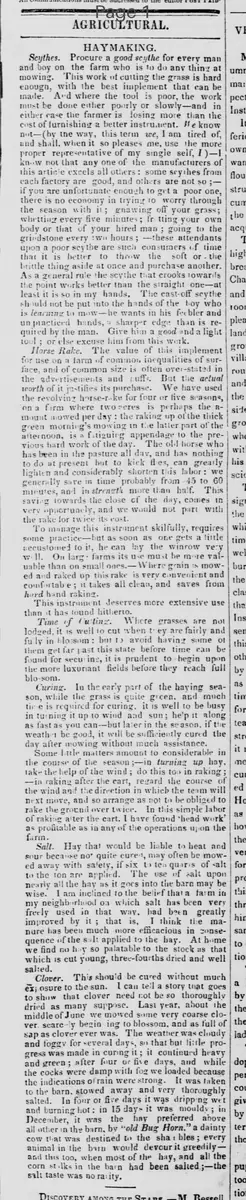
Scythes. Procure a good scythe for every man and boy on the farm who is to do any thing at mowing. This work of cutting the grass is hard enough, with the best implement that can be made. And where the tool is poor, the work must be done either poorly or slowly-and in either case the farmer is losing more than the cost of furnishing a better instrument. We know not-(by the way, this term we, I am tired of and shall, when it so pleases me, use the more proper representative of my single self, I)-I know not that any one of the manufacturers of this article excels all others : some scythes from each factory are good, and others are not so;— if you are unfortunate enough to get a poor one, there is no economy in trying to worry through the season with it; gnawing off your grass; whetting every five minutes; fretting your own body or that of your hired man ; going to the grindstone every two hours; -these attendants upon a poor scythe are such consumers of time that it is better to throw the soft or the brittle thing aside at once and purchase another.
As a general rule the scythe that crooks towards the point works better than the straight one-at least it is so in my hands, The cast-off scythe should not be put into the hands of the boy who is learning to mow-he wants in his feebler and unpracticed hands, a sharper edge than is required by the man. Give him a good and a light tool ; or else excuse him from this work.
Horse Rake. The value of this implement for use on a farm of common inequalities of surface, and of common size is often over-stated in the advertisements and puffs. But the actual worth of it justifies its purchase. We have used the revolving horse-rake for four or five seasons, on a farm where two acres is perhaps the average mowed per day : the raking up of the thick green morning's mowing in the latter part of the afternoon, is a fatiguing appendage to the previous hard work of the day. The old horse who has been in the pasture all day, and has nothing to do at present but to kick flies, can greatly lighten and considerably shorten this labor : we generally save in time probably from 45 to 60 minutes. and in strength more than half. This saving towards the close of the day, comes in very opportunely, and we would not part with the rake for twice its cost.
To manage this instrument skilfully, requires some practice-but as soon as one gets a little accustomed to it, he can lay the windrow very well. On large farms its use must be more valuable than on small ones.-Where grain is mowed and raked up this rake is very convenient and comfortable; it takes all clean, and saves from hard hand raking.
This instrument deserves more extensive use than it has found hitherto.
Time of Cutting. Where grasses are not lodged. it is well to cut when they are fairly and fully in blossom : but to avoid having some of them get far past this state before time can be found for securing, it is prudent to begin upon the more luxuriant fields before they reach full blossom.
Curing. In the early part of the haying season, while the grass is quite green. and much time is required for curing. it is well to be busy in turning it up to wind and sun; help it along as fast as you can--but later in the season, if the weather be good, it will be sufficiently cured the day after mowing without much assistance.
Some little matters amount to considerable in the course of the season;-in turning up hay. take the help of the wind ; do this too in raking; -in raking after the cart, regard the course of the wind and the direction in which the team will next move, and so arrange as not to be obliged to rake the ground over twice. In this simple labor of raking after the cart. I have found head work as profitable as in any of the operations upon the farm.
Salt. Hay that would be liable to heat and sour because not quite cured, may often be mowed away with safety, if six to ten quarts of salt to the ton are applied. The use of salt upon nearly all the hay as it goes into the barn may be wise. I am inclined to the belief that a farm in my neighborhood on which salt has been very freely used in that way. had been greatly improved by it; that is, I think the manure has been much more efficacious in consequence of the salt applied to the hay. At home we find no hay so palatable to the stock as that which is cut young, three-fourths dried and well salted.
Clover.
This should be cured without much exposure to the sun. I can tell a story that goes to show that clover need not be so thoroughly dried as many suppose. Last year, about the middle of June we mowed some very coarse clover. scarcely beginning to blossom, and as full of sap as clover ever was. The weather was cloudy and foggy for several days, so that but little progress was made in curing it; it continued heavy and green; after four or five days, and while the cocks were damp with fog we loaded because the indications of rain were strong. It was taken to the barn, stowed away and very thoroughly salted. In four or five days it was dripping wet and burning hot: in 15 days it was mouldy; in December, it was the hay preferred above all other in the barn, by "old BugHorn," a dainty cow that was destined to the shambles; every animal in the barn would devour it greedily- and this too, when most of the hay, and all the corn stalks in the barn had been salted;-the salt taste was no rarity.
HAYMAKING
Scythes. Procure a good scythe for every man and boy on the farm who is to do any thing at mowing. This work of cutting the grass is hard enough, with the best implement that can be made. And where the tool is poor, the work must be done either poorly or slowly-and in either case the farmer is losing more than the cost of furnishing a better instrument. We know not-(by the way, this term we, I am tired of and shall, when it so pleases me, use the more proper representative of my single self, I)-I know not that any one of the manufacturers of this article excels all others : some scythes from each factory are good, and others are not so;— if you are unfortunate enough to get a poor one, there is no economy in trying to worry through the season with it; gnawing off your grass; whetting every five minutes; fretting your own body or that of your hired man ; going to the grindstone every two hours; -these attendants upon a poor scythe are such consumers of time that it is better to throw the soft or the brittle thing aside at once and purchase another.
As a general rule the scythe that crooks towards the point works better than the straight one-at least it is so in my hands, The cast-off scythe should not be put into the hands of the boy who is learning to mow-he wants in his feebler and unpracticed hands, a sharper edge than is required by the man. Give him a good and a light tool ; or else excuse him from this work.
Horse Rake. The value of this implement for use on a farm of common inequalities of surface, and of common size is often over-stated in the advertisements and puffs. But the actual worth of it justifies its purchase. We have used the revolving horse-rake for four or five seasons, on a farm where two acres is perhaps the average mowed per day : the raking up of the thick green morning's mowing in the latter part of the afternoon, is a fatiguing appendage to the previous hard work of the day. The old horse who has been in the pasture all day, and has nothing to do at present but to kick flies, can greatly lighten and considerably shorten this labor : we generally save in time probably from 45 to 60 minutes. and in strength more than half. This saving towards the close of the day, comes in very opportunely, and we would not part with the rake for twice its cost.
To manage this instrument skilfully, requires some practice-but as soon as one gets a little accustomed to it, he can lay the windrow very well. On large farms its use must be more valuable than on small ones.-Where grain is mowed and raked up this rake is very convenient and comfortable; it takes all clean, and saves from hard hand raking.
This instrument deserves more extensive use than it has found hitherto.
Time of Cutting. Where grasses are not lodged. it is well to cut when they are fairly and fully in blossom : but to avoid having some of them get far past this state before time can be found for securing, it is prudent to begin upon the more luxuriant fields before they reach full blossom.
Curing. In the early part of the haying season, while the grass is quite green. and much time is required for curing. it is well to be busy in turning it up to wind and sun; help it along as fast as you can--but later in the season, if the weather be good, it will be sufficiently cured the day after mowing without much assistance.
Some little matters amount to considerable in the course of the season;-in turning up hay. take the help of the wind ; do this too in raking; -in raking after the cart, regard the course of the wind and the direction in which the team will next move, and so arrange as not to be obliged to rake the ground over twice. In this simple labor of raking after the cart. I have found head work as profitable as in any of the operations upon the farm.
Salt. Hay that would be liable to heat and sour because not quite cured, may often be mowed away with safety, if six to ten quarts of salt to the ton are applied. The use of salt upon nearly all the hay as it goes into the barn may be wise. I am inclined to the belief that a farm in my neighborhood on which salt has been very freely used in that way. had been greatly improved by it; that is, I think the manure has been much more efficacious in consequence of the salt applied to the hay. At home we find no hay so palatable to the stock as that which is cut young, three-fourths dried and well salted.
Clover.
This should be cured without much exposure to the sun. I can tell a story that goes to show that clover need not be so thoroughly dried as many suppose. Last year, about the middle of June we mowed some very coarse clover. scarcely beginning to blossom, and as full of sap as clover ever was. The weather was cloudy and foggy for several days, so that but little progress was made in curing it; it continued heavy and green; after four or five days, and while the cocks were damp with fog we loaded because the indications of rain were strong. It was taken to the barn, stowed away and very thoroughly salted. In four or five days it was dripping wet and burning hot: in 15 days it was mouldy; in December, it was the hay preferred above all other in the barn, by "old BugHorn," a dainty cow that was destined to the shambles; every animal in the barn would devour it greedily- and this too, when most of the hay, and all the corn stalks in the barn had been salted;-the salt taste was no rarity.
What sub-type of article is it?
Agricultural Advice
What keywords are associated?
Haymaking
Scythes
Horse Rake
Cutting Time
Curing Hay
Salt Application
Clover Harvest
Where did it happen?
Farm
Story Details
Location
Farm
Event Date
Last Year, About The Middle Of June
Story Details
Advice on selecting good scythes, using horse rakes to save time and effort, cutting grasses in blossom, curing hay by turning and using wind, applying salt to prevent spoilage and improve palatability, and an anecdote of successfully curing damp clover with salt that became preferred feed for livestock.