Thank you for visiting SNEWPapers!
Sign up free
Alexandria Daily Gazette, Commercial & Political
Alexandria, Virginia
What is this article about?
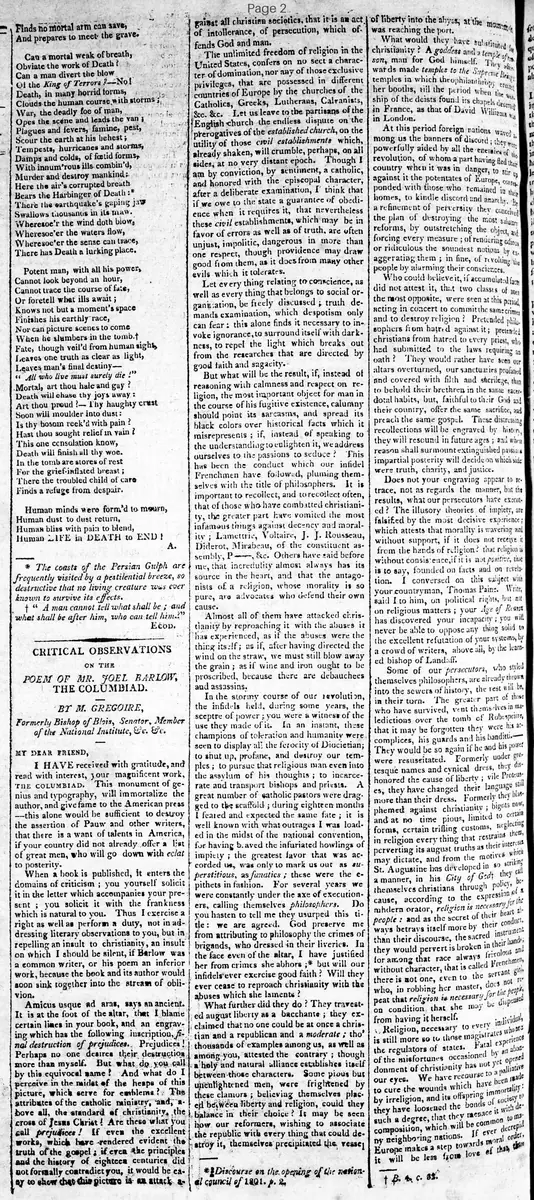
Henri Grégoire, former Bishop of Blois, writes to Joel Barlow critiquing his poem 'The Columbiad' and its engraving for portraying Christian symbols as prejudices to be destroyed, insulting Christianity. He defends the faith's role in morality, liberty, and society, referencing French Revolution persecutions and historical precedents.
Merged-components note: This is a continuation of the critical letter from Gregoire to Barlow on 'The Columbiad' across pages 2 and 3, originally labeled as 'review' and 'letter_to_editor'; merging into a single coherent letter_to_editor component.
Clippings
1 of 2
OCR Quality
Full Text
ON THE
POEM OF MR. JOEL BARLOW,
THE COLUMBIAD.
BY M. GREGOIRE,
Formerly Bishop of Blois, Senator, Member
of the National Institute, &c. &c.
MY DEAR FRIEND,
I HAVE received with gratitude, and
read with interest, your magnificent work.
'THE COLUMBIAD.'
This monument of ge-
ius and typography, will immortalize the
author, and give fame to the American press
--this alone would be sufficient to destroy
the assertion of Pauw and other writers,
that there is a want of talents in America.
if your country did not already offer a list
of great men, who will go down with eclat
to posterity.
When a book is published, it enters the
domains of criticism ; you yourself solicit
it in the letter which accompanies your pre-
sent ; you solicit it with the frankness
which is natural to you. Thus I exercise a
right as well as perform a duty, not in ad-
dressing literary observations to you, but in
repelling an insult to christianity, an insult
on which I should be silent, if Barlow was
a common writer, or his poem an inferior
work, because the book and its author would
soon sink together into the stream of obli-
vion.
Amicus usque ad aras, says an ancient.
It is at the foot of the altar, that I blame
certain lines in your book, and an engrav-
ing which has the following inscription, fi-
nal destruction of prejudices.. Prejudices!
Perhaps no one desires their destruction
more than myself. But what do you call
by this equivocal name ? And what do I
perceive in the midst of the heaps of this
picture, which serve for emblems? The
attributes of the catholic ministry. and, a-
bove all, the standard of christianity. the
cross of Jesus Christ ! Are these what you
call prejudices! If even the excellent
works, which have rendered evident the
truth of the gospel : if even the principles
and the history of eighteen centuries did
not formally contradict you, it would be ea-
sy to see that this picture is- an attack a-
gainst all christian societies, that it is an act
of intollerance, of persecution, which of-
fends God and man.
The unlimited freedom of religion in the
United States, confers on no sect a charac-
ter-of domination, nor any of those exclusive
privileges, that are possessed in different
countries of Europe by the churches of the
Catholics, Greeks, Lutherans, Calvinists,
&c. &c. . Let us leave to the partisans of the
English church the endless dispute on the
prerogatives of the established church, on the
utility of those civil establishments which,
already shaken, will crumble, perhaps, on all
sides, at no very distant epoch. Though I
am by conviction, by sentiment, a catholic.
and honored with the episcopal character.
after a deliberate examination, I think that
if we owe to the state a guarantee of obedi-
ence when it requires it, that nevertheless
these civil establishments, which may be in
favor of errors as well as of truth. are often
unjust, impolitic, dangerous in more than
one respect, though providence may draw
good from them, as it does from many other
evil which it tolerates.
Let every thing relating to conscience, as
well as every thing that belongs to social or-
ganization, be freely discussed ; truth de-
mands examination, which despotism only
can fear : this alone finds it necessary to in-
voke ignorance, to surround itself with dark-
ness, to repel the light which breaks out
from the researches that are directed by
good faith and sagacity.
But what will be the result, if, instead of
reasoning with calmness and respect on re-
ligion, the most important object for man in
the course of his fugitive existence, calumny
should point its sarcasms, and spread its
black colors over historical facts which it
misrepresents ; if, instead of speaking to
the understanding to enlighten it, we address
ourselves to the passions to seduce ? This
has been the conduct which our infidel
Frenchmen have followed, pluming them-
selves with the title of philosophers. It is
important to recollect, and to recollect often,
that of those who have combatted christianity,
the greater part have vomited the most
infameus things against decency and moral-
ity ; Lamettrie, Voltaire, J. J. Rousseau,
Diderot, Mirabeau, of the constituent as-
sembly, P r, &c. Others have said before
me, that incredulity almost always has its
source in the heart, and that the antago-
nists of. a religion, whose morality is so
pure, are advocates who defend their own
cause.
Almost all of them have attacked chris-
tianity by reproaching it with the abuses it
has experienced, as if the abuses were the
thing itself; as if, after having directed the
wind on the straw, we must still blow away
the grain ; as if wine and iron ought to be
proscribed, because there are debauchees
and assassins.
In the stormy course of our revolution,
the infidels held. during some years, the
sceptre of power ; you were a witness of the
use they made of it. In an instant, these
champions of toleration and humanity were
seen to display all the ferocity of Diocletian:
to shut up, profane, and destroy our tem-
ples; to pursue that religious man even into
the assylum of his thoughts ; to incarcerate
and transport bishops and priests. A
great number of catholic pastors were dragged
to the scaffold ; during eighteen months
I feared and expected the same fate : it is
well known with what outrages I was load-
ed in the midst of the national convention,
for having braved the infuriated howlings of
impiety ; the greatest favor that was ac-
corded us, was only to mark us out as su-
perstitious, as fanatics ; these were the e-
pithets in fashion. For several years we
were constantly under the axe of execution-
ers, calling themselves philosophers. Do
you hasten to tell me they usurped this ti-
tle: we are agreed. God preserve me
from attributing to philosophy the crimes of
brigands, who dressed in their liveries. In
the face even of the altar, I have justified
her from crimes she abhors ;* but will our
infidels ever exercise good faith ? Will they
ever cease to reproach christianity with the
abuses which she laments ?
What further did they do ? They travest-
ed august liberty as a bacchante ; they ex-
claimed that no one could be at once a chris-
tian and a republican and a moderate ; tho'
thousands of examples among us, as well as
among you, attested the contrary ; though
a holy and natural alliance establishes itself
between-those characters. Some pious but
unenlightened men, were frightened by
these clamors; believing themselves placed
between liberty and religion, could they
balance in their choice? It may be seen
now our reformers, wishing to associate
the republic with every thing that could de-
story it, themselves precipitated the vessel
of liberty into the abyss; at the moment
was reaching the port.
What would they have substituted
for christianity ? A goddess and a temple of
Reason
son man for God himself They
wards made temples to the Supreme Being
temples her booths in which the theophilanthropy period when the erecte
ship of the deists found its chapels desecrated
in France, as that of David
Willamt wa
in London.
At this period foreign nations waved a.
mong us the banners of discord ; they were
powerfully aided by all the enemies of the
revolution, of whom a part having fled their
country when it was in danger, to stir up
against it the potentates of Europe, corq-
ponded with those who remained in their
homes, to kindle discord und anarchy. 'By
a refinement of perversity they conceived
the plan of destroying the most salutary
reforms, by outstretching the object, and
forcing every measure ; of rendering odious
or ridiculous the soundest notions by ex-
aggerating them ; in fine, of revolting the
people by alarming their consciences.
Who could believe it, if accumulated facts
did not attest it, tht. that two classes of men
the most opposite, were seen at this period
acting in concert to commit the same crimes
and to destroy religion ? Pretended philo.
sophers from hatred against it; pretended
christians from hatred to every priest, who
had submitted to the laws requiring an
oath ? They would rather have seen our
altars overturned, our sanctuaries profaned
and covered with filth and shcrilege, than
to behold their brethren in the same sacer.
dotal habits, but, faithful to their God and
their country, offer the same sacrifice, and
preach the same gospel. These distressing
recollections will be engraved by history.
they will resound in future ages ; and when
reason shall surmount extinguished passion
impartial posterity will decide on which side
were truth, charity, and justice.
Does not your engraving appear to re-
trace, not as regards the manner, but the
results, what our persecutors have executed?
The illusory theories of impiety, are
falsified by the most decisive experience;
which attests that morality is wavering and
without support, if it does not receive it
from the hands of religion? that religion is
without consistence, if it is not positive, that
is to say. founded on facts and on revelation.
I conversed on this subject with
your countryman, Thomas Paine. Write,
said I to him, on political rights, but not
on religious matters ; your Age of Reason
has discovered your incapacity : you will
never be able to oppose any thing solid to
the excellent refutation of your systems, by
a crowd of writers, above all, by the learned
bishop of Landaff.
Some of our persecutors, who styled
themselves philosophers, are already thrown
into the sewers of history, the rest will be
in their turn.
The greater part of those
who have survived, vent themselves in ma-
that it may be forgotten they were his ac-
complices, his guards and his banditti.--
In grotesque names and cynical dress, they dis-
were resuscitated. Formerly under gro.
They would be so again if he and his power
honored the cause of liberty : vile Proteus-
more than their dress. Formerly they blas-
phemed against christianity ; bigots now
and at no time pious, limited to certain
forms, certain trifling customs, neglecting
perverting its august truths as their interests
in religion every thing that restrains them,
may dictate, and from the motives which
themselves christians through policy, be-
a manner, in his City of God they call
St. Augustine has developed in so striking
people : and as the secret of their heart al-
modern orator, religion is necessary for the
cause, according
to the
expression of a
than their discourse, the sacred instrument
ways betrays itself more by their conduct,
they would pervert is broken in their hand;
without character, that is called Frenchmen,
for among that race always
frivolous and
there is not one.
even to the servant girl
peat that religion is necessary for the people
who, in robbing her master,
does not re
on condition that she may
be dispensed
from having it herself.
is still more so to those magistrates who are
, Religion, necessary
to every
individual,
the regulators of
states.
Fatal experience
to cure the wounds which have been made
our eyes.
of the misfortunes
We have recourse to a palliative
occasioned
has not yet opened
by an aban-
donment of christianity
by irreligion, and its offspring immorality :
such a degres, that they menace it with de-
they have loosened the
bonds of society to
composition, which will
be common to man.
Europe makes a step
towards moral order,
If
ever
decrepit
my neighboring nations.
it will be less from
love
of than than
t B. 4. c. st.*
from lassitude or crime; but it will be under the escort of christianity and in consequence of inevitable catastrophes. In spite of the clouds that cover the future, this epoch may be perceived, though we are unable to calculate its term, or its disasters. If the bounds of this letter permitted me, I would oppose to the evils engendered by infidelity, the benefits profusely spread by the most vast of all revolutions, and the christian religion; its introduction was most beautiful, because the most useful to the human race. The cross and the gospel, in preparing us for the happiness of eternity, have civilized the world; virtue and knowledge have every where marched in their train; every religion has been abandoned by virtue and knowledge, which has lost christianity; those regions have turned to barbarism; witness the church of Africa, illustrious for so many learned men, and which was once one of the most brilliant portions of Christendom. Witness Algiers, where you resided two years; such would be the lot which the United States would fall, if ever they should cease to be christians.
And is not this equivalent to what you propose in some lines, and by an engraving, which a disciple of the Gospel repels with horror? The attributes of pure christianity are classed among the emblems of prejudices. Where are your proofs? It is in the nature of things, that what is invariably useful should be essentially true; instead of proofs, you give up to derision objects revered by many hundred millions of men, who will not believe you on your word; they will see that your anti-christian sentence lacks justness; that it is a consequence without premises; that, without reasoning, you have decided that all the disciples of the gospel reason falsely.
Virtuous minds would sigh to behold calumny, impiety, and lubricity display themselves with effrontery, protected by the liberty of the press; but as we do not know where to place the limits, if we attempt to establish by law repressive measures this evil would be counterbalanced by others, if our mouths were locked, and our pens crushed by tyranny. The press is free in your country; thus you are not reprehensible by the law, but condemnable at the tribunal of opinion, the supreme judge of all crimes that offend propriety and justice. Yours offends both.
It offends justice, because it is a gratuitous outrage, that resembles that of the Jesuists at Japan. What would you say, if the attributes of liberty, which are so dear to you, were trampled under foot before your eyes? It offends propriety, because in holding out as prejudices the emblems of the christian religion, it is saying to all those who profess it, that they are fools; this compliment addresses itself to the disciples of the gospel in every part of the globe; it addresses itself to the estimable descendants of those catholics, who, flying from British persecution, established in Maryland, a state belonging to your confederation: it addresses itself to the venerable Carroll, bishop of Baltimore; you trample on the attributes of his pastoral character. In France, it is true, the nonconformists outrage in this way episcopacy in the person of those pastors, who, faithful to the voice of their consciences, have committed the unpardonable crime of submitting to the laws of their country; this is a sad example to cite, not a model to imitate. Your presbyterian countrymen will perhaps ask, if you have abjured the principles that you professed when you were the chaplain of a regiment in the war of independence.
If to believe in the gospel be a prejudice, permit us to partake of it with the feeble minds of Addison, Abbadie, Arbuthnot, Bacon, Berkeley, Barrow, Beattie, Bentley, Bernoulli, Bossuet, Bourdaloue, Bruyere, Copernicus, Corneille, D'Aguesseau, Descartes, Despreaux, Fenelon, Galileo, Gassendi, Houbigant, Malebranche, Massillon, Nicole, Pope, Pascal, Racine, and all sincere Catholics, Winslow, Winkelman, &c.
, it is pleasant to lose ourselves in brilliant company. I must add, that in wishing to undeceive ourselves in such a tin regard to what you call prejudices, you err in the choice of means; for conviction can only be the effect of reasoning: man cannot detach his affection from the object most dear to him, unless the motives that support it are destroyed. But if injuries that revolt are substituted for argument that convince, we are sure to strengthen the adhesion to principles which are rooted in the mind and the heart. If to convert a mus-
sulman, instead of proving to him that Mahomet was an imposter, I should commence by placing before his eyes a picture, in which the Koran and the Crescent were trampled under foot, his heart, embittered, would cloud his understanding, and prevent all access to my attempts. Apply these reflections to the true religion, and see if you have not failed entirely in a deplorable design.
Persecution, my dear Barlow, does not consist only in exiling, incarcerating, and assassinating men; Julian invented more cunning, and not less cruel vexations. They have been revived among us at the end of the eighteenth century, in harassing and lacerating the catholics without cessation, by repeated invectives, by a multitude of those little means, whose application was continual torture; impious verses, songs, epigrams, caricatures, every thing was made use of.
You are very different from such men; but why resemble them in any thing? Your engraving is an offence against the freedom of religion; a sort of persecution which your heart disavows; reflection will bring on regret. Believe me, my friend, that these injured catholics will not make use of reprisals; true piety opens her bosom to erring brethren, without opening it to error; to enlighten them, she places the torch of truth in the hand of charity. Having but a moment to exist in this world, we should love our fellow men, be benevolent towards all, whatever may be their religion, their color, or their country. Jesus Christ has given us both precept and example in their turn; he displayed alternately firmness and goodness towards the pharisees; his parable of the Samaritan is a perpetual judgment against persecutors.
If you should say farther, that France offers examples worthy of condemnation, and that previous to censuring an American, my zeal should be exercised to convert my countrymen; far from weakening the objection, I would fortify it. I would say that, in a country where so many truths have returned to their wells, we see printed and circulated freely the obscene poetry of a member of the national institute, and the rhapsodies of romance writers, who serve up afresh impieties so many times refuted. I would say too, that, without respect to the first body of the state, which ought to give an example of decency, immorality is authorized, by peopling the garden of the palace with licentious statues, to such a degree that virtuous mothers dare not conduct their children thither.
You see that I am far from avoiding objections; but by my disapprobation of an offence, in which I have no share, and against which my colleague, Lanjuinais, protested vainly in full senate, though with the general assent of the senators, I have reserved to myself the right of telling you, that to recriminate is not to answer; and that what might be alledged as an example to follow, cannot be but as an abuse to reform. Gorani observes that the licentiousness of painting and sculpture had exercised a disastrous influence over Italy: that the masterpieces of the arts had drawn away sound minds from useful and necessary studies, had depraved their manners, enervated their courage, and fomented the most hateful vices.* When public shame is extinct, do not expect to preserve the private virtues; and when religion is publicly insulted, it is a wound to morality, a national calamity.
Many times I have repented having employed so many efforts to defend the arts of those who cultivate them against vandalism; not that those arts, which are called fine, and which are not always good, are bad in their very nature; but, almost always, they are flatterers and corrupters, which, by an inconceivable fatality, precede, bring on, escort, and follow depravation. Even in this time, the illustrious Garson† complained of it, to whom France owes a monument, and whom she has almost forgotten; he was grieved to see scandalous pictures, and a libidinous work, the Romance of the Rose, exposed to the eyes of youth. At the moment I am writing, we are menaced with a new edition of it.
What will be the fruit of my remonstrance? You are not one of those men who are afraid to acknowledge that you are wrong: A man is always honored in doing an act of reparation. I appeal to your loyalty, to your delicacy; this is to put you at strife with yourself.
My soul is oppressed in finding cause of blame in a man in whom I see so much to praise. You character is not degraded by meanness, like that of the great part of your brethren the poets: you have not prostituted your talents to adulation; do not tarnish them by incredulity, nor by a sort of persecution. Placed at the summit of the American parnassus, a creditor of glory, you have sung in beautiful verses that liberty you defended with your arms; you came to render her homage at the bar of the national convention, where, as president, I answered in a manner that accorded with the principles you proclaimed. Our hearts were in unison.
The true foundation of political liberty is in the gospel, for it perpetually reminds men, that, having all proceeded from the same stock, they compose only one family; that there exist among them, not a species of relationship, as has been said in a well known work, but a real consanguinity, whose bond is indestructible. The gospel unceasingly inculcates on men a spirit of charity and fraternal sentiments. The christian religion would be perverted and disguised, if it were subordinate to the caprices of rulers and the passions; but well understood and rightly practised, it is the most certain guarantee of the purity of public and private manners.
Under its wings, my friend, your state of society was raised, and consolidated, and the domestic virtues hereditarily transmitted: it is to that, without doubt, that you owe, among other advantages, that of having a wife gifted with so many rare qualities and inestimable virtues. Ingratitude alone could mistake the benefits of this august and divine religion; it would be like despising the bosom of our mother.
I have discharged, my dear Barlow, a very painful task in censuring, without human respect, what in your poem, offends christianity. The work being public, I give the same publicity to my remonstrance; thus satisfying what is prescribed to me by my principles, my situation, my conscience, and my invariable friendship.
H. GREGOIRE
Former Bishop of Blois, Senator, &c.
Paris, 15th March, 1809.
What sub-type of article is it?
What themes does it cover?
What keywords are associated?
What entities or persons were involved?
Letter to Editor Details
Author
H. Gregoire, Formerly Bishop Of Blois, Senator, &C.
Recipient
My Dear Friend (Joel Barlow)
Main Argument
criticizes barlow's 'the columbiad' and its engraving for insulting christianity by depicting its symbols as prejudices to be destroyed; defends christianity as essential to morality, liberty, and society, based on experiences from the french revolution.
Notable Details