Thank you for visiting SNEWPapers!
Sign up free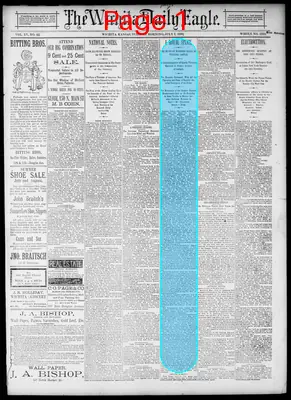
The Wichita Daily Eagle
Wichita, Sedgwick County, Kansas
What is this article about?
Princess Louise, granddaughter of Queen Victoria, married Prince Aribert of Anhalt at Windsor Castle on July 6 in a lavish royal ceremony attended by the Queen, German Emperor and Empress, and other dignitaries.
Clipping

OCR Quality
Full Text
THE MUSIC OF WEDDING BELLS AT
WINDSOR CASTLE.
A Granddaughter of Queen Victoria
Married to Prince Aribert
of Anhalt.
The Nuptials Celebrated With All the
Pageantry and Pomp of Royalty-Detailed
Description of the Event
The Movements of the German Emperor.
LONDON, July 6.-The chapel of Windsor castle was the scene of a royal wedding this afternoon. As the hour fixed for the ceremony (4 o'clock) drew near Windsor castle and its neighborhood may be said to have been entirely alive with people. Shortly after 4, amid a scene of splendor and with imposing ceremonies, Princess Louise, second daughter of Prince and Princess Christian of Schleswig-Holstein, and granddaughter of the queen of England, was married to Prince Aribert of Anhalt in the historic chapel of Windsor castle. Not since the marriage of the late duke of Albany has the castle been crowded with so many distinguished people, and not since that event has the chapel been so crowded with members of royal families. The route followed by the procession was the same as that taken at the wedding of the duke of Albany. This route, down the castle hill, was lined on both sides with troops and all the castle guards of honor were mounted at every available point.
The royal standard of Great Britain, from the highest tower of the castle, floated proudly over the whole while here and there, and everywhere, were dazzling uniforms, gorgeous staffs, and state carriages containing diplomats, statesmen, generals, admirals, princes of minor degree, and high church dignitaries. Down the castle hill the Eton boys on the sward on the left ran with the carriages containing the bridegroom's family. The second section consisted of twelve state carriages, which conveyed to the chapel the emperor and empress of Germany and the imperial party, with the prince and princess of Wales, the duke and duchess of Edinburgh, the duke and duchess of Connaught, Prince Henry of Battenberg and his wife, Princess Beatrice, Princess Louise and the duchess of Fife. The prince of Anhalt, the bridegroom, wearing a German uniform, with attendants, formed the third section of the procession. The queen of England, in the most elaborate of all the carriages, surrounded by life guardsmen, magnificent horses and arms, cuirasses and helmets flashing brightly, formed the fourth part of this bewildering and attractive panorama.
The queen was greeted overwhelmingly with the wildest acclamations of loyalty. The bride, accompanied by her father, Prince Christian of Schleswig-Holstein, and by her brother, had already driven from Cumberland Lodge, their residence, to Windsor castle, and as the queen started for St. George's chapel, the bride and her two male relatives followed.
As each and every member in the imperial or royal families reached the chapel, their arrival was heralded by resounding blasts from the trumpets of the state trumpeters. At the chapel doors the wedding guests were received by the lord chamberlain, the earl of Lathom, who ushered them with much ceremony to their places about the altar. In front of the altar a dais was erected, and was covered with a blue velvet carpet with the Order of the Garter and the royal arms handsomely interwoven in its center. Upon this royal carpet were velvet and gold seats for the members of the imperial and royal families. The banners of the Knights of the Garter--all renewed for the occasion--overhung the seats of the other important guests.
The prince of Wales entered the chapel, having upon his arm the empress of Germany. They were followed by the emperor of Germany, escorting the princess of Wales and the princess of Wales was followed by the queen of England, who wore a simple black dress. Upon her head the queen wore a beautiful diamond coronet, but, with this exception, there were few or no ornaments about the queen's attire. After Queen Victoria had been escorted by the lord chamberlain to the seat of honor close to the altar, the bridegroom, in company with his two brothers, appeared and was led to the altar by the lord chamberlain.
About ten minutes later the bride arrived, supported by her father and brother. The bride's dress was cream white satin of the most unique texture. It was bordered with orange blossoms, and the skirt was draped with honiton and duchesse lace, which was designed by the late prince consort for the queen, and which was afterwards worn by the bride's mother, Princess Christian, just twenty-five years ago. This handsome dress hung from under the basque in plain straight folds, its border of white buds and green giving it a very effective appearance.
The bodice, equally handsome, was of white satin with sleeves of honiton lace similar to that on the skirt. As to jewelry, the bride wore a necklace of diamonds and pearls, the gift of her parents. The wedding veil was the one worn by Princess Christian upon the occasion of her marriage.
The bridesmaids were Ladies Emily Cadogan, Edith Ward, Mable Edgerton, Elizabeth Meade, Esther Gore and the Honorable Beatrice Brideman.
The archbishop of Canterbury performed the marriage service, which was most simple, and made only a brief exhortation. The bridegroom's responses were given in a clear, firm voice, but those of the bride were indistinct. The bride was given away by her father, Prince Christian.
After the service Mendelssohn's "Wedding March" was played and the wedding ceremony concluded. The marriage register was, later on, signed in Windsor castle. After the benediction the queen advanced and kissed the bride. The emperor insisted upon the same privilege, and then the bride was kissed by all the princesses. The procession then reformed and returned to the castle, the queen preceding by a private carriage, so as to be in readiness to receive the couple. Here there was a pretty scene in the grand drawing room. All assembled to sign the register, the queen's signature following those of the emperor and empress. On the route to Cliveden, the duke of Westminster's residence, where the couple will spend their honeymoon, the bride was greeted with the usual showers of rice, satin slippers and flowers. A grand banquet at the castle closed the day. In the evening the queen drove through Windsor to see the decorations. The emperor and empress meanwhile walked to Frogmore house. A Venetian fete and display of fireworks were given on the Thames tonight, which was witnessed by the emperor and empress.
What sub-type of article is it?
What keywords are associated?
What entities or persons were involved?
Where did it happen?
Foreign News Details
Primary Location
Windsor Castle
Event Date
July 6
Key Persons
Outcome
the marriage was celebrated with royal pageantry, including a procession, ceremony, banquet, and fireworks; the couple proceeded to cliveden for their honeymoon.
Event Details
Princess Louise, second daughter of Prince and Princess Christian of Schleswig-Holstein and granddaughter of Queen Victoria, married Prince Aribert of Anhalt in St. George's Chapel at Windsor Castle at 4 o'clock. The event featured a grand procession with state carriages, troops, and distinguished guests including the German Emperor and Empress, Prince and Princess of Wales, and others. The chapel was adorned with a dais and banners. The Archbishop of Canterbury officiated the simple service. The bride wore a cream white satin dress with lace and a family veil. Bridesmaids included Ladies Emily Cadogan and others. Post-ceremony, the register was signed, kisses exchanged, and a banquet held.