Thank you for visiting SNEWPapers!
Sign up free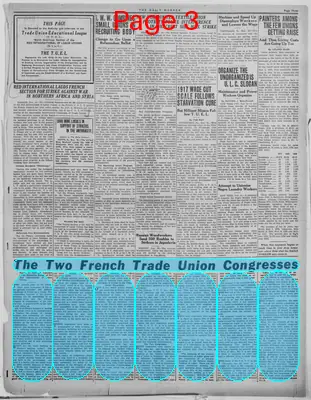
The Daily Worker
Chicago, Cook County, Illinois
What is this article about?
Report on French trade union movement amid financial crisis and colonial wars. Details simultaneous Paris congresses of Unitary CGT (CGTU) and reformist CGT on August 26, with CGTU pushing for unity; 10% of reformist delegates support it, indicating left-wing growth despite low overall unionization.
Clipping
OCR Quality
Full Text
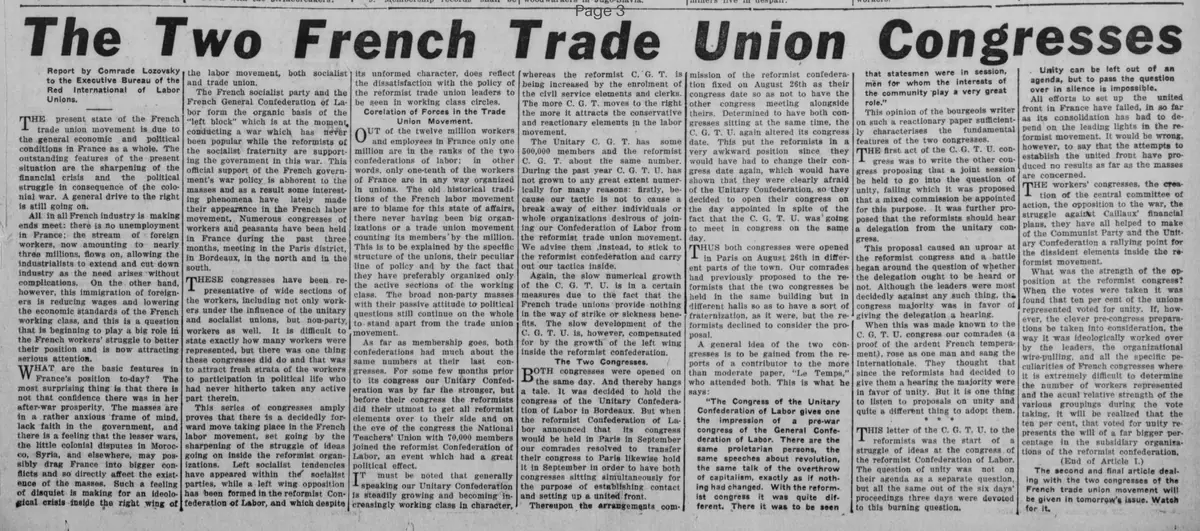
Report by Comrade Lozovsky to the Executive Bureau of the Red International of Labor Unions.
THE present state of the French trade union movement is due to the general economic and political conditions in France as a whole. The outstanding features of the present situation are the sharpening of the financial crisis and the political struggle in consequence of the colonial war. A general drive to the right is still going on.
All in all French industry is making ends meet: there is no unemployment in France: the stream of foreign workers, now amounting to nearly three millions, flows on, allowing the industrialists to extend and cut down industry as the need arises without complications. On the other hand, however, this immigration of foreigners is reducing wages and lowering the economic standards of the French working class, and this is a question that is beginning to play a big role in the French workers' struggle to better their position and is now attracting serious attention.
WHAT are the basic features in France's position to-day? The most surprising thing is that there is not that confidence there was in her after-war prosperity. The masses are in a rather anxious frame of mind, lack faith in the government, and there is a feeling that the lesser wars, the little colonial disputes in Morocco, Syria, and elsewhere, may possibly drag France into bigger conflicts and so directly affect the existence of the masses. Such a feeling of disquiet is making for an ideological crisis inside the right wing of the labor movement, both socialist and trade union.
The French socialist party and the French General Confederation of Labor form the organic basis of the "left block" which is at the moment conducting a war which has never been popular while the reformists of the socialist fraternity are supporting the government in this war. This official support of the French government's war policy is abhorrent to the masses and as a result some interesting phenomena have lately made their appearance in the French labor movement. Numerous congresses of workers and peasants have been held in France during the past three months, meeting in the Paris district, in Bordeaux, in the north and in the south.
THESE congresses have been representative of wide sections of the workers, including not only workers under the influence of the unitary and socialist unions, but non-party workers as well. It is difficult to state exactly how many workers were represented, but there was one thing these congresses did do and that was to attract fresh strata of the workers to participation in political life who had never hitherto taken any active part therein.
This series of congresses amply proves that there is a decidedly forward move taking place in the French labor movement, set going by the sharpening of the struggle of ideas going on inside the reformist organizations. Left socialist tendencies have appeared within the socialist parties, while a left wing opposition has been formed in the reformist Confederation of Labor, and which despite its unformed character, does reflect the dissatisfaction with the policy of the reformist trade union leaders to be seen in working class circles.
Correlation of Forces in the Trade Union Movement.
OUT of the twelve million workers and employees in France only one million are in the ranks of the two confederations of labor: in other words, only one-tenth of the workers of France are in any way organized in unions. The old historical traditions of the French labor movement are to blame for this state of affairs, there never having been big organizations or a trade union movement counting its members by the million.
This is to be explained by the specific structure of the unions, their peculiar line of policy and by the fact that they have preferably organized only the active sections of the working class. The broad non-party masses with their passive attitude to political questions still continue on the whole to stand apart from the trade union movement.
As far as membership goes, both confederations had much about the same numbers at their last congresses. For some few months prior to its congress our Unitary Confederation was by far the stronger, but before their congress the reformists did their utmost to get all reformist elements over to their side and on the eve of the congress the National Teachers' Union with 70,000 members joined the reformist Confederation of Labor, an event which had a great political effect.
Speaking of our Unitary Confederation must be noted that generally is steadily growing and becoming increasingly working class in character, whereas the reformist C.G.T. is being increased by the enrolment of the civil service elements and clerks. The more C.G.T. moves to the right the more it attracts the conservative and reactionary elements in the labor movement.
The Unitary C.G.T.U. has some 500,000 members and the reformist C.G.T. about the same number. During the past year C.G.T.U. has not grown to any great extent numerically for many reasons: firstly, because our tactic is not to cause a break away of either individuals or whole organizations desirous of joining our Confederation of Labor from the reformist trade union movement. We advise them instead, to stick to the reformist confederation and carry out our tactics inside.
Again, the slow numerical growth of the C.G.T.U. is in a certain measure due to the fact that the French trade unions provide nothing in the way of strike or sickness benefits. The slow development of the C.G.T.U. is, however, compensated for by the growth of the left wing inside the reformist confederation.
The Two Congresses.
BOTH congresses were opened on the same day. And thereby hangs a tale. It was decided to hold the congress of the Unitary Confederation of Labor in Bordeaux. But when the reformist Confederation of Labor announced that its congress would be held in Paris in September our comrades resolved to transfer their congress to Paris likewise hold it in September in order to have both congresses sitting simultaneously for the purpose of establishing contact and setting up a united front.
Thereupon the commission of the reformist confederation fixed on August 26th as their congress date so as not to have the other congress meeting alongside theirs. Determined to have both congresses sitting at the same time, the C.G.T.U. again altered its congress date. This put the reformists in a very awkward position since they would have had to change their congress date again, which would have shown that they were clearly afraid of the Unitary Confederation, so they decided to open their congress on the day appointed in spite of the fact that the C.G.T.U. was going to meet in congress on the same day.
THUS both congresses were opened in Paris on August 26th in different parts of the town. Our comrades had previously proposed to the reformists that the two congresses be held in the same building but in different halls so as to have a sort of fraternization, as it were, but the reformists declined to consider the proposal.
A general idea of the two congresses is to be gained from the reports of a contributor to the more than moderate paper, "Le Temps," who attended both. This is what he says:
"The Congress of the Unitary Confederation of Labor gives one the impression of a pre-war congress of the General Confederation of Labor. There are the same proletarian persons, the same speeches about revolution, the same talk of the overthrow of capitalism, exactly as if nothing had changed. With the reformist congress it was quite different. There it was to be seen that statesmen were in session, men for whom the interests of the community play a very great role."
This opinion of the bourgeois writer on such a reactionary paper sufficiently characterises the fundamental features of the two congresses.
THE first act of the C.G.T.U. congress was to write the other congress proposing that a joint session be held to go into the question of unity, failing which it was proposed that a mixed commission be appointed for this purpose. It was further proposed that the reformists should hear a delegation from the unitary congress.
This proposal caused an uproar at the reformist congress and a battle began around the question of whether the delegation ought to be heard or not. Although the leaders were most decidedly against any such thing, the congress majority was in favor of giving the delegation a hearing.
When this was made known to the C.G.T.U. congress our comrades (a proof of the ardent French temperament), rose as one man and sang the Internationale. They thought that since the reformists had decided to give them a hearing the majority were in favor of unity. But it is one thing to listen to proposals on unity and quite a different thing to adopt them.
THIS letter of the C.G.T.U. to the reformists was the start of a struggle of ideas at the congress of the reformist Confederation of Labor. The question of unity was not on their agenda as a separate question, but all the same out of the six days' proceedings three days were devoted to this burning question.
Unity can be left out of an agenda, but to pass the question over in silence is impossible. All efforts to set up the united front in France have failed, in so far as its consolidation has had to depend on the leading lights in the reformist movement. It would be wrong, however, to say that the attempts to establish the united front have produced no results as far as the masses are concerned.
THE workers' congresses, the creation of the central committee of action, the opposition to the war, the struggle against Caillaux' financial plans, they have all helped to make of the Communist Party and the Unitary Confederation a rallying point for the dissident elements inside the reformist movement.
What was the strength of the opposition at the reformist congress? When the votes were taken it was found that ten per cent of the unions represented voted for unity. If, however, the clever pre-congress preparations be taken into consideration, the way it was ideologically worked over by the leaders, the organizational wire-pulling, and all the specific peculiarities of French congresses where it is extremely difficult to determine the number of workers represented and the actual relative strength of the various groupings during the vote taking, it will be realized that the ten per cent, that voted for unity represents the will of a far bigger percentage in the subsidiary organizations of the reformist confederation.
(End of Article I.)
The second and final article dealing with the two congresses of the French trade union movement will be given in tomorrow's issue. Watch for it.
What sub-type of article is it?
What keywords are associated?
What entities or persons were involved?
Where did it happen?
Foreign News Details
Primary Location
France
Event Date
August 26th
Key Persons
Outcome
10% of reformist unions voted for unity; growth of left-wing opposition in labor movement; each confederation has about 500,000 members.
Event Details
Report on French labor movement amid financial crisis, immigration impacts, and unpopularity of colonial wars in Morocco and Syria. Describes simultaneous Paris congresses of Unitary CGTU and reformist CGT on August 26, with CGTU advocating unity; reformist congress debates hearing delegation, devotes three days to unity question despite not on agenda; indicates ideological crisis and forward move in labor movement with workers' congresses attracting new participants.