Thank you for visiting SNEWPapers!
Sign up free
Editorial
December 26, 1829
New Hampshire Statesman And Concord Register
Concord, Merrimack County, New Hampshire
What is this article about?
A satirical editorial in The Statesman critiques the essential integrity required for a probate judge, portraying a hypothetical 'Unjust Judge' as incompetent, dishonest, and morally corrupt, endangering widows and orphans' estates. It urges public vigilance and constitutional remedies if such a figure holds office. Dated December 26, 1829.
Clipping
OCR Quality
95%
Excellent
Full Text
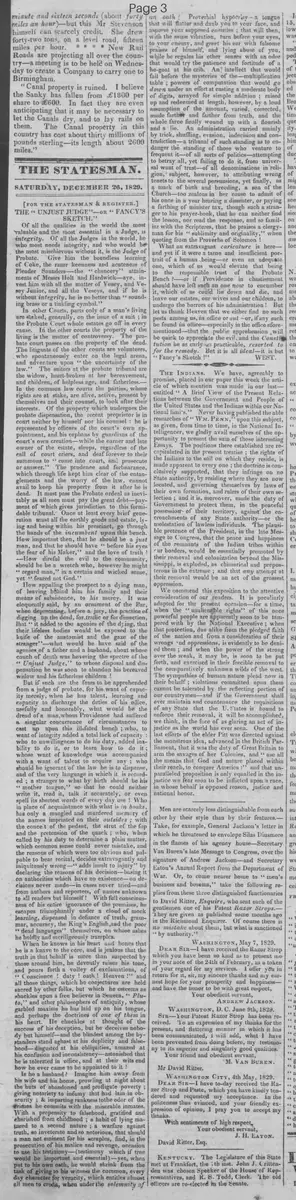
THE STATESMAN.
SATURDAY. DECEMBER 26. 1829.
[FOR THE STATESMAN & REGISTER.]
THE "UNJUST JUDGE"—OR "FANCY'S SKETCH."
Of all the qualities in the world the most valuable and the most essential in a Judge, is integrity. Of all the Judges in the world, he who most needs integrity, and who would be the most mischievous without it, is the Judge of Probate. Give him the boundless learning of Coke, the razor keenness and acuteness of Pleader Saunders—the "chancery" attainments of Messrs Holt and Hardwick—aye, invest him with all the matter of Vesey, and Vesey Junior, and all the Veseys, and if he is without integrity, he is no better than "sounding brass or a tinkling cymbal."
In other Courts, parts only of a man's living are staked, generally, on the issue of a suit; in the Probate Court whole estates go off in every cause. In the other courts the property of the living is the matter of controversy. The probate court passes on the property of the dead. The litigants of the other courts are volunteers, who spontaneously enter on the legal arena, and adventure upon "the uncertainty of the law." The suitors at the probate tribunal are the widow, heart-broken at her bereavement, and children, of helpless age, and fatherless.—In the common law courts the parties, whose rights are at stake, are alive, active, present by themselves and their counsel, to look after their interests. Of the property which undergoes the probate dispensation, the recent proprietor is in court neither by himself nor his counsel: he is represented by officers of the court's own appointment, and his orphans by guardians of the court's own creation—while the earner and late owner of the estate, sleeps, regardless of the call of court criers, and deaf forever to their summons to "come into court, and prosecute or answer." The prudence and forbearance, which through life kept him clear of the entanglements and the worry of the law, cannot avail to keep his property from it after he is dead. It must pass the Probate ordeal as inevitably as all men must pay the great debt—payment of which gives jurisdiction to this formidable tribunal. Once at least every brief generation must all the earthly goods and estate, lying and being within his precinct, go through the hands of the incumbent upon this bench. How important then, that he should be a just man, and that he should have "before his eyes the fear of his Maker," and the love of truth! How direful the evil to the community, should he be a wretch who, however he might "regard man," in a certain and wicked sense, yet "feared not God."
How appalling the prospect to a dying man, of leaving behind him his family and their means of subsistence, to his mercy. It was eloquently said, by an ornament of the Bar, when deprecating, before a jury, the practice of digging up the dead, for traffic or for dissection, that "it added to the agonies of the dying, that their lifeless bodies would be exposed to the knife of the anatomist and the gaze of the stranger"—what would he have said of the agonies of a father and a husband, about whose couch of death was hovering the spectre of the "Unjust Judge," to whose disposal and dispensation he was soon to abandon his bereaved widow and his fatherless children!
But if such are the fears to be apprehended from a judge of probate, for his want of capacity merely, when he has talent, learning and capacity to discharge the duties of his office usefully and honorably, what would be the dread of a man, whom Providence had suffered a singular concurrence of circumstances to cast up upon this ill-fated bench; who, to want of integrity added a total lack of capacity: who to unwillingness to do his duty, added inability to do it, or to learn how to do it: whose want of knowledge was accompanied with a want of talent to acquire any; who should be ignorant of the law he is to dispense, and of the very language in which it is recorded; a stranger to what by birth should be his "mother tongue," so that he could neither write it, read it, talk it accurately, or even spell its shortest words of every day use! Who in place of acquaintance with what is in books, has only a mangled and murdered memory of the names imprinted on their outsides; with the conceit of the pedant, the strut of the fop and the pretension of the quack; who, when called by his duty to determine a plain matter, which common sense could never mistake, and the reasons of which were too obvious and palpable to bear recital, decides extravagantly and iniquitously wrong—"adds insult to injury" by declaring the reasons of his decision—basing it on authorities which have no existence—on decisions never made—in cases never tried—and from authors and reporters, of names unknown to all readers but himself! With full consciousness of his entire ignorance of the premises, he escapes triumphantly under a cloud of mock learning, dispensed in defiance of truth, grammar, accuracy, the King's English, and the poor "dead languages" themselves, on whose ashes he boldly and sacrilegiously tramples.
When he knows in his heart and bones that he is a knave to the core, and is jealous that the truth in that behalf is more than suspected by those around him, he devoutly raises his tone, and pours forth a volley of exclamations, of "Conscience! duty! oath! Heaven!" and all those things, which he conjectures are held sacred by other folks, but which he esteems as shackles upon a free believer in Seneca, "Pluto," and other philosophers of antiquity, whose garbled maxims he has laid up on his tongue, and perhaps the doctrines of one of them in his heart. He chuckles at thought of the success of his deception, but he deceives nobody but himself—and the blindest among the bystanders stand aghast at his duplicity and falsehood—disgusted at his obliquities, amazed at his confusion and inconsistency—astonished that he is tolerated in office, and at their wits end how he ever came to be appointed to it!
Is he a husband? Imagine him away from his wife and his home, prowling at night about the huts of abandoned and profligate poverty; giving notoriety to infamy that had lain in obscurity; & imparting rankness to the odor of the crimes he commits with the miserable inmates. With a propensity to falsehood, gratified and cherished from childhood; a habit of lying matured to a second nature; a warfare against truth, so inveterate and so notorious, that should a man not eminent for his scruples, find, in the prosecution of his malice and revenge, occasion to use his testimony—(testimony which if true would be important and essential)—yet, when put to his own oath, he would shrink from the task of giving to his witness the common, every day character for veracity, which entitles almost all men to credit, when under the solemnity of an oath! Proverbial hypocrisy—a tongue that will flatter and daub you to your face, and asperse your supposed enemies; that will then with the same vibration, turn before your eyes, to your enemy, and greet his ear with fulsome praises of himself, and lying abuse of you, while he regales his other senses with an odor that would try the patience and fortitude of a he-goat at his crib. An intellect that would fail before the mysteries of the multiplication table; powers of computation that would go down under an effort at casting a moderate body of digits, arrayed for simple addition; raised up and redeemed at length, however, by a loud assumption of the amount, varied, corrected, made farther and farther from truth, and the whole farce finally wound up with a flourish and a lie. An administration carried mainly by trick, shuffling, evasion, indecision and contradiction—a tribunal of such standing as to endanger the standing of those who venture to frequent it—of all sorts of politics—attempting to betray all, yet failing to do it, from universal want of trust—of all denominations in religion, subject, however, to attributing wrong tenets to the several persuasions, yet finally, as a mark of birth and breeding, a son of the Church too zealous in her cause to admit of his once in a year hearing a dissenter, or paying a farthing of minister tax, though such a stranger to his prayer-book, that he can neither find the lesson, nor read the response, and so familiar with the Scriptures, that he praises a clergyman for his "sublimity and originality," when quoting from the Proverbs of Solomon!
What an extravagant caricature is here—and yet if it were a tame and insufficient portrait of a human being—or even an adequate one, which of us would elevate that being to the responsible trust of the Probate Bench?—or if Providence in chastisement should have left such an one now to encumber it, which of us could lie down and die, and leave our estates, our wives and our children, to undergo the horrors of his administration! But let us thank Heaven that we either find no such pests among us, in office or out—or, if any such be found in office—especially in the office aforementioned—that the public apprehension will be quick to appreciate the evil, and the Constitution be as early as practicable, resorted to for the remedy. But it is all ideal—it is but "Fancy's Sketch!"
SATURDAY. DECEMBER 26. 1829.
[FOR THE STATESMAN & REGISTER.]
THE "UNJUST JUDGE"—OR "FANCY'S SKETCH."
Of all the qualities in the world the most valuable and the most essential in a Judge, is integrity. Of all the Judges in the world, he who most needs integrity, and who would be the most mischievous without it, is the Judge of Probate. Give him the boundless learning of Coke, the razor keenness and acuteness of Pleader Saunders—the "chancery" attainments of Messrs Holt and Hardwick—aye, invest him with all the matter of Vesey, and Vesey Junior, and all the Veseys, and if he is without integrity, he is no better than "sounding brass or a tinkling cymbal."
In other Courts, parts only of a man's living are staked, generally, on the issue of a suit; in the Probate Court whole estates go off in every cause. In the other courts the property of the living is the matter of controversy. The probate court passes on the property of the dead. The litigants of the other courts are volunteers, who spontaneously enter on the legal arena, and adventure upon "the uncertainty of the law." The suitors at the probate tribunal are the widow, heart-broken at her bereavement, and children, of helpless age, and fatherless.—In the common law courts the parties, whose rights are at stake, are alive, active, present by themselves and their counsel, to look after their interests. Of the property which undergoes the probate dispensation, the recent proprietor is in court neither by himself nor his counsel: he is represented by officers of the court's own appointment, and his orphans by guardians of the court's own creation—while the earner and late owner of the estate, sleeps, regardless of the call of court criers, and deaf forever to their summons to "come into court, and prosecute or answer." The prudence and forbearance, which through life kept him clear of the entanglements and the worry of the law, cannot avail to keep his property from it after he is dead. It must pass the Probate ordeal as inevitably as all men must pay the great debt—payment of which gives jurisdiction to this formidable tribunal. Once at least every brief generation must all the earthly goods and estate, lying and being within his precinct, go through the hands of the incumbent upon this bench. How important then, that he should be a just man, and that he should have "before his eyes the fear of his Maker," and the love of truth! How direful the evil to the community, should he be a wretch who, however he might "regard man," in a certain and wicked sense, yet "feared not God."
How appalling the prospect to a dying man, of leaving behind him his family and their means of subsistence, to his mercy. It was eloquently said, by an ornament of the Bar, when deprecating, before a jury, the practice of digging up the dead, for traffic or for dissection, that "it added to the agonies of the dying, that their lifeless bodies would be exposed to the knife of the anatomist and the gaze of the stranger"—what would he have said of the agonies of a father and a husband, about whose couch of death was hovering the spectre of the "Unjust Judge," to whose disposal and dispensation he was soon to abandon his bereaved widow and his fatherless children!
But if such are the fears to be apprehended from a judge of probate, for his want of capacity merely, when he has talent, learning and capacity to discharge the duties of his office usefully and honorably, what would be the dread of a man, whom Providence had suffered a singular concurrence of circumstances to cast up upon this ill-fated bench; who, to want of integrity added a total lack of capacity: who to unwillingness to do his duty, added inability to do it, or to learn how to do it: whose want of knowledge was accompanied with a want of talent to acquire any; who should be ignorant of the law he is to dispense, and of the very language in which it is recorded; a stranger to what by birth should be his "mother tongue," so that he could neither write it, read it, talk it accurately, or even spell its shortest words of every day use! Who in place of acquaintance with what is in books, has only a mangled and murdered memory of the names imprinted on their outsides; with the conceit of the pedant, the strut of the fop and the pretension of the quack; who, when called by his duty to determine a plain matter, which common sense could never mistake, and the reasons of which were too obvious and palpable to bear recital, decides extravagantly and iniquitously wrong—"adds insult to injury" by declaring the reasons of his decision—basing it on authorities which have no existence—on decisions never made—in cases never tried—and from authors and reporters, of names unknown to all readers but himself! With full consciousness of his entire ignorance of the premises, he escapes triumphantly under a cloud of mock learning, dispensed in defiance of truth, grammar, accuracy, the King's English, and the poor "dead languages" themselves, on whose ashes he boldly and sacrilegiously tramples.
When he knows in his heart and bones that he is a knave to the core, and is jealous that the truth in that behalf is more than suspected by those around him, he devoutly raises his tone, and pours forth a volley of exclamations, of "Conscience! duty! oath! Heaven!" and all those things, which he conjectures are held sacred by other folks, but which he esteems as shackles upon a free believer in Seneca, "Pluto," and other philosophers of antiquity, whose garbled maxims he has laid up on his tongue, and perhaps the doctrines of one of them in his heart. He chuckles at thought of the success of his deception, but he deceives nobody but himself—and the blindest among the bystanders stand aghast at his duplicity and falsehood—disgusted at his obliquities, amazed at his confusion and inconsistency—astonished that he is tolerated in office, and at their wits end how he ever came to be appointed to it!
Is he a husband? Imagine him away from his wife and his home, prowling at night about the huts of abandoned and profligate poverty; giving notoriety to infamy that had lain in obscurity; & imparting rankness to the odor of the crimes he commits with the miserable inmates. With a propensity to falsehood, gratified and cherished from childhood; a habit of lying matured to a second nature; a warfare against truth, so inveterate and so notorious, that should a man not eminent for his scruples, find, in the prosecution of his malice and revenge, occasion to use his testimony—(testimony which if true would be important and essential)—yet, when put to his own oath, he would shrink from the task of giving to his witness the common, every day character for veracity, which entitles almost all men to credit, when under the solemnity of an oath! Proverbial hypocrisy—a tongue that will flatter and daub you to your face, and asperse your supposed enemies; that will then with the same vibration, turn before your eyes, to your enemy, and greet his ear with fulsome praises of himself, and lying abuse of you, while he regales his other senses with an odor that would try the patience and fortitude of a he-goat at his crib. An intellect that would fail before the mysteries of the multiplication table; powers of computation that would go down under an effort at casting a moderate body of digits, arrayed for simple addition; raised up and redeemed at length, however, by a loud assumption of the amount, varied, corrected, made farther and farther from truth, and the whole farce finally wound up with a flourish and a lie. An administration carried mainly by trick, shuffling, evasion, indecision and contradiction—a tribunal of such standing as to endanger the standing of those who venture to frequent it—of all sorts of politics—attempting to betray all, yet failing to do it, from universal want of trust—of all denominations in religion, subject, however, to attributing wrong tenets to the several persuasions, yet finally, as a mark of birth and breeding, a son of the Church too zealous in her cause to admit of his once in a year hearing a dissenter, or paying a farthing of minister tax, though such a stranger to his prayer-book, that he can neither find the lesson, nor read the response, and so familiar with the Scriptures, that he praises a clergyman for his "sublimity and originality," when quoting from the Proverbs of Solomon!
What an extravagant caricature is here—and yet if it were a tame and insufficient portrait of a human being—or even an adequate one, which of us would elevate that being to the responsible trust of the Probate Bench?—or if Providence in chastisement should have left such an one now to encumber it, which of us could lie down and die, and leave our estates, our wives and our children, to undergo the horrors of his administration! But let us thank Heaven that we either find no such pests among us, in office or out—or, if any such be found in office—especially in the office aforementioned—that the public apprehension will be quick to appreciate the evil, and the Constitution be as early as practicable, resorted to for the remedy. But it is all ideal—it is but "Fancy's Sketch!"
What sub-type of article is it?
Satire
Legal Reform
Moral Or Religious
What keywords are associated?
Probate Judge
Judicial Integrity
Unjust Judge
Satirical Sketch
Widows Orphans
Legal Corruption
Moral Hypocrisy
What entities or persons were involved?
Unjust Judge
Judge Of Probate
Coke
Pleader Saunders
Messrs Holt And Hardwick
Vesey
Editorial Details
Primary Topic
Satirical Critique Of An Unjust Probate Judge
Stance / Tone
Strongly Critical And Satirical
Key Figures
Unjust Judge
Judge Of Probate
Coke
Pleader Saunders
Messrs Holt And Hardwick
Vesey
Key Arguments
Integrity Is Essential For A Probate Judge Due To Vulnerability Of Widows And Orphans
Probate Court Handles Estates Of The Dead, Unlike Other Courts
Lack Of Integrity And Capacity In A Judge Leads To Mischief And Injustice
The Caricature Depicts Ignorance, Dishonesty, Hypocrisy, And Moral Corruption
Public Should Seek Constitutional Remedies If Such A Judge Exists
The Sketch Is Ideal But Warns Of Real Dangers