Thank you for visiting SNEWPapers!
Sign up free
Atlanta Daily World
Atlanta, Fulton County, Georgia
What is this article about?
The Georgia Committee on Interracial Cooperation's workshop in Atlanta highlighted southerners' failure to recognize social changes, emphasizing inclusive human relations across education, health, and more, with over 70 attendees from various professions.
Clipping
OCR Quality
Full Text
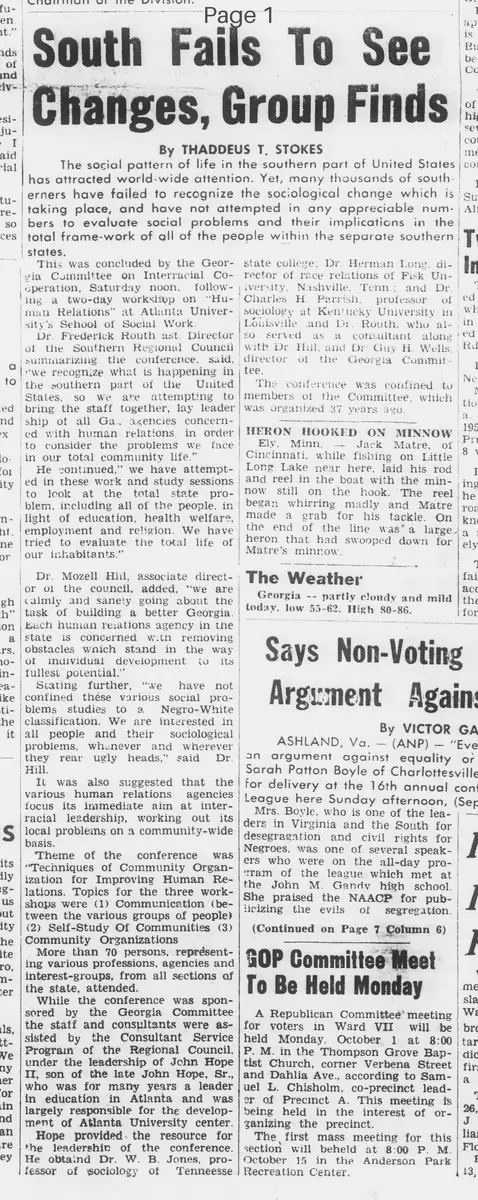
By THADDEUS T. STOKES
The social pattern of life in the southern part of United States has attracted world-wide attention. Yet, many thousands of southerners have failed to recognize the sociological change which is taking place, and have not attempted in any appreciable numbers to evaluate social problems and their implications in the total frame-work of all of the people within the separate southern states.
This was concluded by the Georgia Committee on Interracial Cooperation, Saturday noon, following a two-day workshop on "Human Relations" at Atlanta University's School of Social Work.
Dr. Frederick Routh as Director of the Southern Regional Council summarizing the conference, said. 'we recognize what is happening in the southern part of the United States, so we are attempting to bring the staff together, lay leadership of all Ga, agencies concerned with human relations in order to consider the problems we face in our total community life."
He continued." we have attempted in these work and study sessions to look at the total state problem. including all of the people, in light of education, health welfare, employment and religion. We have tried to evaluate the total life of our inhabitants."
Dr. Mozell Hill, associate director of the council, added, "we are calmly and sanely going about the task of building a better Georgia. Each human relations agency in the state is concerned with removing obstacles which stand in the way of individual development to its fullest potential."
Stating further, "we have not confined these various social problems studies to a Negro-White classification. We are interested in all people and their sociological problems, whenever and wherever they rear ugly heads," said Dr Hill.
It was also suggested that the various human relations agencies focus its immediate aim at interracial leadership, working out its local problems on a community-wide basis.
Theme of the conference was "Techniques of Community Organization for Improving Human Relations. Topics for the three workshops were (i) Communication (between the various groups of people) (2) Self-Study Of Communities (3) Community Organizations
More than 70 persons. representing various professions, agencies and interest-groups, from all sections of the state, attended.
While the conference was sponsored by the Georgia Committee the staff and consultants were assisted by the Consultant Service Program of the Regional Council. under the leadership of John Hope II. son of the late John Hope. Sr.. who was for many years a leader in education in Atlanta and was largely responsible for the development of Atlanta University center.
Hope provided. the resource for the leadership of the conference. He obtained Dr. W. B. Jones, professor of sociology of Tennessee state college. Dr Herman Long. director of race relations of Fisk University. Nashville. Tenn: and Dr Charles H.Parrish. professor of sociology at Kentucky University in Louisville and D Routh, who also served as a consultant along with Dr Hill. and Dr Guy H Wells director of the Georgia Committee.
The conference was confined to members of the Committee. which was organized 37 years ago
What sub-type of article is it?
What themes does it cover?
What keywords are associated?
What entities or persons were involved?
Where did it happen?
Story Details
Key Persons
Location
Atlanta University's School Of Social Work, Georgia, Southern United States
Event Date
Saturday Noon Following A Two Day Workshop
Story Details
The Georgia Committee on Interracial Cooperation held a two-day workshop on 'Human Relations' at Atlanta University's School of Social Work, concluding that many southerners fail to recognize sociological changes. The conference focused on community organization techniques, education, health, welfare, employment, and religion, aiming to build better human relations for all people in Georgia.