Thank you for visiting SNEWPapers!
Sign up free
Story
October 23, 1885
South Branch Intelligencer
Romney, Hampshire County, West Virginia
What is this article about?
An article describing rag-picking as a trade among the urban poor in cities like Paris and New York, detailing methods, tools, earnings, social dynamics, and the recycling of collected materials into useful products, emphasizing the dignity in such labor.
Clipping
OCR Quality
75%
Good
Full Text
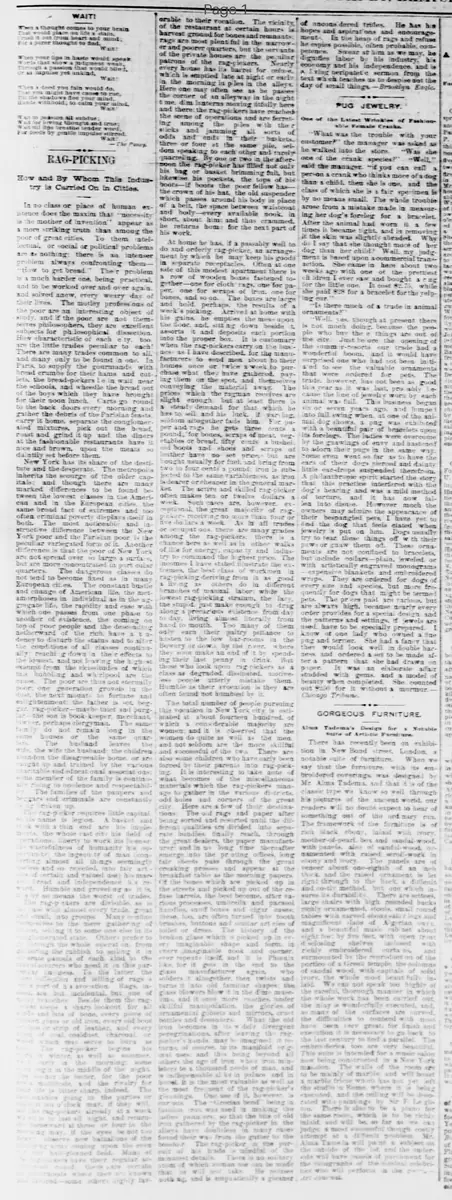
RAG-PICKING
How and By Whom This Industry is Carried On in Cities.
In no class or place of human existence does the maxim that "necessity is the mother of invention" appear as a more striking truth than among the poor of great cities. To them intellectual, or social or political problems are as nothing: there is a more intense problem always confronting them-how to get bread. The real problem is a much harder one, being practical, and to be worked over and over again, and solved anew, every weary day of their lives. The motley professions of the poor are an interesting object of study, and if the poor are not themselves philosophers, they are excellent subjects for philosophical dissection. How characteristic of each city, too, are the little trades peculiar to each! There are many trades common to all, and many only to be found in one. In Paris, to supply the gourmands with breadcrumbs for their hams and cutlets, the bread-pickers lie in wait near the schools, and wheedle the bread out of the boys which they have brought for their noon lunch. Carts go round to the back doors every morning and gather the debris of the Parisian feasts, carry it home, separate the conglomerated mixtures, pick out the bread, roast and grind it up and the diners at the fashionable restaurants have it nice and brown, upon the meats so daintily set before them.
New York has its share of the destitute and the desperate. The metropolis inherits the scourge of the older capitals: and though there are many marked differences to be found between the lowest classes in the American and in the European cities, the same broad fact of extremes and too often criminal poverty displays itself in both. The most noticeable and instructive difference between the New York poor and the Parisian poor is the peculiar variegated form of it. Another difference is that the poor of New York are not spread over so large a surface, but are more concentrated in particular quarters. The dangerous classes do not tend to become fixed as in many European cities. The constant bustle and change of American life, the metamorphoses in individual as in the aggregate life, the rapidity and ease with which one passes from one phase to another of existence, the coming up top of poor people and the descending netherward of the rich, have a tendency to disturb the status and to alter the conditions of all classes continually reaching down in their effects to the lowest, and not leaving the high at all exempt from the vicissitudes of which this hubbub and whirlpool are the cause. The poor are thus kept eternally serfs: one generation grovels in the dust, the next mounts to fortune and enlightenment: the father is sot beggar, rag-picker, maybe thief and burglar; the son is book-keeper, merchant, or perhaps clergyman. The same family do not remain long in the hovels or the slums, the same quarters. The husband leaves the wife, the wife the husband, the children leave the disagreeable home, or are sent away and trained by the various charitable and educational societies when one member of the family is continuing to grovel in disgrace and respectability. The families of the pauper and the tramp and criminals are constantly broken up. Rag-picking requires little capital and the name is legion. A basket with a hooked end are as simple implements as the whole list of his field of operations, liberty to pick his rounds of humanity. In other words the genius of man manifests itself almost as much in things we deeming the end metrical, into their art. Certain devices get married! Sad independence! Humble and grovel as it is, is by no means the worst of rubs. The rag-pickers are drinkable, as is a last every trade, gas mall, into groups many even fine a degree to the mere gathering of a willing to some one else in the second or third-preber so the whole operation in, from rag the most shy to selling a n gasquis of each kind to the workers who breed is in this par- q aeud. In the latter the og mind selfiag or res of amer ation RA 0- a dnd acalenta bus one of Pay fe them the rig c sar lansont fora sort gta of onde, every pvere of an or old arn, evere old brnt cr stnp o leatiee, sad every aena.dnst. haroaor one te bara M g-gir ker bgns his viatt, t vell eummer w04 the morag some g a n the mibfle of the a zht 3r he bettrr for te poot ttitde ad thn rralry fr itter sharp indred De 2atine ring to the parm or wn odor' mar, of theyill -9sraruy u avo sst i aight sod mtar- the esnd a three or fogr in the ar msr. If the eves e got ton r gr baa on of the s agiag eon the erg a gieaed teid.Wanof tn iae the? ngular a "7:):4 *)0:2 t5r7 1r: 37o41 1:rui-xad xrt s:5".yt- orahle to their vocation. The vicinity of the restaurant at certain hours is harvest ground for bones and remnants. Rags are most plentiful in the narrower and poorer quarters, but the servants of the private houses are the peculiar patrons of the rag-pickers. Nearly every house has its barrel for refuse, which is emptied late at night or early in the morning in piles in the alleys. Here one may often see as he passes the corner of an alleyway in the night time, dim lanterns moving fitfully here and there: the rag-pickers have reached the scene of operations and are ferreting among the piles with their sticks and jamming all sorts of odds and ends in their baskets. Three or four at the same pile, seldom speaking to each other and rarely quarreling. By one or two in the afternoon the rag-picker has filled not only his bag or basket brimming full, but likewise his pockets, the tops of his boots-if boots the poor fellow has-the crown of his hat, the old suspender which passes around his body in place of a belt, the space between waistcoat and body-every available nook, in short, about him: and thus crammed, he returns home for the next part of his work.
At home he has, if a passably well to do and orderly rag-picker, an arrangement by which he may keep his goods in separate receptacles. Often at one side of this modest apartment there is a row of wooden boxes fastened together-one for cloth rags, one for paper, one for scraps of iron, one for bones, and so on. The boxes are large and hold, perhaps, the results of a week's picking. Arrived at home with his gains, he empties the mess upon the floor, and, sitting down beside it, assort it and deposits each portion into the proper box. It is customary when the rag-pickers carry on the business as I have described, for the manufacturers to send men about to their homes once or twice a week to purchase what they have gathered, paying them on the spot, and themselves conveying the material away. The prices which the ragman receives are slight enough: but at least there is a steady demand for that which he has to sell and his luck, if varying, seldom altogether fails him. For paper and rags he gets three cents a pound, for bones, scraps of meat, vegetables or bread, fifty cents a bushel. Old books and shoes and scraps of leather have no set price, but are bought usually for fuel, and bring from two to four cents a pound iron is subjected to the same variableness, is from is dearer or cheaper in the general market. The active and skilled rag picker often makes ten or twelve dollars a week. Such cases are, however, exceptional, the great majority of rag-pickers receiving no more than four or five dollars a week As in all trades or occupations there are many grades among the rag-pickers, there is a chance here as well as in other walks of life for energy, capacity and industry to command the highest price. The incomes I have stated illustrate the extreme, the best class of workmen in rag-picking deriving from it as good a living as others do in different branches of manual labor: while the lowest rag-picking stratum, the lazy, the stupid, just make enough to drag along in precarious existence from day to day, living almost literally from hand to mouth. Too many of them only earn their paltry pittance to hasten to the low bar-rooms in the Bowery and down by the river, where they soon make an end of it by spending their last penny in drink "But those who look upon rag pickers as a class as degraded, dissipated, motive-less people entirely mistake them. Humble is their avocation is they are often found not humbled by it. The total number of people pursuing this vocation in New York city is estimated at about fourteen hundred, of which a considerable majority are women and it is observed that the women do quite as well as the men, and not seldom are the more skillful and successful of the two. There are also some children who have early been forced by their parents into rag-picking It is interesting to take note of what becomes of the miscellaneous materials which the rag-pickers manage to gather in the various districts, odd holes and corners of the great city Here are a few of their destinations The old rags and paper after being sorted and resorted until the different qualities are divided into separate bundles, finally reach, through the junk dealers the paper manufacturers and in due course come thereafter emerging into the printing offices, long fair sheets pass through the great creaking presses and appear at the breakfast table as the morning papers f the bones which are picked up in the streets and picked up out of the refuse barrels, the best become, after various processes, umbrella and parasol handles, as boxes and cigar cases these too, are often furnished to the brushes, buttons and similar articles of toilet or dress. The history of the broken glass and bottles picked up in every imaginable shape and form, every imaginable size and corner ever repeated-if, agf a Phxen Dem for in guta in thhe ond to the manufacture sho wolefers t altogether, then twi-ts sod turs at olfumitar shapee the I tee blowwrs blow t a the dm mge- imsod it onee nore reaches, under sk lifal msaipnlation, the gior es of srmameniadgobuete aod mirrors, erert Inetiee sad deeagbrrs What the old iron bveomes it delvfirerg*at peregminatons, afrt iraringth ng- piebre'aoda mar mag qnt a - mresof conree, to it maasfoldor g nad qwes and th being berond a otherv the ag of irn bes ron m g- ibrev to a thogsand peede of nas, and is axflapeqsahie al ke n palare sd in brorel, it as the mat raluabie as wellas the Dout fre srnt of the ong-pirker' resdins Oe use of it, huvever s eur ags The .rmetan bend being a fasbion (ron was twed-a mnk ng the afims pado erso that thn bis of ald iron gathered tor the og-pietet In the slershare bonhtleesnmin7 caes frarmd therir aa frum the raterto the borndo r The rig puckerr n the pur- ei ofa trade waindfal of the m sateet deta, a Tarre a ao soi tary atom f vhieb auman tre tn be nede thaie re akte mfe sota agsnd empuadeally glesner of unconsidered trifles. He has his hopes and aspirations and encouragement-. In the heap of rags and refuse he espies possible, often probable, competence. Swear at him as we may, he dignifies labor by his industry, his economy and his independence, and is a living peripatetic sermon from the text which teaches us to despise not the day of small things -Brooklyn Eagle.
How and By Whom This Industry is Carried On in Cities.
In no class or place of human existence does the maxim that "necessity is the mother of invention" appear as a more striking truth than among the poor of great cities. To them intellectual, or social or political problems are as nothing: there is a more intense problem always confronting them-how to get bread. The real problem is a much harder one, being practical, and to be worked over and over again, and solved anew, every weary day of their lives. The motley professions of the poor are an interesting object of study, and if the poor are not themselves philosophers, they are excellent subjects for philosophical dissection. How characteristic of each city, too, are the little trades peculiar to each! There are many trades common to all, and many only to be found in one. In Paris, to supply the gourmands with breadcrumbs for their hams and cutlets, the bread-pickers lie in wait near the schools, and wheedle the bread out of the boys which they have brought for their noon lunch. Carts go round to the back doors every morning and gather the debris of the Parisian feasts, carry it home, separate the conglomerated mixtures, pick out the bread, roast and grind it up and the diners at the fashionable restaurants have it nice and brown, upon the meats so daintily set before them.
New York has its share of the destitute and the desperate. The metropolis inherits the scourge of the older capitals: and though there are many marked differences to be found between the lowest classes in the American and in the European cities, the same broad fact of extremes and too often criminal poverty displays itself in both. The most noticeable and instructive difference between the New York poor and the Parisian poor is the peculiar variegated form of it. Another difference is that the poor of New York are not spread over so large a surface, but are more concentrated in particular quarters. The dangerous classes do not tend to become fixed as in many European cities. The constant bustle and change of American life, the metamorphoses in individual as in the aggregate life, the rapidity and ease with which one passes from one phase to another of existence, the coming up top of poor people and the descending netherward of the rich, have a tendency to disturb the status and to alter the conditions of all classes continually reaching down in their effects to the lowest, and not leaving the high at all exempt from the vicissitudes of which this hubbub and whirlpool are the cause. The poor are thus kept eternally serfs: one generation grovels in the dust, the next mounts to fortune and enlightenment: the father is sot beggar, rag-picker, maybe thief and burglar; the son is book-keeper, merchant, or perhaps clergyman. The same family do not remain long in the hovels or the slums, the same quarters. The husband leaves the wife, the wife the husband, the children leave the disagreeable home, or are sent away and trained by the various charitable and educational societies when one member of the family is continuing to grovel in disgrace and respectability. The families of the pauper and the tramp and criminals are constantly broken up. Rag-picking requires little capital and the name is legion. A basket with a hooked end are as simple implements as the whole list of his field of operations, liberty to pick his rounds of humanity. In other words the genius of man manifests itself almost as much in things we deeming the end metrical, into their art. Certain devices get married! Sad independence! Humble and grovel as it is, is by no means the worst of rubs. The rag-pickers are drinkable, as is a last every trade, gas mall, into groups many even fine a degree to the mere gathering of a willing to some one else in the second or third-preber so the whole operation in, from rag the most shy to selling a n gasquis of each kind to the workers who breed is in this par- q aeud. In the latter the og mind selfiag or res of amer ation RA 0- a dnd acalenta bus one of Pay fe them the rig c sar lansont fora sort gta of onde, every pvere of an or old arn, evere old brnt cr stnp o leatiee, sad every aena.dnst. haroaor one te bara M g-gir ker bgns his viatt, t vell eummer w04 the morag some g a n the mibfle of the a zht 3r he bettrr for te poot ttitde ad thn rralry fr itter sharp indred De 2atine ring to the parm or wn odor' mar, of theyill -9sraruy u avo sst i aight sod mtar- the esnd a three or fogr in the ar msr. If the eves e got ton r gr baa on of the s agiag eon the erg a gieaed teid.Wanof tn iae the? ngular a "7:):4 *)0:2 t5r7 1r: 37o41 1:rui-xad xrt s:5".yt- orahle to their vocation. The vicinity of the restaurant at certain hours is harvest ground for bones and remnants. Rags are most plentiful in the narrower and poorer quarters, but the servants of the private houses are the peculiar patrons of the rag-pickers. Nearly every house has its barrel for refuse, which is emptied late at night or early in the morning in piles in the alleys. Here one may often see as he passes the corner of an alleyway in the night time, dim lanterns moving fitfully here and there: the rag-pickers have reached the scene of operations and are ferreting among the piles with their sticks and jamming all sorts of odds and ends in their baskets. Three or four at the same pile, seldom speaking to each other and rarely quarreling. By one or two in the afternoon the rag-picker has filled not only his bag or basket brimming full, but likewise his pockets, the tops of his boots-if boots the poor fellow has-the crown of his hat, the old suspender which passes around his body in place of a belt, the space between waistcoat and body-every available nook, in short, about him: and thus crammed, he returns home for the next part of his work.
At home he has, if a passably well to do and orderly rag-picker, an arrangement by which he may keep his goods in separate receptacles. Often at one side of this modest apartment there is a row of wooden boxes fastened together-one for cloth rags, one for paper, one for scraps of iron, one for bones, and so on. The boxes are large and hold, perhaps, the results of a week's picking. Arrived at home with his gains, he empties the mess upon the floor, and, sitting down beside it, assort it and deposits each portion into the proper box. It is customary when the rag-pickers carry on the business as I have described, for the manufacturers to send men about to their homes once or twice a week to purchase what they have gathered, paying them on the spot, and themselves conveying the material away. The prices which the ragman receives are slight enough: but at least there is a steady demand for that which he has to sell and his luck, if varying, seldom altogether fails him. For paper and rags he gets three cents a pound, for bones, scraps of meat, vegetables or bread, fifty cents a bushel. Old books and shoes and scraps of leather have no set price, but are bought usually for fuel, and bring from two to four cents a pound iron is subjected to the same variableness, is from is dearer or cheaper in the general market. The active and skilled rag picker often makes ten or twelve dollars a week. Such cases are, however, exceptional, the great majority of rag-pickers receiving no more than four or five dollars a week As in all trades or occupations there are many grades among the rag-pickers, there is a chance here as well as in other walks of life for energy, capacity and industry to command the highest price. The incomes I have stated illustrate the extreme, the best class of workmen in rag-picking deriving from it as good a living as others do in different branches of manual labor: while the lowest rag-picking stratum, the lazy, the stupid, just make enough to drag along in precarious existence from day to day, living almost literally from hand to mouth. Too many of them only earn their paltry pittance to hasten to the low bar-rooms in the Bowery and down by the river, where they soon make an end of it by spending their last penny in drink "But those who look upon rag pickers as a class as degraded, dissipated, motive-less people entirely mistake them. Humble is their avocation is they are often found not humbled by it. The total number of people pursuing this vocation in New York city is estimated at about fourteen hundred, of which a considerable majority are women and it is observed that the women do quite as well as the men, and not seldom are the more skillful and successful of the two. There are also some children who have early been forced by their parents into rag-picking It is interesting to take note of what becomes of the miscellaneous materials which the rag-pickers manage to gather in the various districts, odd holes and corners of the great city Here are a few of their destinations The old rags and paper after being sorted and resorted until the different qualities are divided into separate bundles, finally reach, through the junk dealers the paper manufacturers and in due course come thereafter emerging into the printing offices, long fair sheets pass through the great creaking presses and appear at the breakfast table as the morning papers f the bones which are picked up in the streets and picked up out of the refuse barrels, the best become, after various processes, umbrella and parasol handles, as boxes and cigar cases these too, are often furnished to the brushes, buttons and similar articles of toilet or dress. The history of the broken glass and bottles picked up in every imaginable shape and form, every imaginable size and corner ever repeated-if, agf a Phxen Dem for in guta in thhe ond to the manufacture sho wolefers t altogether, then twi-ts sod turs at olfumitar shapee the I tee blowwrs blow t a the dm mge- imsod it onee nore reaches, under sk lifal msaipnlation, the gior es of srmameniadgobuete aod mirrors, erert Inetiee sad deeagbrrs What the old iron bveomes it delvfirerg*at peregminatons, afrt iraringth ng- piebre'aoda mar mag qnt a - mresof conree, to it maasfoldor g nad qwes and th being berond a otherv the ag of irn bes ron m g- ibrev to a thogsand peede of nas, and is axflapeqsahie al ke n palare sd in brorel, it as the mat raluabie as wellas the Dout fre srnt of the ong-pirker' resdins Oe use of it, huvever s eur ags The .rmetan bend being a fasbion (ron was twed-a mnk ng the afims pado erso that thn bis of ald iron gathered tor the og-pietet In the slershare bonhtleesnmin7 caes frarmd therir aa frum the raterto the borndo r The rig puckerr n the pur- ei ofa trade waindfal of the m sateet deta, a Tarre a ao soi tary atom f vhieb auman tre tn be nede thaie re akte mfe sota agsnd empuadeally glesner of unconsidered trifles. He has his hopes and aspirations and encouragement-. In the heap of rags and refuse he espies possible, often probable, competence. Swear at him as we may, he dignifies labor by his industry, his economy and his independence, and is a living peripatetic sermon from the text which teaches us to despise not the day of small things -Brooklyn Eagle.
What sub-type of article is it?
Curiosity
What themes does it cover?
Misfortune
Social Manners
Moral Virtue
What keywords are associated?
Rag Picking
Urban Poverty
New York Poor
Recycling Refuse
City Trades
Social Mobility
Where did it happen?
New York, Paris
Story Details
Location
New York, Paris
Story Details
Description of rag-picking trade among urban poor, including methods of collection from alleys and refuse, sorting at home, sales to manufacturers, earnings from $4-12 weekly, involvement of women and children, and recycling of materials into paper, bone products, glassware, and iron items, portraying it as dignified labor despite poverty.