Thank you for visiting SNEWPapers!
Sign up free
Kentucky Gazette And General Advertiser
Lexington, Fayette County, Kentucky
What is this article about?
Thomas Bodley defends his criticisms of Humphrey Marshall in the Kentucky Gazette, accusing him of promoting the anti-republican Western World, personal slander, past perjury, betraying constituents in the Virginia Convention and British treaty ratification, and altering land entries. He refutes Marshall's attacks on his connections to John Fowler and Harry Innes, denying any Spanish Conspiracy involvement.
Clipping
OCR Quality
Full Text
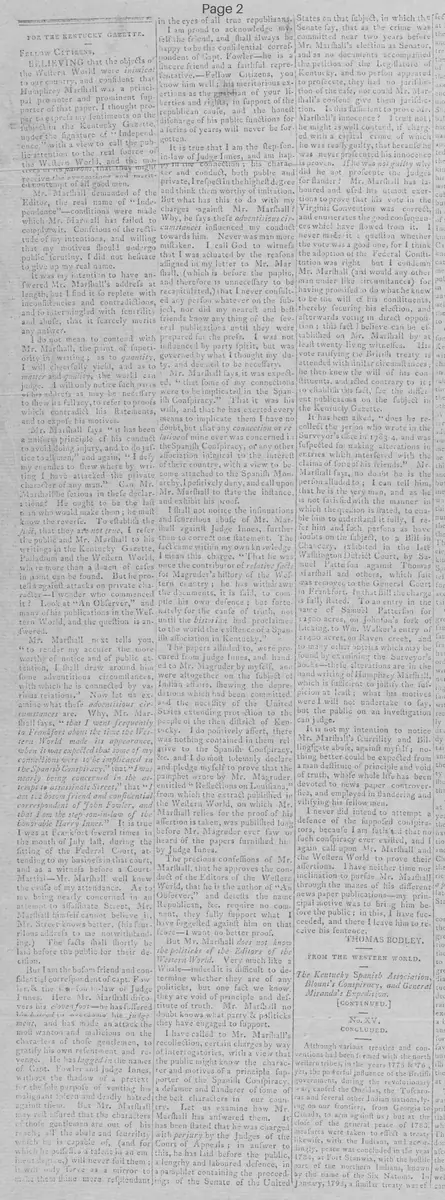
Fellow Citizens,
BELIEVING that the objects of the Western World were inimical to our country, and confident that Humphrey Marshall was a principal promoter and prominent supporter of that paper, I thought proper to express my sentiments on the subject in the Kentucky Gazette. Hence, with a view to call the public attention to the real source of the Western World, and the more effectually to expose the demerits of its patrons, that they might be held in the contempt of all good men.
Mr. Marshall demanded of the Editor, the real name of "Independence"—conditions were made which Mr. Marshall has failed to comply with. Conscious of the rectitude of my intentions, and willing that my motives should undergo public scrutiny, I did not hesitate to give up my real name.
It was my intention to have answered Mr. Marshall's address at length, but I find it so replete with inconsistencies and contradictions, and so intermingled with scurrility and abuse, that it scarcely merits any answer.
I do not mean to contend with Mr. Marshall, the point of superiority in writing; as to quantity, I will cheerfully yield, and as to matter and quality, the world can judge. I will only notice such parts of his address as may be necessary to show its fallacy, to refer to proofs which contradict his statements, and to expose his motives.
Mr. Marshall says "it has been a uniform principle of his conduct to avoid doing injury, and to do justice to all men," and again, "I defy my enemies to show where by writing I have attacked the private character of any man." Can Mr. Marshall be serious in these declarations? He ought to be the last man who would make them; he must know the reverse. To establish the fact, that they are not true, I refer the public and Mr. Marshall to his writings in the Kentucky Gazette, Palladium and the Western World, where more than a dozen of cases in point can be found. But he protests against attacks on private character—I wonder who commenced it? Look at "An Observer," and many of his publications in the Western World, and the question is answered.
Mr. Marshall next tells you, "to render my accuser the more worthy of notice and of public attention, I shall draw around him some adventitious circumstances, with which he is connected by various relations." Now let us examine what these adventitious circumstances are. Why, Mr. Marshall says, "that I went frequently to Frankfort about the time the Western World made its appearance, when it was expected that some of my connections were to be implicated in the Spanish Conspiracy," that "I was nearly being concerned in the attempt to assassinate Street," that "I am the bosom friend and confidential correspondent of John Fowler, and that I am the step son-in-law of the honorable Harry Innes." It is true I was at Frankfort several times in the month of July last, during the sitting of the Federal Court, attending to my business in that court, and as a witness before a Court-Martial—Mr. Marshall well knew the cause of my attendance. As to my being nearly concerned in an attempt to assassinate Street, Mr. Marshall himself cannot believe it. Mr. Street knows better. (His scurrilous address to me notwithstanding.) The facts shall shortly be laid before the public for their decision.
But I am the bosom friend and confidential correspondent of Capt. Fowler, & the son-in-law of Judge Innes. Here Mr. Marshall discovers his cloven foot—he has suffered his spleen to overcome his judgment, and has made an attack the most wanton and malicious on the characters of those gentlemen, to gratify his own resentment and revenge. He has dragged in the names of Capt. Fowler and Judge Innes, without the shadow of a pretext for the sole purpose of venting his malignant spleen and deadly hatred against them. But Mr. Marshall may rest assured that the characters of those gentlemen are out of his reach, all the abuse and scurrility which he is capable of, (and for which he possesses a talent in an eminent degree,) will never soil them; it will only serve as a mirror to make them shine more resplendent in the eyes of all true republicans.
I am proud to acknowledge myself the friend, and shall always be happy to be the confidential correspondent of Capt. Fowler—he is a sincere friend and a faithful representative.—Fellow Citizens, you know him well; his meritorious exertions as the guardian of your liberties and rights, in support of the republican cause, and the honest discharge of his public functions for a series of years, will never be forgotten.
It is true that I am the step-son-in-law of Judge Innes, and am happy in the connection; his character and conduct, both public and private, I respect in the highest degree and think them worthy of imitation.
But what has this to do with my charges against Mr. Marshall? Why, he says these adventitious circumstances influenced my conduct towards him. Never was man more mistaken. I call God to witness that I was actuated by the reasons assigned in my letter to Mr. Marshall, (which is before the public, and therefore is unnecessary to be recapitulated,) that I never consulted any person whatever on the subject, nor did my nearest and best friends know any thing of the several publications until they were prepared for the press. I was not influenced by party spirit, but was governed by what I thought my duty, and deemed to be necessary.
Mr. Marshall says it was expected, "that some of my connections were to be implicated in the Spanish Conspiracy." That it was his wish, and that he has exerted every means to implicate them I have no doubt, but that any connection or relative of mine ever was concerned in the Spanish Conspiracy, or any other association inimical to the interest of their country, with a view to become attached to the Spanish Monarchy, I positively deny, and call upon Mr. Marshall to state the instance, and exhibit his proof.
I shall not notice the insinuations and scurrilous abuse of Mr. Marshall against Judge Innes, further than to correct one statement. The fact came within my own knowledge I mean this charge, "That he was once the contributor of relative facts for Magruder's history of the Western country; he has withdrawn the documents, it is said, to compile his own defence; but fortunately for the cause of truth, not until the historian had proclaimed to the world the existence of a Spanish association in Kentucky."
The papers alluded to, were procured from Judge Innes, and handed to Mr. Magruder by myself, and were altogether on the subject of Indian affairs, showing the depredations which had been committed, and the necessity of the United States extending protection to the people of the then district of Kentucky. I do positively assert, there was nothing contained in them relative to the Spanish Conspiracy, &c. and I do most solemnly declare and pledge myself to prove that the pamphlet wrote by Mr. Magruder entitled "Reflections on Louisiana," from which the extract published in the Western World, on which Mr. Marshall relies for the proof of his assertion is taken, was published long before Mr. Magruder ever saw or heard of the papers furnished him by Judge Innes.
The precious confessions of Mr. Marshall, that he approves the conduct of the Editors of the Western World, that he is the author of "An Observer," and detests the name Republican, &c. require no comment, they fully support what I have suggested against him on that score—I want no better proof.
But Mr. Marshall does not know the politics of the Editors of the Western World. Very much like a whale—indeed it is difficult to determine whether they are of any politics, but one fact we know, they are void of principle and destitute of truth. Mr. Marshall no doubt knows what party & politics they have engaged to support.
I have called to Mr. Marshall's recollection, certain charges by way of interrogatories, with a view that the public might know the character and motives of a principal supporter of the Spanish Conspiracy, a defamer and slanderer of some of the best characters in our country. Let us examine how Mr. Marshall has answered them.
It has been stated that he was charged with perjury by the Judges of the Court of Appeals; in answer to this, he has laid before the public, a lengthy and laboured defence, in a pamphlet containing the proceedings of the Senate of the United States on that subject, in which the Senate say, that as the crime was committed near two years before Mr. Marshall's election as Senator, and as no documents accompanied the petition of the Legislature of Kentucky, and no person appeared to prosecute, they had no jurisdiction of the case, nor could Mr. Marshall's consent give them jurisdiction. Is this sufficient to prove Mr. Marshall's innocence? I trust not: he might as well contend, if charged with a capital crime of which he was really guilty, that because he was never prosecuted his innocence is proven. If he was not guilty why did he not prosecute the Judges for slander? Mr. Marshall has laboured and used his utmost exertions to prove that his vote in the Virginia Convention was correct, and enumerates the good consequences which have flowed from it. I never made it a question whether the vote was a good one, for I think the adoption of the Federal Constitution was right but I condemn Mr. Marshall (and would any other man under like circumstances) for having promised to do what he knew to be the will of his constituents, thereby securing his election, and afterwards voting in direct opposition; this fact I believe can be established on Mr. Marshall by at least twenty living witnesses.
His vote ratifying the British treaty is attended with similar circumstances; he then knew the will of his constituents, and acted contrary to it; to establish this fact, see the different publications on the subject in the Kentucky Gazette.
It has been asked, "does he recollect the person who wrote in the Surveyor's office in 1783-4, and was suspected of making alterations in entries which interfered with the claims of some of his friends." Mr. Marshall says, no doubt he is the person alluded to; I can tell him, that he is the very man, and as he is not satisfied with the manner in which the question is stated, to enable him to understand it fully, I refer him and such persons as have doubts on the subject, to a Bill in Chancery, exhibited in the late Washington District Court, by Samuel Patterson against Thomas Marshall and others, which suit was removed to the General Court in Frankfort. In that Bill the charge is fully stated. To an entry in the name of Samuel Patterson for 12500 acres, on Johnson's fork of Licking, to Wm. Walker's entry of 21400 acres, on Raven creek, and to many other entries which may be found by examining the Surveyor's books—these alterations are in the hand writing of Humphrey Marshall, which is sufficient to justify the suspicion at least; what his motives were I will not undertake to say, but the public on an investigation can judge.
It is not my intention to notice Mr. Marshall's scurrility and Billingsgate abuse, against myself; nothing better could be expected from a man destitute of principle and void of truth, whose whole life has been devoted to newspaper controversies, and employed in slandering and vilifying his fellow men.
I never did intend to attempt a defence of the supposed conspirators, because I am satisfied that no such conspiracy ever existed, and I again call upon Mr. Marshall and the Western World to prove their assertions. I have neither time nor inclination to pursue Mr. Marshall through the mazes of his different newspaper publications—my principal motive was to bring him before the public; in this, I have succeeded, and there I leave him to receive his sentence.
THOMAS BODLEY.
What sub-type of article is it?
What themes does it cover?
What keywords are associated?
What entities or persons were involved?
Letter to Editor Details
Author
Thomas Bodley
Recipient
Fellow Citizens
Main Argument
bodley refutes humphrey marshall's defenses and personal attacks, exposing marshall's support for the anti-republican western world, his history of slander, perjury charges, betrayal of constituents in key votes, and suspected land fraud, while denying any spanish conspiracy ties among his associates.
Notable Details