Thank you for visiting SNEWPapers!
Sign up free
Editorial
March 25, 1852
The Mountain Sentinel
Ebensburg, Cambria County, Pennsylvania
What is this article about?
Editorial critiques a state Senate bill akin to the Maine Liquor Law banning alcohol sales and manufacture, opposing it on constitutional grounds while supporting anti-intemperance efforts that respect property rights. Quotes arguments from New York Courier and Enquirer on violations of search, seizure, due process, and trial rights.
Clipping
OCR Quality
95%
Excellent
Full Text
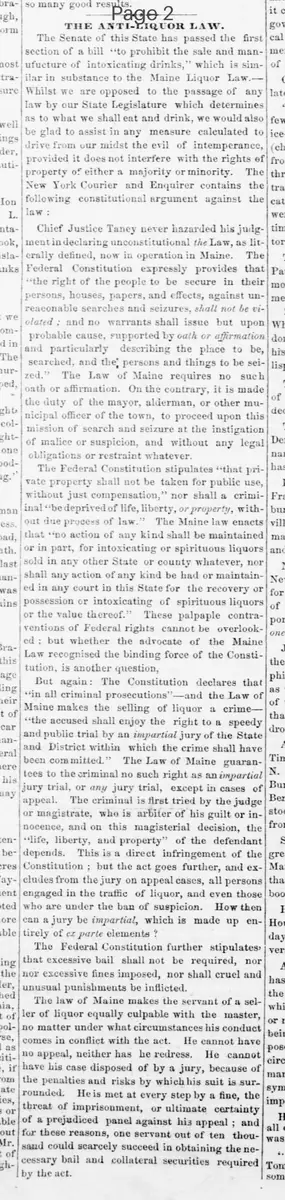
THE ANTI-LIQUOR LAW.
The Senate of this State has passed the first section of a bill "to prohibit the sale and manufacture of intoxicating drinks," which is similar in substance to the Maine Liquor Law. Whilst we are opposed to the passage of any Law by our State Legislature which determines as to what we shall eat and drink, we would also be glad to assist in any measure calculated to drive from our midst the evil of intemperance, provided it does not interfere with the rights of property of either a majority or minority. The New York Courier and Enquirer contains the following constitutional argument against the law:
Chief Justice Taney never hazarded his judgment in declaring unconstitutional the Law, as literally defined, now in operation in Maine. The Federal Constitution expressly provides that "the right of the people to be secure in their persons, houses, papers, and effects, against unreasonable searches and seizures, shall not be violated; and no warrants shall issue but upon probable cause, supported by oath or affirmation and particularly describing the place to be searched, and the persons and things to be seized." The Law of Maine requires no such oath or affirmation. On the contrary, it is made the duty of the mayor, alderman, or other municipal officer of the town, to proceed upon this mission of search and seizure at the instigation of malice or suspicion, and without any legal obligations or restraint whatever.
The Federal Constitution stipulates "that private property shall not be taken for public use, without just compensation," nor shall a criminal "be deprived of life, liberty, or property, without due process of law." The Maine law enacts that "no action of any kind shall be maintained or in part, for intoxicating or spirituous liquors sold in any other State or county whatever, nor shall any action of any kind be had or maintained in any court in this State for the recovery or possession or intoxicating of spirituous liquors or the value thereof." These palpable contraventions of Federal rights cannot be overlooked; but whether the advocate of the Maine Law recognised the binding force of the Constitution, is another question.
But again: The Constitution declares that "in all criminal prosecutions"-and the Law of Maine makes the selling of liquor a crime- "the accused shall enjoy the right to a speedy and public trial by an impartial jury of the State and District within which the crime shall have been committed." The Law of Maine guarantees to the criminal no such right as an impartial jury trial, or any jury trial, except in cases of appeal. The criminal is first tried by the judge or magistrate, who is arbiter of his guilt or innocence, and on this magisterial decision, the "life, liberty, and property" of the defendant depends. This is a direct infringement of the Constitution; but the act goes further, and excludes from the jury on appeal cases, all persons engaged in the traffic of liquor, and even those who are under the ban of suspicion. How then can a jury be impartial, which is made up entirely of ex parte elements?
The Federal Constitution further stipulates, that excessive bail shall not be required, nor excessive fines imposed, nor shall cruel and unusual punishments be inflicted.
The law of Maine makes the servant of a seller of liquor equally culpable with the master, no matter under what circumstances his conduct comes in conflict with the act. He cannot have no appeal, neither has he redress. He cannot have his case disposed of by a jury, because of the penalties and risks by which his suit is surrounded. He is met at every step by a fine, the threat of imprisonment, or ultimate certainty of a prejudiced panel against his appeal; and for these reasons, one servant out of ten thousand could scarcely succeed in obtaining the necessary bail and collateral securities required by the act.
The Senate of this State has passed the first section of a bill "to prohibit the sale and manufacture of intoxicating drinks," which is similar in substance to the Maine Liquor Law. Whilst we are opposed to the passage of any Law by our State Legislature which determines as to what we shall eat and drink, we would also be glad to assist in any measure calculated to drive from our midst the evil of intemperance, provided it does not interfere with the rights of property of either a majority or minority. The New York Courier and Enquirer contains the following constitutional argument against the law:
Chief Justice Taney never hazarded his judgment in declaring unconstitutional the Law, as literally defined, now in operation in Maine. The Federal Constitution expressly provides that "the right of the people to be secure in their persons, houses, papers, and effects, against unreasonable searches and seizures, shall not be violated; and no warrants shall issue but upon probable cause, supported by oath or affirmation and particularly describing the place to be searched, and the persons and things to be seized." The Law of Maine requires no such oath or affirmation. On the contrary, it is made the duty of the mayor, alderman, or other municipal officer of the town, to proceed upon this mission of search and seizure at the instigation of malice or suspicion, and without any legal obligations or restraint whatever.
The Federal Constitution stipulates "that private property shall not be taken for public use, without just compensation," nor shall a criminal "be deprived of life, liberty, or property, without due process of law." The Maine law enacts that "no action of any kind shall be maintained or in part, for intoxicating or spirituous liquors sold in any other State or county whatever, nor shall any action of any kind be had or maintained in any court in this State for the recovery or possession or intoxicating of spirituous liquors or the value thereof." These palpable contraventions of Federal rights cannot be overlooked; but whether the advocate of the Maine Law recognised the binding force of the Constitution, is another question.
But again: The Constitution declares that "in all criminal prosecutions"-and the Law of Maine makes the selling of liquor a crime- "the accused shall enjoy the right to a speedy and public trial by an impartial jury of the State and District within which the crime shall have been committed." The Law of Maine guarantees to the criminal no such right as an impartial jury trial, or any jury trial, except in cases of appeal. The criminal is first tried by the judge or magistrate, who is arbiter of his guilt or innocence, and on this magisterial decision, the "life, liberty, and property" of the defendant depends. This is a direct infringement of the Constitution; but the act goes further, and excludes from the jury on appeal cases, all persons engaged in the traffic of liquor, and even those who are under the ban of suspicion. How then can a jury be impartial, which is made up entirely of ex parte elements?
The Federal Constitution further stipulates, that excessive bail shall not be required, nor excessive fines imposed, nor shall cruel and unusual punishments be inflicted.
The law of Maine makes the servant of a seller of liquor equally culpable with the master, no matter under what circumstances his conduct comes in conflict with the act. He cannot have no appeal, neither has he redress. He cannot have his case disposed of by a jury, because of the penalties and risks by which his suit is surrounded. He is met at every step by a fine, the threat of imprisonment, or ultimate certainty of a prejudiced panel against his appeal; and for these reasons, one servant out of ten thousand could scarcely succeed in obtaining the necessary bail and collateral securities required by the act.
What sub-type of article is it?
Temperance
Constitutional
What keywords are associated?
Anti Liquor Law
Maine Liquor Law
Constitutional Violations
Intemperance
Property Rights
Due Process
Jury Trial
Searches And Seizures
What entities or persons were involved?
Senate Of This State
Maine Liquor Law
Chief Justice Taney
New York Courier And Enquirer
Federal Constitution
Editorial Details
Primary Topic
Opposition To Anti Liquor Law On Constitutional Grounds
Stance / Tone
Opposed To The Law While Supportive Of Anti Intemperance Measures Respecting Property Rights
Key Figures
Senate Of This State
Maine Liquor Law
Chief Justice Taney
New York Courier And Enquirer
Federal Constitution
Key Arguments
Opposed To Laws Dictating Personal Consumption But Supportive Of Anti Intemperance Without Property Infringement
Maine Law Violates Right Against Unreasonable Searches And Seizures Without Probable Cause
Maine Law Denies Just Compensation For Private Property And Due Process
Maine Law Infringes On Right To Speedy Public Trial By Impartial Jury
Maine Law Imposes Excessive Fines And Cruel Punishments
Maine Law Holds Servants Equally Culpable Without Fair Appeal Or Jury Trial