Thank you for visiting SNEWPapers!
Sign up free
Editorial
December 27, 1810
The Enquirer
Richmond, Henrico County, Virginia
What is this article about?
A series of editorials by Jesse Atwater opposing the renewal of the First Bank of the United States' charter, due to expire on March 4, 1811. Argues against benefits to foreign stockholders, political influence, and economic harms, urging Congress to let it dissolve to protect republicanism.
Clipping
OCR Quality
95%
Excellent
Full Text
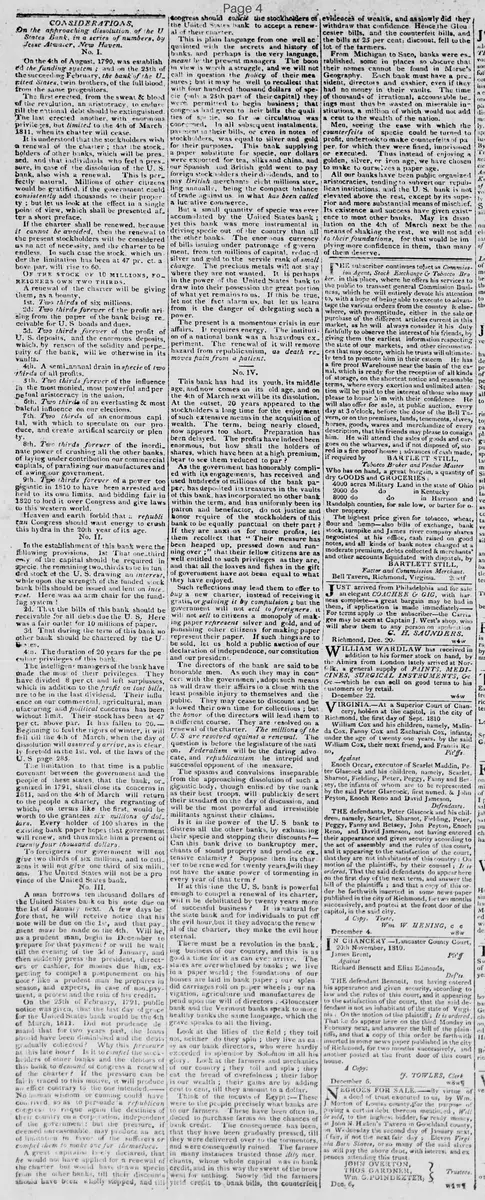
CONSIDERATIONS.
On the approaching dissolution of the United States Bank, in a series of numbers, by Jesse Atwater. New Haven.
No. I.
On the 4th of August, 1790, was established the funding system; and on the 25th of the succeeding February, the bank of the United States, twin brothers, of the full blood, from the same progenitors.
The first erected, from the sweat & blood of the revolution, an aristocracy, to endure till the national debt should be extinguished.
The last erected another, with enormous privileges, but limited to the 4th of March 1811, when its charter will cease.
It is understood that the stockholders wish a renewal of the charter: that the stockholders of other banks, which will be pressed, and that individuals who feel a pressure, in case of the dissolution of the U. S. bank, also wish a renewal. This is perfectly natural. Millions of other citizens would be gratified, if the government could consistently add thousands to their property; but let us look at the effect in a single point of view, which shall be presented after a short preface.
If the charter shall be renewed, because it cannot be avoided, then the renewal to the present stockholders will be considered as an act of necessity, and the charter to be endless. In such case the stock, which under the limitation has been at 47 pr. ct. above par, will rise to 60.
Of the stock of 10 millions, foreigners own two thirds.
A renewal of the charter will be giving them, as a bounty,
1st. Two thirds of six millions.
2d. Two thirds forever of the profit arising from the paper of the bank being receivable for U. S. bonds and dues.
3d. Two thirds forever of the profit of U. S. deposits, and the enormous deposits, which, by reason of the solidity and perpetuity of the bank, will be otherwise in its vaults.
4th. A semi-annual drain in specie of two thirds of all profits.
5th. Two thirds forever of the influence in the most monied, most powerful and perpetual aristocracy in the union.
6th. Two thirds of an everlasting most painful influence on our elections.
7th. Two thirds of an enormous capital, with which to speculate on our produce, and create artificial scarcity or plenty.
8th. Two thirds forever of the inordinate power of crushing all the other banks, of laying under contribution our commercial capitals, of paralyzing our manufactures and of awing our government.
9th. Two thirds forever of a power too gigantic in 1810 to have been arrested and held to its own limits, and bidding fair in 1820 to lord it over Congress and give laws to this western world.
Heaven and earth forbid that a republican Congress should want energy to crush this hydra in the 20th year of its age.
No. II.
In the establishment of this bank were the following provisions, 1st That one-third only of the capital should be required in specie, the remaining two-thirds to be in funded stock of the U.S. drawing an interest, while upon the strength of the funded stock bank bills should be issued and lent on interest. Here was an arm chair for the funding system!
2d. That the bills of this bank should be receivable for all debts due the U. S. Here was a fair outlet for 10 millions of paper.
3d That during the term of this bank no other bank should be chartered by the U. States.
4th. The duration of 20 years for the peculiar privileges of this bank
The intelligent managers of the bank have made the most of their privileges. They have divided 8 per ct and left surpluses, which in addition to the profit on lost bills, are to be in the last dividend. Their influence on our commercial, agricultural, manufacturing and political concerns has been without limit. Their stock has been at 47 per ct. above par. It has fallen to 20. Beginning to feel the rigors of winter, it will fall till the 4th of March, when the day of dissolution will assuredly arrive, as is clearly foretold in the 1st. vol. of the laws of the U.S page 285.
The limitation to that time is a public covenant between the government and the people of these states, that the bank, organized in 1791, shall close its concerns in 1811, and on the 4th of March will return to the people a charter, the regranting of which, on terms like the first, would be worth to the grantees six millions of dollars. Every holder of 100 shares in the existing bank paper hopes that government will renew, and thus make him a present of twenty four thousand dollars.
To foreigners our government will not give two thirds of six millions, and to citizens it will not give one third of six millions. The United States will not be a province of the United States bank.
No. III.
A man borrows ten thousand dollars of the United States bank on his note due on the 1st of January next. A few days before that, he will receive notice that his note will be due on the 1st, and that payment must be made on the 4th. Will he, as a prudent man, begin in December to prepare for that payment? or will he wait till the evening of the 3d of January, and then suddenly press the president, directors or cashier, for monies due him, expecting to compel a postponement on his note? like a prudent man he prepares in season, and expects, in case of non-payment, a protest and the ruin of his credit.
On the 25th of February, 1791, public notice was given, that the last day of grace for the United States bank would be the 4th of March, 1811. Did not prudence demand that for two years past, the loans should have been diminished and the debts gradually collected? Why this pressure at this late hour? Is it to compel the stockholders of other banks and the debtors of this bank to demand of Congress a renewal of the charter? If the pressure can be fairly traced to this motive, it will produce an effect contrary to the one intended,--
No human wisdom or cunning could have contrived, so as to persuade a republican Congress to reroute again the destinies of their country on a corporation independent of the government: but the pressure, if deemed unreasonable, may produce an act of legislation in favor of the sufferers or compel them to make one for themselves.
A great capitalist lately declared, that he would not have applied for a renewal of the charter but would have drawn specie from the other banks, till their discounts should have been wholly stopped, and till Congress should solicit the stockholders of the United States bank to accept a renewal of their charter.
This is plain language from one well acquainted with the secrets and history of banks, and perhaps is the very language, meant by the present managers The boon in view is worth a struggle, and we will not call in question the policy of their measures; but it may be well to recollect that with four hundred thousand dollars of specie (only a 25th part of their capital) they were permitted to begin business; that Congress had given to their bills the qualities of specie, so far as circulation was concerned. In all subsequent instalments, payment in their bills, or even in notes of stockholders, was equal to silver and gold for their purposes. This bank supplying a paper substitute for specie, our dollars were exported for tea, silks and china, and our Spanish and British gold went to pay foreign stockholders their dividends, and to pay British merchants eight millions sterling annually, being the constant balance of trade against us, in what has been called a lucrative commerce.
But a small quantity of specie was ever accumulated by the United States bank; yet this bank was more instrumental in driving specie out of the country than all the other banks. The enormous currency of bills issuing under patronage of government, from ten millions of capital, reduced silver and gold to the servile rank of small change. The precious metals will not stay where they are not wanted. It is perhaps in the power of the United States bank to draw into their possession the great portion of what yet remains to us. If this be true, let not the fact alarm us, but let us learn from it the danger of delegating such a power.
The present is a momentous crisis in our affairs. It requires energy. The institution of a national bank was a hazardous experiment. The renewal of it will remove hazard from republicanism, as death removes pain from a patient.
No. IV.
This bank has had its youth, its middle age, and now comes on its old age, and on the 4th of March next will be its dissolution. At the outset, 20 years appeared to the stockholders a long time for the enjoyment of such extensive means in the acquisition of wealth. The term, being nearly closed, now appears too short. Preparation has been delayed. The profits have indeed been enormous, but how shall the holders of shares, which have been at a high premium, bear to see them reduced to par?
As the government has honorably complied with its engagements, has received and used hundreds of millions of the bank paper, has deposited its treasures in the vaults of this bank, has incorporated no other bank within the term, and has uniformly been its patron and benefactor, do not justice and honor require of the stockholders of this bank to be equally punctual on their part?
If they are anxious for more profits, let them recollect that "Their measure has been heaped up, pressed down and running over;" that their fellow citizens are as well entitled to such privileges as they are, and that all the loaves and fishes in the gift of government have not been equal to what they have enjoyed.
Such reflections may lead them to offer to buy a new charter, instead of receiving it gratis, or gaining it by compulsion: but the government will not sell to foreigners, it will not sell to citizens a monopoly of making paper represent silver and gold, and of punishing other citizens for making paper represent their paper. If such things are to be sold, let us hold a public auction of our declaration of independence, our constitution and our president.
The directors of the bank are said to be honorable men. As such they may in concert with the government, adopt such means as will draw their affairs to a close with the least possible injury to themselves and the public. They may cease to discount and be allowed their own time for collections; but the honor of the directors will lead them to a different course. They are resolved on a renewal of the charter. The millions of the U.S are resolved against a renewal. The question is before the legislature of the nation. Federalism will be the daring advocate, and republicanism the intrepid and successful opponent of the measure.
The spasms and convulsions inseparable from the approaching dissolution of such a gigantic body, though enlisted by the Bank as their best troops, will publicly desert their standard on the day of discussion, and will be the most powerful and irresistible militants against their claims.
Is it in the power of the U.S. bank to distress all the other banks, by exhausting their specie and stopping their discounts? Can this bank drive to bankruptcy merchants of sound property and produce extensive calamity? Suppose then its charter to be renewed for twenty years, will they not have the same power of tormenting in every year of that term?
If at this time the U. S. bank is powerful enough to compel a renewal of its charter, will it be debilitated by twenty years more of successful business? It is natural for the state bank and for individuals to put off the evil hour, but if they advocate the renewal of the charter, they make the evil hour eternal.
There must be a revolution in the banking business of our country, and this is as good a time for it as can ever arrive. The states are overwhelmed by banks; we live in a paper world; the foundations of our houses are laid in bank paper; our splendid carriages roll on paper wheels; our navigation, agriculture and manufactures depend upon the will of directors. Gloucester bank and the Vermont banks speak to more healthy banks the same language, which the grave speaks to all the living.
Look at the lilies of the field; they toil not, neither do they spin; they live as easily as our bank directors, who were hardly exceeded in splendor by Solomon in all his glory. Look at the farmers and mechanics of our country; they toil and spin; they eat the bread of carefulness; their labor is our wealth; their gains are by adding cent to cent, till they amount to a dollar.
Think of the locusts of Egypt: These were to the people precisely what banks are to our farmers. These have been often induced to purchase farms on the chances of bank credit. The consequence has been, that they have been gradually pressed, till they were delivered over to the tormentors, and were consequently ruined The farmer in many instances trusted those filthy merchants, whose whole capital was in bank credit, and in this way the sweat of the brow went for nothing. Slowly did the farmers yield credit to bank bills, the counterfeit evidences of wealth, and as slowly did they withdraw that confidence. Hence the Gloucester bills, and the counterfeit bills, and the bills at 25 per cent. discount, fell to the lot of the farmers.
From Michigan to Saco, banks were established, some in places so obscure that their names cannot be found in Morse's Geography. Each bank must have a president, directors and cashier, even if they had no money in their vaults. The time of thousands of irrational, accountable beings must thus be wasted on miserable institutions, a million of which would not add a cent to the wealth of the nation.
Men, seeing the ease with which the counterfeits of specie could be turned to profit, undertook to make counterfeits of paper, for which they were fined, imprisoned or executed. Thus instead of enjoying a golden, silver, or iron age, we have chosen to make to ourselves a paper age.
All our banks have been public organized aristocracies, tending to subvert our republican institutions, and the U. S. bank is not elevated above the rest, except by its superior and more substantial means of mischief.
Its existence and success have given existence to most other banks. May its dissolution on the 4th of March next be the means of shaking the rest, we will not add to their foundations, for that would be implying more confidence in them, than many of them deserve.
On the approaching dissolution of the United States Bank, in a series of numbers, by Jesse Atwater. New Haven.
No. I.
On the 4th of August, 1790, was established the funding system; and on the 25th of the succeeding February, the bank of the United States, twin brothers, of the full blood, from the same progenitors.
The first erected, from the sweat & blood of the revolution, an aristocracy, to endure till the national debt should be extinguished.
The last erected another, with enormous privileges, but limited to the 4th of March 1811, when its charter will cease.
It is understood that the stockholders wish a renewal of the charter: that the stockholders of other banks, which will be pressed, and that individuals who feel a pressure, in case of the dissolution of the U. S. bank, also wish a renewal. This is perfectly natural. Millions of other citizens would be gratified, if the government could consistently add thousands to their property; but let us look at the effect in a single point of view, which shall be presented after a short preface.
If the charter shall be renewed, because it cannot be avoided, then the renewal to the present stockholders will be considered as an act of necessity, and the charter to be endless. In such case the stock, which under the limitation has been at 47 pr. ct. above par, will rise to 60.
Of the stock of 10 millions, foreigners own two thirds.
A renewal of the charter will be giving them, as a bounty,
1st. Two thirds of six millions.
2d. Two thirds forever of the profit arising from the paper of the bank being receivable for U. S. bonds and dues.
3d. Two thirds forever of the profit of U. S. deposits, and the enormous deposits, which, by reason of the solidity and perpetuity of the bank, will be otherwise in its vaults.
4th. A semi-annual drain in specie of two thirds of all profits.
5th. Two thirds forever of the influence in the most monied, most powerful and perpetual aristocracy in the union.
6th. Two thirds of an everlasting most painful influence on our elections.
7th. Two thirds of an enormous capital, with which to speculate on our produce, and create artificial scarcity or plenty.
8th. Two thirds forever of the inordinate power of crushing all the other banks, of laying under contribution our commercial capitals, of paralyzing our manufactures and of awing our government.
9th. Two thirds forever of a power too gigantic in 1810 to have been arrested and held to its own limits, and bidding fair in 1820 to lord it over Congress and give laws to this western world.
Heaven and earth forbid that a republican Congress should want energy to crush this hydra in the 20th year of its age.
No. II.
In the establishment of this bank were the following provisions, 1st That one-third only of the capital should be required in specie, the remaining two-thirds to be in funded stock of the U.S. drawing an interest, while upon the strength of the funded stock bank bills should be issued and lent on interest. Here was an arm chair for the funding system!
2d. That the bills of this bank should be receivable for all debts due the U. S. Here was a fair outlet for 10 millions of paper.
3d That during the term of this bank no other bank should be chartered by the U. States.
4th. The duration of 20 years for the peculiar privileges of this bank
The intelligent managers of the bank have made the most of their privileges. They have divided 8 per ct and left surpluses, which in addition to the profit on lost bills, are to be in the last dividend. Their influence on our commercial, agricultural, manufacturing and political concerns has been without limit. Their stock has been at 47 per ct. above par. It has fallen to 20. Beginning to feel the rigors of winter, it will fall till the 4th of March, when the day of dissolution will assuredly arrive, as is clearly foretold in the 1st. vol. of the laws of the U.S page 285.
The limitation to that time is a public covenant between the government and the people of these states, that the bank, organized in 1791, shall close its concerns in 1811, and on the 4th of March will return to the people a charter, the regranting of which, on terms like the first, would be worth to the grantees six millions of dollars. Every holder of 100 shares in the existing bank paper hopes that government will renew, and thus make him a present of twenty four thousand dollars.
To foreigners our government will not give two thirds of six millions, and to citizens it will not give one third of six millions. The United States will not be a province of the United States bank.
No. III.
A man borrows ten thousand dollars of the United States bank on his note due on the 1st of January next. A few days before that, he will receive notice that his note will be due on the 1st, and that payment must be made on the 4th. Will he, as a prudent man, begin in December to prepare for that payment? or will he wait till the evening of the 3d of January, and then suddenly press the president, directors or cashier, for monies due him, expecting to compel a postponement on his note? like a prudent man he prepares in season, and expects, in case of non-payment, a protest and the ruin of his credit.
On the 25th of February, 1791, public notice was given, that the last day of grace for the United States bank would be the 4th of March, 1811. Did not prudence demand that for two years past, the loans should have been diminished and the debts gradually collected? Why this pressure at this late hour? Is it to compel the stockholders of other banks and the debtors of this bank to demand of Congress a renewal of the charter? If the pressure can be fairly traced to this motive, it will produce an effect contrary to the one intended,--
No human wisdom or cunning could have contrived, so as to persuade a republican Congress to reroute again the destinies of their country on a corporation independent of the government: but the pressure, if deemed unreasonable, may produce an act of legislation in favor of the sufferers or compel them to make one for themselves.
A great capitalist lately declared, that he would not have applied for a renewal of the charter but would have drawn specie from the other banks, till their discounts should have been wholly stopped, and till Congress should solicit the stockholders of the United States bank to accept a renewal of their charter.
This is plain language from one well acquainted with the secrets and history of banks, and perhaps is the very language, meant by the present managers The boon in view is worth a struggle, and we will not call in question the policy of their measures; but it may be well to recollect that with four hundred thousand dollars of specie (only a 25th part of their capital) they were permitted to begin business; that Congress had given to their bills the qualities of specie, so far as circulation was concerned. In all subsequent instalments, payment in their bills, or even in notes of stockholders, was equal to silver and gold for their purposes. This bank supplying a paper substitute for specie, our dollars were exported for tea, silks and china, and our Spanish and British gold went to pay foreign stockholders their dividends, and to pay British merchants eight millions sterling annually, being the constant balance of trade against us, in what has been called a lucrative commerce.
But a small quantity of specie was ever accumulated by the United States bank; yet this bank was more instrumental in driving specie out of the country than all the other banks. The enormous currency of bills issuing under patronage of government, from ten millions of capital, reduced silver and gold to the servile rank of small change. The precious metals will not stay where they are not wanted. It is perhaps in the power of the United States bank to draw into their possession the great portion of what yet remains to us. If this be true, let not the fact alarm us, but let us learn from it the danger of delegating such a power.
The present is a momentous crisis in our affairs. It requires energy. The institution of a national bank was a hazardous experiment. The renewal of it will remove hazard from republicanism, as death removes pain from a patient.
No. IV.
This bank has had its youth, its middle age, and now comes on its old age, and on the 4th of March next will be its dissolution. At the outset, 20 years appeared to the stockholders a long time for the enjoyment of such extensive means in the acquisition of wealth. The term, being nearly closed, now appears too short. Preparation has been delayed. The profits have indeed been enormous, but how shall the holders of shares, which have been at a high premium, bear to see them reduced to par?
As the government has honorably complied with its engagements, has received and used hundreds of millions of the bank paper, has deposited its treasures in the vaults of this bank, has incorporated no other bank within the term, and has uniformly been its patron and benefactor, do not justice and honor require of the stockholders of this bank to be equally punctual on their part?
If they are anxious for more profits, let them recollect that "Their measure has been heaped up, pressed down and running over;" that their fellow citizens are as well entitled to such privileges as they are, and that all the loaves and fishes in the gift of government have not been equal to what they have enjoyed.
Such reflections may lead them to offer to buy a new charter, instead of receiving it gratis, or gaining it by compulsion: but the government will not sell to foreigners, it will not sell to citizens a monopoly of making paper represent silver and gold, and of punishing other citizens for making paper represent their paper. If such things are to be sold, let us hold a public auction of our declaration of independence, our constitution and our president.
The directors of the bank are said to be honorable men. As such they may in concert with the government, adopt such means as will draw their affairs to a close with the least possible injury to themselves and the public. They may cease to discount and be allowed their own time for collections; but the honor of the directors will lead them to a different course. They are resolved on a renewal of the charter. The millions of the U.S are resolved against a renewal. The question is before the legislature of the nation. Federalism will be the daring advocate, and republicanism the intrepid and successful opponent of the measure.
The spasms and convulsions inseparable from the approaching dissolution of such a gigantic body, though enlisted by the Bank as their best troops, will publicly desert their standard on the day of discussion, and will be the most powerful and irresistible militants against their claims.
Is it in the power of the U.S. bank to distress all the other banks, by exhausting their specie and stopping their discounts? Can this bank drive to bankruptcy merchants of sound property and produce extensive calamity? Suppose then its charter to be renewed for twenty years, will they not have the same power of tormenting in every year of that term?
If at this time the U. S. bank is powerful enough to compel a renewal of its charter, will it be debilitated by twenty years more of successful business? It is natural for the state bank and for individuals to put off the evil hour, but if they advocate the renewal of the charter, they make the evil hour eternal.
There must be a revolution in the banking business of our country, and this is as good a time for it as can ever arrive. The states are overwhelmed by banks; we live in a paper world; the foundations of our houses are laid in bank paper; our splendid carriages roll on paper wheels; our navigation, agriculture and manufactures depend upon the will of directors. Gloucester bank and the Vermont banks speak to more healthy banks the same language, which the grave speaks to all the living.
Look at the lilies of the field; they toil not, neither do they spin; they live as easily as our bank directors, who were hardly exceeded in splendor by Solomon in all his glory. Look at the farmers and mechanics of our country; they toil and spin; they eat the bread of carefulness; their labor is our wealth; their gains are by adding cent to cent, till they amount to a dollar.
Think of the locusts of Egypt: These were to the people precisely what banks are to our farmers. These have been often induced to purchase farms on the chances of bank credit. The consequence has been, that they have been gradually pressed, till they were delivered over to the tormentors, and were consequently ruined The farmer in many instances trusted those filthy merchants, whose whole capital was in bank credit, and in this way the sweat of the brow went for nothing. Slowly did the farmers yield credit to bank bills, the counterfeit evidences of wealth, and as slowly did they withdraw that confidence. Hence the Gloucester bills, and the counterfeit bills, and the bills at 25 per cent. discount, fell to the lot of the farmers.
From Michigan to Saco, banks were established, some in places so obscure that their names cannot be found in Morse's Geography. Each bank must have a president, directors and cashier, even if they had no money in their vaults. The time of thousands of irrational, accountable beings must thus be wasted on miserable institutions, a million of which would not add a cent to the wealth of the nation.
Men, seeing the ease with which the counterfeits of specie could be turned to profit, undertook to make counterfeits of paper, for which they were fined, imprisoned or executed. Thus instead of enjoying a golden, silver, or iron age, we have chosen to make to ourselves a paper age.
All our banks have been public organized aristocracies, tending to subvert our republican institutions, and the U. S. bank is not elevated above the rest, except by its superior and more substantial means of mischief.
Its existence and success have given existence to most other banks. May its dissolution on the 4th of March next be the means of shaking the rest, we will not add to their foundations, for that would be implying more confidence in them, than many of them deserve.
What sub-type of article is it?
Economic Policy
Partisan Politics
What keywords are associated?
Us Bank Charter
Renewal Opposition
Foreign Ownership
Economic Influence
Republican Congress
Banking Reform
Specie Drainage
Political Aristocracy
What entities or persons were involved?
United States Bank
Jesse Atwater
Foreign Stockholders
Congress
Federalism
Republicanism
Editorial Details
Primary Topic
Opposition To Renewal Of The United States Bank Charter
Stance / Tone
Strongly Against Renewal, Pro Republican
Key Figures
United States Bank
Jesse Atwater
Foreign Stockholders
Congress
Federalism
Republicanism
Key Arguments
Renewal Would Gift Millions To Foreign Owners Of Two Thirds Of Stock
Bank Exerts Undue Political Influence And Aristocracy
Charter Expiration Is A Public Covenant To Be Honored
Bank's Pressure Tactics To Force Renewal Will Backfire
National Bank Drives Out Specie And Harms Economy
Dissolution Needed To Reform Banking And Protect Farmers/Mechanics
Banks Subvert Republican Institutions