Thank you for visiting SNEWPapers!
Sign up free
The Fairmont West Virginian
Fairmont, Marion County, West Virginia
What is this article about?
A syndicate article explains the 1860 Democratic Party split at the Charleston Convention, leading to multiple tickets (Douglas for Northern Democrats, Breckinridge for Southern, and Bell for Constitutional Unionists), which enabled Abraham Lincoln's Republican victory. It argues Lincoln would have won even if Democrats united, carrying most free states and securing an electoral majority.
Clipping
OCR Quality
Full Text
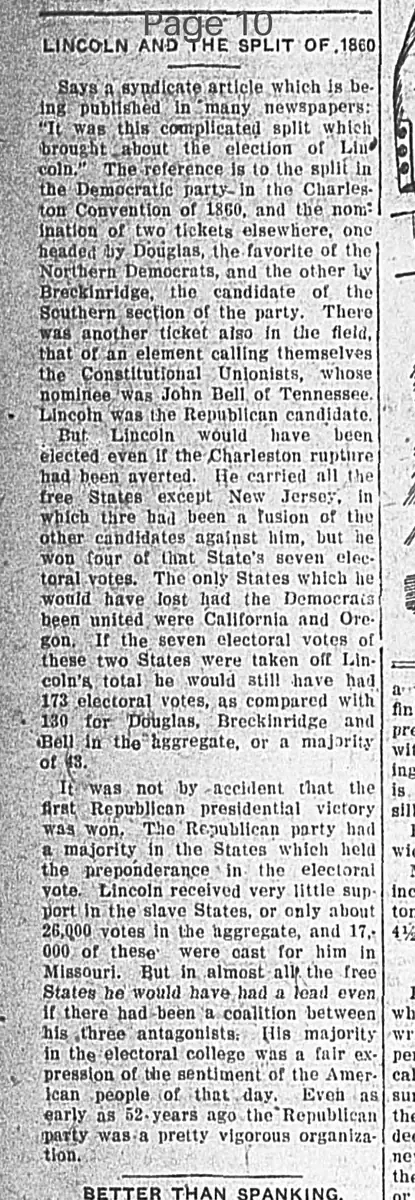
Says a syndicate article which is being published in many newspapers:
It was this complicated split which brought about the election of Lincoln. The reference is to the split in the Democratic party in the Charleston Convention of 1860, and the nomination of two tickets elsewhere, one headed by Douglas, the favorite of the Northern Democrats, and the other by Breckinridge, the candidate of the Southern section of the party. There was another ticket also in the field, that of an element calling themselves the Constitutional Unionists, whose nominee was John Bell of Tennessee. Lincoln was the Republican candidate.
But Lincoln would have been elected even if the Charleston rupture had been averted. He carried all the free States except New Jersey, in which there had been a fusion of the other candidates against him, but he won four of that State's seven electoral votes. The only States which he would have lost had the Democrats been united were California and Oregon. If these seven electoral votes of these two States were taken off Lincoln's total he would still have had 173 electoral votes, as compared with 130 for Douglas, Breckinridge and Bell in the aggregate, or a majority of 43.
It was not by accident that the first Republican presidential victory was won. The Republican party had a majority in the States which held the preponderance in the electoral vote. Lincoln received very little support in the slave States, or only about 26,000 votes in the aggregate, and 17,000 of these were cast for him in Missouri. But in almost all the free States he would have had a lead even if there had been a coalition between his three antagonists. His majority in the electoral college was a fair expression of the sentiment of the American people of that day.
Even as early as 52 years ago the Republican party was a pretty vigorous organization.
What sub-type of article is it?
What themes does it cover?
What keywords are associated?
What entities or persons were involved?
Where did it happen?
Story Details
Key Persons
Location
United States
Event Date
1860
Story Details
The Democratic Party split at the Charleston Convention in 1860, nominating Douglas for Northern Democrats and Breckinridge for Southern, with Bell as Constitutional Unionist candidate. This allowed Lincoln, the Republican, to win the election. Even without the split, Lincoln would have carried most free states and secured 173 electoral votes against 130 for opponents.