Thank you for visiting SNEWPapers!
Sign up free
Daily National Intelligencer
Washington, District Of Columbia
What is this article about?
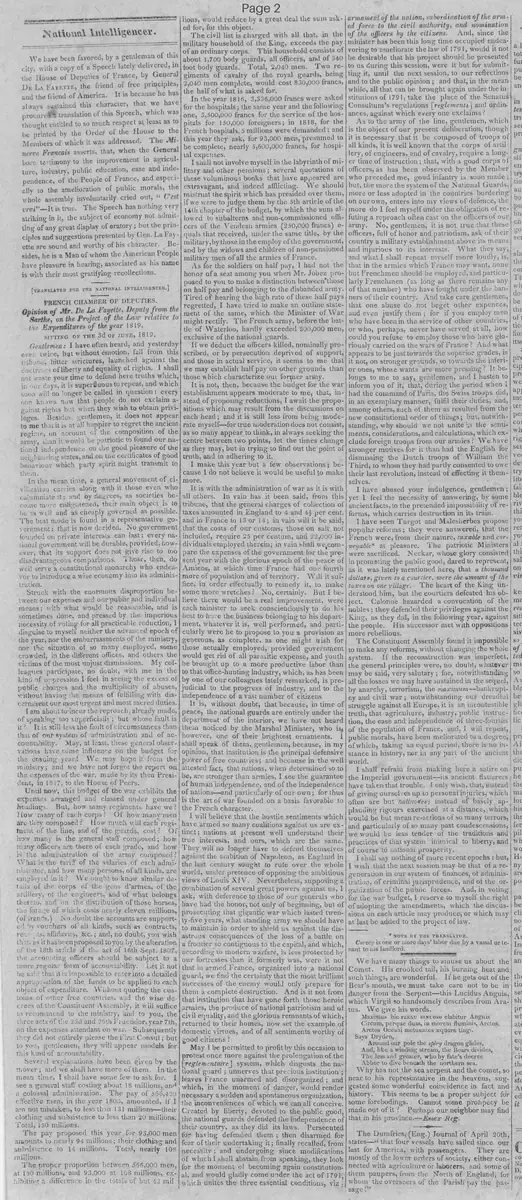
On June 3, 1819, General Lafayette delivered a speech in the French Chamber of Deputies advocating for economic reforms in the 1819 war budget, emphasizing reduced military expenditures, efficient administration, and strengthening the national guard while upholding liberty and equality.
Clipping
OCR Quality
Full Text
We have been favored, by a gentleman of this city, with a copy of a Speech lately delivered, in the House of Deputies of France, by General De La Fayette, the friend of free principles, and the friend of America. It is because he has always sustained this character, that we have procured a translation of this Speech, which was thought entitled to so much respect at least as to be printed by the Order of the House to the Members of which it was addressed. The Moniteur Français asserts, that, when the General bore testimony to the improvement in agriculture, industry, public education, ease and independence, of the People of France, and especially to the amelioration of public morals, the whole assembly involuntarily cried out, "C'est vrai" It is true. The Speech has nothing very striking in it, the subject of economy not admitting of any great display of oratory; but the principles and suggestions presented by Gen. La Fayette are sound and worthy of his character. Besides, he is a Man of whom the American People have pleasure in hearing, associated as his name is with their most gratifying recollections.
[TRANSLATED FOR THE NATIONAL INTELLIGENCER.]
FRENCH CHAMBER OF DEPUTIES.
Opinion of Mr. De La Fayette, Deputy from the Sarthe, on the Project of the Law relative to the Expenditures of the year 1819.
SITTING OF THE 3d OF JUNE, 1819.
Gentlemen: I have often heard, and yesterday even, twice, but without emotion, fall from this tribune, bitter strictures, launched against the doctrines of liberty and equality of rights. I shall not waste your time to defend here truths which, in our days, it is superfluous to repeat, and which soon will no longer be called in question: every one knows now that people do not exclaim against rights but when they wish to obtain privileges. Besides gentlemen, it does not appear to me that it is at all happier to regret the ancient regime, on account of the composition of the army, than it would be patriotic to found our national independence on the good pleasure of the neighboring states, and on the certificates of good behaviour which party spirit might transmit to them.
In the mean time, a general movement of civilization carries along with it those even who calumniate it; and by degrees, as societies become more enlightened, their main object is to be as well and as cheaply governed as possible. The best mode is found in a representative government: that is now decided. No government founded on private interests can last: every national government will be durable, provided, however, that its support does not give rise to too disadvantageous comparisons. Those, then, do well serve a constitutional monarchy who endeavor to introduce a wise economy into its administration.
Struck with the enormous disproportion between our expenses and our public and individual means; with what would be reasonable, and is sometimes done, and pressed by the imperious necessity of voting for all practicable reduction, I disguise to myself neither the advanced epoch of the year, nor the embarrassments of the ministry, nor the situation of so many employed, some crowded, in the different offices, and others the victims of the most unjust dismissions. My colleagues participate, no doubt, with me in the kind of oppression I feel in seeing the excess of public charges and the multiplicity of abuses, without having the means of fulfilling with discernment our most urgent and most sacred duties.
I am about to incur the reproach, already made, of speaking too superficially; but whose fault is it? It is still less the fault of circumstances than that of our system of administration and of accountability. May, at least, these general observations have some influence on the budget for the ensuing year! We may hope it from the ministry; and we have not forgot the report on the expenses of the war, made by its then President, in 1817, to the House of Peers.
Until now, this budget of the war exhibits the expenses arranged and classed under general headings. But, how many regiments have we? How many of each corps? Of how many men are they composed? How much will each regiment of the line, and of the guards, cost? Of how many is the general staff composed; how many officers are there of each grade, and how is the administration of the army composed? What is the tariff of the salaries of each administrator, and how many persons, of all kinds, are employed in it? We ought to know similar details of the corps of the gens d'armes, of the artillery, of the engineers, and of what belongs thereto, and on the distribution of those horses, the forage of which costs nearly eleven millions, (of francs.) No doubt the accounts are supported by vouchers of all kinds, such as contracts, receipts, affidavits, &c.; and, no doubt, you wish that, as it has been proposed to you by the alteration of the 18th article of the act of 16th Sept. 1807, the accounting officers should be subject to a more regular form of accountability. Let it not be said that it is impossible to enter into a detailed appropriation of the funds to be applied to each object of expenditure. Without quoting the customs of other free countries, and the wise decrees of the Constituent Assembly, it will suffice to recommend to the ministry, and to you, the three acts of the 23d and 26th Fructidor, year 7th, on the expenses attendant on war. Subsequently they did not entirely please the First Consul; but to you, gentlemen, they will appear models for this kind of accountability.
Several explanations have been given by the mover; and we shall have more of them. In the mean time, I shall have some few to ask for. I see a general staff costing about 18 millions, and a colossal administration. The pay of 566,420 effective men, in the year 1800, amounted, if I am not mistaken, to less than 131 millions--their clothing and subsistence to less than 20 millions. Total, 150 millions.
The pay proposed this year for 93,000 men amounts to nearly 94 millions; their clothing and subsistence to 14 millions. Total, nearly 108 millions.
The proper proportion between 566,000 men, at 150 millions, and 93,000 at 108 millions, exhibiting a difference in the totals of but 42 millions, would reduce by a great deal the sum asked for, for this object.
The civil list is charged with all that, in the military household of the King, exceeds the pay of an ordinary corps. This household consists of about 1,700 body guards, all officers, and of 340 foot body guards. Total, 2,040 men. Two regiments of cavalry of the royal guards, being 2,040 men complete, would cost 830,000 francs, the half of what is asked for.
In the year 1816, 3,336,000 francs were asked for the hospitals; the same year and the following one, 3,500,000 francs for the service of the hospitals for 150,000 foreigners; in 1818, for the French hospitals, 5 millions were demanded: and this year they ask, for 93,000 men, presumed to be complete, nearly 5,600,000 francs, for hospital expenses.
I shall not involve myself in the labyrinth of military and other pensions; several quotations of these voluminous books that have appeared are extravagant, and indeed afflicting. We should mistrust the spirit which has presided over them, if we were to judge them by the 5th article of the 14th chapter of the budget, by which the sum allowed to subalterns and non-commissioned officers of the Vendean armies (250,000 francs) equals that received, under the same title, by the military, by those in the employ of the government, and by the widows and children of non-pensioned military men of all the armies of France.
As for the soldiers on half pay, I had not the honor of a seat among you when Mr. Jobez proposed to you to make a distinction between those on half pay and belonging to the disbanded army. Tired of hearing the high rate of these half pays regretted, I have tried to make an outline statement of the same, which the Minister of War might rectify. The French army, before the battle of Waterloo, hardly exceeded 200,000 men, exclusive of the national guards.
If we deduct the officers killed, nominally proscribed, or by persecution deprived of support, and those in actual service, it seems to me that we may establish half pay on other grounds than those which characterize our former army.
It is not, then, because the budget for the war establishment appears moderate to me, that, instead of proposing reductions, I await the propositions which may result from the discussions on each head; and it is still less from being moderate myself--for true moderation does not consist, as so many appear to think, in always seeking the centre between two points, let the times change as they may, but in trying to find out the point of truth, and in adhering to it.
I make this year but a few observations; because I do not believe it would be useful to make more.
It is with the administration of war as it is with all others. In vain has it been said, from this tribune, that the general charges of collection of taxes amounted in England to 4 and 4d per cent. and in France to 13 or 14; in vain will it be said, that the costs of our customs, those on salt not included, require 25 per centum, and 22,000 individuals employed therein; in vain shall we compare the expenses of the government for the present year with the glorious epoch of the peace of Amiens, at which time France had one fourth more of population and of territory. Will it suffice, in order effectually to remedy it, to make some more wrecks? No, certainly. But I believe there would be a real improvement, were each minister to seek conscientiously to do his best to have the business belonging to his department, whatever it is, well performed, and particularly were he to propose to you a provision as generous, as complete, as one might wish for those actually employed, provided government would get rid of all parasitic expense, and youth be brought up to a more productive labor than to that office-hunting industry, which, as has been by one of our colleagues lately remarked, is prejudicial to the progress of industry, and to the independence of a vast number of citizens.
It is, without doubt, that because, in time of peace, the national guards are entirely under the department of the interior, we have not heard them noticed by the Marshal Minister, who is however, one of their brightest ornaments. I shall speak of them, gentlemen, because, in my opinion, that institution is the principal defensive power of free countries; and because in the well attested fact, that nations, when determined so to be, are stronger than armies, I see the guarantee of human independence, and of the independence of nations and particularly of our own; for thus is the art of war founded on a basis favorable to the French character.
I will believe that the hostile sentiments which have armed so many coalitions against us are extinct; nations at present well understand their true interests, and ours, which are the same. They will no longer have to defend themselves against the ambition of Napoleon, as England in the last century sought to rule over the whole world, under pretence of opposing the ambitious views of Louis XIV. Nevertheless, supposing a combination of several great powers against us, I ask, with deference to those of our generals who have had the honor, not only of beginning, but of prosecuting that gigantic war which lasted twenty-five years, what standing army we should have to maintain in order to shield us against the disastrous consequences of the loss of a battle on a frontier so contiguous to the capital, and which, according to modern warfare, is less protected by our fortresses than it formerly was, were it not that in armed France, organized into a national guard, we find the certainty that the most brilliant successes of the enemy would only prepare for them a complete destruction. And is it not from that institution that have gone forth those heroic armies, the produce of national patriotism and of civil equality, and the glorious remnants of which, returned to their homes, now set the example of domestic virtues, and of all sentiments worthy of good citizens?
May I be permitted to profit by this occasion to protest once more against the prolongation of the [reglementaire] system, which disgusts the national guard; unnerves that precious institution; leaves France unarmed and disorganized; and which, in the moment of danger, would render necessary a sudden and spontaneous organization, the inconveniences of which we can all conceive. Created by liberty, devoted to the public good, the national guards defended the independence of their country, as they did its laws. Persecuted for having defended them; then disarmed for fear of their undertaking it; finally recalled, from necessity; and undergoing since modifications of which I shall abstain from speaking, they look for the moment of becoming again constitutional, and would gladly come under the act of 1791, which unites the three essential conditions, viz:
armament of the nation, subordination of the armed force to the civil authority, and nomination of the officers by the citizens. And, since the minister has been this long time occupied endeavoring to ameliorate the law of 1791, would it not be desirable that his project should be presented to us during this session, were it but for submitting it, until the next session, to our reflections and to the public opinion; and that, in the mean while, all that can be brought again under the institutions of 1791, take the place of the Senatus Consultum's [reglements] and ordinances, against which every one exclaims?
As to the army of the line, gentlemen, which is the object of our present deliberation, though it is necessary that it be composed of troops of all kinds, it is well known that the corps of artillery, of engineers, and of cavalry, require a longer time of instruction; that, with a good corps of officers, as has been observed by the Member who preceded me, good infantry is soon made; but, the more the system of the National Guards, more or less adopted in the countries bordering on our own, enters into my views of defence, the more do I feel myself under the obligation of refuting a reproach often cast on the officers of our army. No, gentlemen, it is not true that these officers, full of honor and patriotism, ask of their country a military establishment above its means and injurious to its interests. What they say, and what I shall repeat myself more loudly, is, that in the armies which France may want, none but Frenchmen should be employed, and particularly Frenchmen (as long as there remains any of that number) who have fought under the banners of their country. And take care gentlemen, that one abuse do not beget other expences, and even justify them; for if you employ men who have been in the service of other countries, or who, perhaps, never have served at all, how could you refuse to employ those who have gloriously carried on the wars of France? And what appears to be just towards the superior grades, is it not, on stronger grounds, so towards the inferior ones, whose wants are more pressing? It belongs to me to say, gentlemen, and I hasten to inform you of it, that, during the period when I had the command of Paris, the Swiss troops did, in an exemplary manner, fulfil their duties, and, among others, such of them as resulted from the new constitutional order of things; but, notwithstanding, why should we not unite in the sentiments, considerations, and calculations, which exclude foreign troops from our armies? We have stronger motives for it than had the English for dismissing the Dutch troops of William the Third, to whom they had partly consented to owe their last revolution, instead of effecting it themselves.
I have abused your indulgence, gentlemen; yet I feel the necessity of answering, by some ancient facts, to the pretended impossibility of reforms, which carries destruction in its train. I have seen Turgot and Malesherbes propose popular reforms; they were answered, that the French were, from their nature, taxable and corveyable* at pleasure. The patriotic Ministers were sacrificed. Neckar, whose glory consisted in promoting the public good, dared to represent, as it was lately mentioned here, that a thousand dollars, given to a courtier, were the amount of the taxes on one village. The heart of the King understood him, but the courtiers defeated his object. Calonne hazarded a convocation of the nobles; they defended their privileges against the King, as they did, in the following year, against the people. His successor met with oppositions more rebellious.
The Constituent Assembly found it impossible to make any reforms, without changing the whole system. If the reconstruction was imperfect, the general principles were, no doubt, whatever may be said, very salutary; for, notwithstanding all the losses we may have sustained in the sequel, by anarchy, terrorism, the maximum-bankruptcy and civil war; notwithstanding our dreadful struggle against all Europe, it is an incontestible truth, that agriculture, industry, public instruction, the ease and independence of three-fourths of the population of France, and, I will repeat public morals, have been meliorated to a degree, of which, taking an equal period, there is no instance in history, nor in any part of the ancient world.
I shall refrain from making here a satire on the Imperial government its ancient flatterers have taken that trouble. I only wish, that, instead of giving ourselves up to personal injuries, which often are but halinodes; instead of basely applauding rigours exercised at a distance, which would be but mean re-actions of so many terrors, and particularly of so many past condescensions, we would be less tender of the traditions and practices of that system inimical to liberty, and of course to national prosperity.
I shall say nothing of more recent epochs: but, I wish that the next session may be that of a regeneration in our system of finances, of administration, of criminal jurisprudence, and of the organization of the public forces. And, in voting for the war budget, I reserve to myself the right of adopting the amendments, which the discussions on each article may produce, or which may at last be added to the project of law.
* NOTE BY THE TRANSLATOR.
Corvey is one or more days' labor due by a vassal or tenant to his landlord.
What sub-type of article is it?
What keywords are associated?
What entities or persons were involved?
Where did it happen?
Foreign News Details
Primary Location
France
Event Date
1819 06 03
Key Persons
Event Details
General Lafayette delivered a speech in the French Chamber of Deputies on the 1819 war budget, criticizing excessive military expenditures, advocating for detailed accountability, reductions in army costs, support for the national guard under the 1791 act, exclusion of foreign troops, and broader administrative reforms to promote economy and liberty.