Thank you for visiting SNEWPapers!
Sign up free
Editorial
August 18, 1795
Gazette Of The United States
Philadelphia, Philadelphia County, Pennsylvania
What is this article about?
CATO's essay critiques the Jay Treaty for disadvantaging American navigation and commerce by favoring British shipping through tonnage duties and equalizing measures, predicting economic ruin for U.S. merchants and seamen while strengthening British influence and weakening ties with France.
Clipping
OCR Quality
95%
Excellent
Full Text
From the Argus.
CATO—No. VI.
[Concluded.]
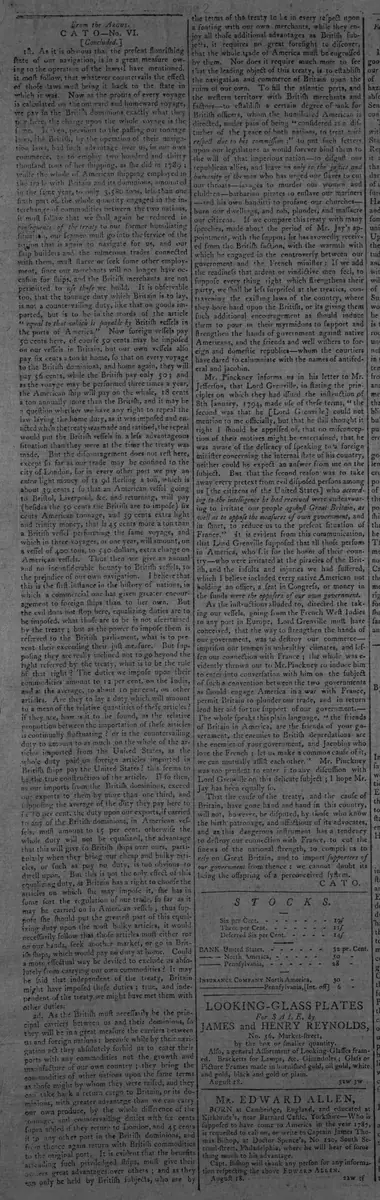
...rit. As it is obvious that the present flourishing state of our navigation, is in a great measure owing to the operation of the laws I have mentioned, it may follow, that whatever countervails the effect of those laws must bring it back to the state in which it was. Now as the profits of every voyage is calculated on the outward and homeward voyage, we pay in the British dominions exactly what they pay here, the charge upon the whole voyage is the same. Herein, previous to the passing our tonnage laws, the British, by the operation of their navigation laws, had such advantage over us, in our own commerce, as to employ two hundred and thirty thousand tons of her shipping, as they did in 1779; while the whole of American shipping employed in the trade with Britain and its dominions, amounted in the same year, to only 35,580 tons, less than one sixth part of the whole quantity engaged in the interchange of commodities between the two nations, it must follow that we shall again be reduced in consequence of the treaty to our former humiliating situation, our seamen must go into the service of the nation that is again to navigate for us, and our ship builders and the numerous trades connected with them, must starve or seek some other employment, since our merchants will no longer have occasion for ships, and the British merchants are not permitted to use those we build. It is observable too, that the tonnage duty which Britain is to lay, is not a countervailing duty, like that on goods imported, but is to be in the words of the article "equal to that which is payable by British vessels in the ports of America." Now foreign vessels pay 20 cents here, of course 50 cents may be imposed on our vessels in Britain, but our own vessels also pay six cents a ton at home, so that on every voyage to the British dominions, and home again, they will pay 56 cents, while the British pay only 50; and as the voyage may be performed three times a year, the American ship will pay on the whole, 18 cents a ton annually more than the British, and it may be a question whether we have any right to repeal the law laying the home duty, as it was imposed and enacted when that treaty was made and ratified, the repeal would put the British vessels in a less advantageous situation than they were at the time the treaty was made. But the discouragement does not rest here, except so far as our trade may be confined to the city of London, for in every other port we pay an extra light money of 3s. 9d. sterling a ton, which is about 39 cents; so that an American vessel going to Bristol, Liverpool, &c. and returning, will pay (besides the 50 cents the British are to impose) six cents American tonnage, and 39 cents extra light and trinity money, that is 45 cents more a ton than a British vessel performing the same voyage, and which in three voyages, or one year, will amount, on a vessel of 400 tons, to 540 dollars, extra charge on American vessels. Thus then we give an annual and no inconsiderable bounty to British vessels, to the prejudice of our own navigation. I believe that this is the first instance in the history of nations, in which a commercial one has given greater encouragement to foreign ships than to her own. But the evil does not stop here, equalizing duties are to be imposed, what those are to be is not ascertained by the treaty; but as the power to impose them is reserved to the British parliament, what is to prevent their exceeding their just measure. But supposing they are really inclined not to go beyond the right reserved by the treaty, what is to be the rule of that right? The duties we impose upon their commodities amount to 12 per cent. on the India, and at the average, to about 10 per cent, on other articles. Are they to lay a duty which will amount to a mean of the relative quantities of these articles? If they are, how is it to be found, as the relative proportion between the importation of these articles is continually fluctuating? Or is the countervailing duty to amount to as much on the whole of the articles imported from the United States, as the whole duty paid on foreign articles imported in British ships pay the United States? This seems to be the true construction of the article. If so then, as our imports from the British dominions, exceed our exports to them by more than one third, and supposing the average of the duty they pay here to be 10 per cent. the duty upon our exports, if carried to any of the British dominions, in American vessels, must amount to 15 per cent. otherwise the whole duty will not be equalized, the advantage that this will give to British ships over ours, particularly when they bring our cheap and bulky articles, or such as pay no duty, is too obvious to dwell upon. But this is not the only effect of this equalizing duty, as Britain has a right to choose the articles on which she may impose it, she has in some sort the regulation of our trade, so far as it may be carried on in American vessels; thus suppose she should put the greatest part of this equalizing duty upon the most bulky articles, it would necessarily follow that those articles must either rot on our hands, seek another market, or go in British ships, which would pay no duty at home. Could a more effectual way be devised to exclude us absolutely from carrying our own commodities? It may be said that independent of the treaty, Britain might have imposed these duties; true, and independent of the treaty we might have met them with other duties.
2d. As the British must necessarily be the principal carriers between us and their dominions, so they will be in a great measure the carriers between us and foreign nations: because while by their navigation act they absolutely forbid us to enter their ports with any commodities not the growth and manufacture of our own country; they bring the commodities of other nations upon the same terms as those might by whom they were raised, and they can take back a return cargo to Britain, or its dominions, with greater advantage than we can carry our own produce, by the whole difference of the tonnage, and countervailing duties with six cents extra added if they return to London, and 45 cents if to any other port in the British dominions, and from thence again return with British commodities to the original port. It is evident that the benefits attending such privileged ships, must give their owners great advantages over others; and as they can only be held by British subjects, who are by the terms of the treaty to be in every respect upon a footing with our own merchants, while they enjoy all those additional advantages as British subjects, it requires no great foresight to discover, that the whole trade of America must be engrossed by them. Nor does it require much more to see that the leading object of this treaty, is to establish the navigation and commerce of Britain upon the ruins of our own. To fill the atlantic ports, and the western territory with British merchants and factors—to establish a certain degree of rank for British officers, whom the humiliated American is directed, under pain of being "considered as a disturber of the peace of both nations, to treat with respect due to his commission;" to put such fetters upon our legislature as would forever bind them to the will of that imperious nation—to insult our republican allies, and leave us only to the justice and humanity of the man who has urged our savages to cut our throats—savages to murder our women and children—barbarian pirates to enslave our seamen—and his own banditti to profane our churches—burn our dwellings, and rob, plunder, and massacre our citizens. If we compare this treaty with many speeches, made about the period of Mr. Jay's appointment, with the support he has avowedly received from the British faction, with the warmth with which he engaged in the controversy between our government and the French minister: If we add the readiness that ardent or vindictive men feel, to suppose every thing right which strengthens their party, we shall be less surprised at the treaties, contravening the existing laws of the country, where they bore hard upon the British, or its giving them such additional encouragement as should induce them to pour in their myrmidons to support and strengthen the hands of government against native Americans, and the friends and well wishers to foreign and domestic republics—whom the courtiers have dared to calumniate with the names of antifederal and jacobin.
Mr. Pinckney informs us in his letter to Mr. Jefferson, that Lord Grenville, in stating the principles on which they had issued the instructions of 8th January, 1794, made use of these terms, "the second was that he [Lord Grenville] could not mention to me officially, but that he still thought it right I should be apprised of, that no misconception of their motives might be entertained, that he was aware of the delicacy of speaking to a foreign minister concerning the internal state of his country, neither could he expect an answer from me on the subject. But that the second reason was to take away every pretext from evil disposed persons among us [the citizens of the United States] who according to the intelligence he had received were endeavouring to irritate our people against Great Britain, as well as to oppose the measures of own government, and in short, to reduce us to the present situation of France." It is evident from this communication, that Lord Grenville supposed that all those persons in America, who felt for the honor of their country—who were irritated at the piracies of the British, and the insults and injuries we had suffered, which I believe included every native American not holding an office, a seat in Congress, or money in the funds were the opposers of our own government. As the instructions alluded to, directed the taking our vessels, going from the French West Indies to any port in Europe, Lord Grenville must have conceived, that the way to strengthen the hands of our government, was to destroy our commerce—imprison our seamen in unhealthy climates, and lessen our connection with France; the whole was evidently thrown out to Mr. Pinckney to induce him to enter into conversation with him on the subject of such a convention between the two governments as should engage America in a war with France, permit Britain to plunder our trade, and in return lend her aid for the support of our government.—The whole speaks this plain language, "the friends of Britain in America, are the friends of your government, the enemies to British depredations are the enemies of your government, and Jacobins who love the French; let us make a common cause of it, we can mutually assist each other." Mr. Pinckney was too prudent to enter into any discussion with Lord Grenville on this delicate subject; I hope Mr. Jay has been equally so.
That the cause of the treaty, and the cause of Britain, have gone hand and hand in this country, will not, however, be disputed, by those who know the birth patronage, and affections of its advocates, and as this dangerous instrument has a tendency to destroy our connection with France, to cut the sinews of the national strength, to compel us to rely on Great Britain, and to import supporters of our government from thence: we cannot doubt its being the offspring of a preconceived system.
CATO.
CATO—No. VI.
[Concluded.]
...rit. As it is obvious that the present flourishing state of our navigation, is in a great measure owing to the operation of the laws I have mentioned, it may follow, that whatever countervails the effect of those laws must bring it back to the state in which it was. Now as the profits of every voyage is calculated on the outward and homeward voyage, we pay in the British dominions exactly what they pay here, the charge upon the whole voyage is the same. Herein, previous to the passing our tonnage laws, the British, by the operation of their navigation laws, had such advantage over us, in our own commerce, as to employ two hundred and thirty thousand tons of her shipping, as they did in 1779; while the whole of American shipping employed in the trade with Britain and its dominions, amounted in the same year, to only 35,580 tons, less than one sixth part of the whole quantity engaged in the interchange of commodities between the two nations, it must follow that we shall again be reduced in consequence of the treaty to our former humiliating situation, our seamen must go into the service of the nation that is again to navigate for us, and our ship builders and the numerous trades connected with them, must starve or seek some other employment, since our merchants will no longer have occasion for ships, and the British merchants are not permitted to use those we build. It is observable too, that the tonnage duty which Britain is to lay, is not a countervailing duty, like that on goods imported, but is to be in the words of the article "equal to that which is payable by British vessels in the ports of America." Now foreign vessels pay 20 cents here, of course 50 cents may be imposed on our vessels in Britain, but our own vessels also pay six cents a ton at home, so that on every voyage to the British dominions, and home again, they will pay 56 cents, while the British pay only 50; and as the voyage may be performed three times a year, the American ship will pay on the whole, 18 cents a ton annually more than the British, and it may be a question whether we have any right to repeal the law laying the home duty, as it was imposed and enacted when that treaty was made and ratified, the repeal would put the British vessels in a less advantageous situation than they were at the time the treaty was made. But the discouragement does not rest here, except so far as our trade may be confined to the city of London, for in every other port we pay an extra light money of 3s. 9d. sterling a ton, which is about 39 cents; so that an American vessel going to Bristol, Liverpool, &c. and returning, will pay (besides the 50 cents the British are to impose) six cents American tonnage, and 39 cents extra light and trinity money, that is 45 cents more a ton than a British vessel performing the same voyage, and which in three voyages, or one year, will amount, on a vessel of 400 tons, to 540 dollars, extra charge on American vessels. Thus then we give an annual and no inconsiderable bounty to British vessels, to the prejudice of our own navigation. I believe that this is the first instance in the history of nations, in which a commercial one has given greater encouragement to foreign ships than to her own. But the evil does not stop here, equalizing duties are to be imposed, what those are to be is not ascertained by the treaty; but as the power to impose them is reserved to the British parliament, what is to prevent their exceeding their just measure. But supposing they are really inclined not to go beyond the right reserved by the treaty, what is to be the rule of that right? The duties we impose upon their commodities amount to 12 per cent. on the India, and at the average, to about 10 per cent, on other articles. Are they to lay a duty which will amount to a mean of the relative quantities of these articles? If they are, how is it to be found, as the relative proportion between the importation of these articles is continually fluctuating? Or is the countervailing duty to amount to as much on the whole of the articles imported from the United States, as the whole duty paid on foreign articles imported in British ships pay the United States? This seems to be the true construction of the article. If so then, as our imports from the British dominions, exceed our exports to them by more than one third, and supposing the average of the duty they pay here to be 10 per cent. the duty upon our exports, if carried to any of the British dominions, in American vessels, must amount to 15 per cent. otherwise the whole duty will not be equalized, the advantage that this will give to British ships over ours, particularly when they bring our cheap and bulky articles, or such as pay no duty, is too obvious to dwell upon. But this is not the only effect of this equalizing duty, as Britain has a right to choose the articles on which she may impose it, she has in some sort the regulation of our trade, so far as it may be carried on in American vessels; thus suppose she should put the greatest part of this equalizing duty upon the most bulky articles, it would necessarily follow that those articles must either rot on our hands, seek another market, or go in British ships, which would pay no duty at home. Could a more effectual way be devised to exclude us absolutely from carrying our own commodities? It may be said that independent of the treaty, Britain might have imposed these duties; true, and independent of the treaty we might have met them with other duties.
2d. As the British must necessarily be the principal carriers between us and their dominions, so they will be in a great measure the carriers between us and foreign nations: because while by their navigation act they absolutely forbid us to enter their ports with any commodities not the growth and manufacture of our own country; they bring the commodities of other nations upon the same terms as those might by whom they were raised, and they can take back a return cargo to Britain, or its dominions, with greater advantage than we can carry our own produce, by the whole difference of the tonnage, and countervailing duties with six cents extra added if they return to London, and 45 cents if to any other port in the British dominions, and from thence again return with British commodities to the original port. It is evident that the benefits attending such privileged ships, must give their owners great advantages over others; and as they can only be held by British subjects, who are by the terms of the treaty to be in every respect upon a footing with our own merchants, while they enjoy all those additional advantages as British subjects, it requires no great foresight to discover, that the whole trade of America must be engrossed by them. Nor does it require much more to see that the leading object of this treaty, is to establish the navigation and commerce of Britain upon the ruins of our own. To fill the atlantic ports, and the western territory with British merchants and factors—to establish a certain degree of rank for British officers, whom the humiliated American is directed, under pain of being "considered as a disturber of the peace of both nations, to treat with respect due to his commission;" to put such fetters upon our legislature as would forever bind them to the will of that imperious nation—to insult our republican allies, and leave us only to the justice and humanity of the man who has urged our savages to cut our throats—savages to murder our women and children—barbarian pirates to enslave our seamen—and his own banditti to profane our churches—burn our dwellings, and rob, plunder, and massacre our citizens. If we compare this treaty with many speeches, made about the period of Mr. Jay's appointment, with the support he has avowedly received from the British faction, with the warmth with which he engaged in the controversy between our government and the French minister: If we add the readiness that ardent or vindictive men feel, to suppose every thing right which strengthens their party, we shall be less surprised at the treaties, contravening the existing laws of the country, where they bore hard upon the British, or its giving them such additional encouragement as should induce them to pour in their myrmidons to support and strengthen the hands of government against native Americans, and the friends and well wishers to foreign and domestic republics—whom the courtiers have dared to calumniate with the names of antifederal and jacobin.
Mr. Pinckney informs us in his letter to Mr. Jefferson, that Lord Grenville, in stating the principles on which they had issued the instructions of 8th January, 1794, made use of these terms, "the second was that he [Lord Grenville] could not mention to me officially, but that he still thought it right I should be apprised of, that no misconception of their motives might be entertained, that he was aware of the delicacy of speaking to a foreign minister concerning the internal state of his country, neither could he expect an answer from me on the subject. But that the second reason was to take away every pretext from evil disposed persons among us [the citizens of the United States] who according to the intelligence he had received were endeavouring to irritate our people against Great Britain, as well as to oppose the measures of own government, and in short, to reduce us to the present situation of France." It is evident from this communication, that Lord Grenville supposed that all those persons in America, who felt for the honor of their country—who were irritated at the piracies of the British, and the insults and injuries we had suffered, which I believe included every native American not holding an office, a seat in Congress, or money in the funds were the opposers of our own government. As the instructions alluded to, directed the taking our vessels, going from the French West Indies to any port in Europe, Lord Grenville must have conceived, that the way to strengthen the hands of our government, was to destroy our commerce—imprison our seamen in unhealthy climates, and lessen our connection with France; the whole was evidently thrown out to Mr. Pinckney to induce him to enter into conversation with him on the subject of such a convention between the two governments as should engage America in a war with France, permit Britain to plunder our trade, and in return lend her aid for the support of our government.—The whole speaks this plain language, "the friends of Britain in America, are the friends of your government, the enemies to British depredations are the enemies of your government, and Jacobins who love the French; let us make a common cause of it, we can mutually assist each other." Mr. Pinckney was too prudent to enter into any discussion with Lord Grenville on this delicate subject; I hope Mr. Jay has been equally so.
That the cause of the treaty, and the cause of Britain, have gone hand and hand in this country, will not, however, be disputed, by those who know the birth patronage, and affections of its advocates, and as this dangerous instrument has a tendency to destroy our connection with France, to cut the sinews of the national strength, to compel us to rely on Great Britain, and to import supporters of our government from thence: we cannot doubt its being the offspring of a preconceived system.
CATO.
What sub-type of article is it?
Foreign Affairs
Economic Policy
Partisan Politics
What keywords are associated?
Jay Treaty
Navigation Laws
American Shipping
British Commerce
Tonnage Duties
Trade Disadvantages
British Influence
What entities or persons were involved?
Jay Treaty
Britain
Lord Grenville
Mr. Pinckney
Mr. Jefferson
Mr. Jay
Cato
British Merchants
French Allies
Editorial Details
Primary Topic
Critique Of Jay Treaty On Navigation And Commerce
Stance / Tone
Strongly Anti Jay Treaty And Pro British Faction
Key Figures
Jay Treaty
Britain
Lord Grenville
Mr. Pinckney
Mr. Jefferson
Mr. Jay
Cato
British Merchants
French Allies
Key Arguments
Treaty Disadvantages American Shipping Through Unequal Tonnage Duties
Gives British Vessels Advantages Over American Ones In Trade
Equalizing Duties Allow Britain To Regulate U.S. Trade
Leads To British Monopoly On American Commerce
Undermines U.S. Ties With France And Strengthens British Influence
Supports Pro British Faction Against American Republicans