Thank you for visiting SNEWPapers!
Sign up free
The Hillsdale Standard
Hillsdale, Hillsdale County, Michigan
What is this article about?
British and European reactions to President Lincoln's message, focusing on its silence regarding the Trent affair, amid hopes and fears of war; profound grief over Prince Albert's death; diplomatic circular from France on the seizure of Mason and Slidell; calls for arming merchant ships and arbitration by Mr. Cobden.
Clipping
OCR Quality
Full Text
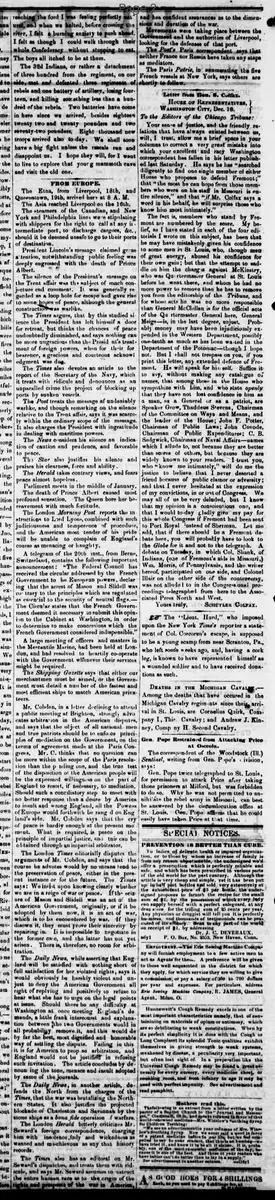
The Etna, from Liverpool, 18th, and Queenstown, 19th, arrived here at 8 A. M. The Asia reached Liverpool on the 16th. The steamers of the Canadian, and New York and Philadelphia lines were stipulating with shippers for the right to call at any intermediate port, to discharge cargoes, &c., should it be deemed unsafe to go to their ports of destination.
President Lincoln's message claimed great attention, notwithstanding public feeling was deeply engrossed with the death of Prince Albert. The silence of the President's message on the Trent affair was the subject of much conjecture and comment. It was generally regarded as a loop hole for escape and gave rise to some hopes of peace, although the general construction was warlike.
The Times argues, that by this studied silence the President has left himself a door for retreat, but thinks the chances of peace undoubtedly diminished, and says nothing can be more ungracious than the President's treatment of foreign powers, when for their forbearance, a gracious and courteous acknowledgment was due.
The Times also devotes an article to the report of the Secretary of the Navy, which it treats with ridicule and denounces as an unparalleled crime the project of blocking up ports by sunken vessels.
The Post treats the message as undeniably warlike, and though remarking on the silence relative to the Trent affair, says it was scarcely within the ordinary scope of the message. It also charges the President with ingratitude in dealing with maritime powers.
The News considers his silence an indication of caution and prudence, and favorable to peace.
The Star also justifies his silence and praises his clearness, force and ability.
The Herald takes contrary views, and fears peace almost hopeless.
Parliament meets in the middle of January.
The death of Prince Albert caused most profound sensation. The Queen bore her bereavement with much fortitude.
The London Morning Post reports the instructions to Lord Lyons, combined with such judiciousness and temperance of procedure and the American most tender of his pride will be unable to complain of England's course as menacing or haughty.
A telegram of the 20th inst., from Berne, Switzerland, contains the following important announcement: "The Federal Council has received the circular addressed by the French Government to the European powers, declaring that the arrest of Mason and Slidell was contrary to the principles which are regulated as essential to the security of neutral flags. The Circular states that the French Government deemed it necessary to submit this opinion to the Cabinet at Washington, in order to determine to make concessions which the French Government considered indispensable."
A large meeting of officers and masters in the Mercantile Marine, had been held at London, and had resolved to heartily co-operate with the Government whenever their services might be required.
The Shipping Gazette says that either our merchantmen must be armed, or the Government must detail a number of the fastest and most efficient ships to match American privateers.
Mr. Cobden, in a letter declining to attend a public meeting at Brighton, strongly advocates arbitration in the American disputes and says that the object of all national men and true patriots should be to enforce principles of mediation on the Government, on the terms of agreement made at the Paris Congress. Mr. C. thinks that no question can be more within the scope of the Paris resolution than the pending one, and the true test of the disposition of the American people will be the expressed willingness on the part of England to resort, if necessary, to mediation. Should such a conciliatory step to meet with no better response than a desire by America to insult and wrong England, all the Powers of Europe would forthwith be ranged on England's side. Mr. Cobden says that the cry of peace is hardly loud enough at the present moment. What is required, is peace on the principle of impartial justice, and that can be obtained through an impartial arbitrator.
The London Times editorially disputes the arguments of Mr. Cobden, and says that the course he advocates would by no means tend to the preservation of peace, either in the present instance or in the future. The Times says: We insist upon knowing clearly whether we are in a reign of war or peace. If the seizure of Mason and Slidell was an act of the American Government, originally, or if it be adopted by them now, it is an act of war, which is to be encountered by war. If they disown it, they must prove their sincerity by repairing it. It is impossible to negotiate in the former case, and the latter has not yet arisen. There is, therefore, no room for arbitration.
The Daily News, while asserting that England will be satisfied with nothing short of full satisfaction for her violated rights, says it would obviously be harshly violent and unjust to deny the American Government all right of replying, and positively to refuse to hear what she has to urge on the legal points at issue. Should there be any difficulty at once meeting England's demands, a little frank intercourse and explanation between the two Governments would in all probability remove it, and this would be by far the best, most dignified and honorable way of settling the dispute. Failing in this it is for America to propose arbitration, and England would not be justified in refusing such invitation. The article concludes by denouncing the tone, menace and insult adopted by some of the journals.
The Daily News, in another article, defends the North from the charges of the Times, that the war was brutalizing the Northern States. It also justifies the projected blockade of Charleston and Savannah by the stone ships as a bona fide operation of warfare.
The London Herald bitterly criticizes Mr. Seward's foreign correspondence, charging him with insolence, folly and wickedness as flagrant and mischievous as any that history records.
The Times also has an editorial on Mr. Seward's dispatches, and treats them with ridicule, and says Mr. Seward assumes to instruct the entire human race as to the origin of the war and has confident assurances as to the dimensions and duration of the war.
Movements were taking place between the Government and the authorities of Liverpool, looking for the defenses of that port.
The Post's Paris correspondent says that neither France nor Russia have taken any steps as mediators.
The Paris Patrie, in enumerating the five French vessels at New York, says others are shortly to follow.
What sub-type of article is it?
What keywords are associated?
What entities or persons were involved?
Where did it happen?
Foreign News Details
Primary Location
London
Event Date
18th 20th Inst.
Key Persons
Outcome
hopes and fears of war over trent affair; profound sensation from prince albert's death; french circular urging concessions from us; calls for arbitration and arming merchant ships.
Event Details
European news via Etna steamer reports British press reactions to Lincoln's message silence on Trent affair, seen as warlike yet offering peace escape; ridicule of US naval report; Prince Albert's death causes deep grief; French diplomatic circular via Switzerland declares Mason-Slidell arrest violates neutral flags, seeks US concessions; Cobden advocates arbitration per Paris Congress; Times rejects it; preparations for potential conflict including port defenses and ship arming.