Thank you for visiting SNEWPapers!
Sign up free
Story
September 14, 1901
The Colfax Chronicle
Colfax, Grant County, Louisiana
What is this article about?
Article explains how to measure hay stacks and bays for approximate tonnage using length, width, height, and adjustments for settling time; includes example calculation.
Clipping
OCR Quality
75%
Good
Full Text
HAY IN THE STACK
How It Can Be Measured with a Degree of Accuracy Sufficient for Ordinary Purposes.
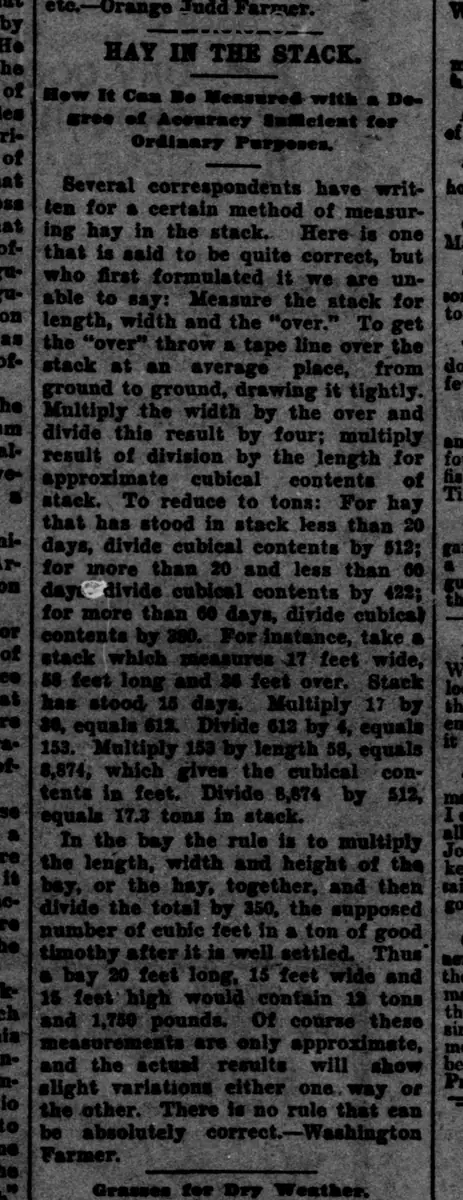
Several correspondents have written for a certain method of measuring hay in the stack. Here is one that is said to be quite correct, but who first formulated it we are unable to say: Measure the stack for length, width and the "over." To get the "over" throw a tape line over the stack at an average place, from ground to ground, drawing it tightly. Multiply the width by the over and divide this result by four; multiply result of division by the length for approximate cubical contents of Stack. To reduce to tons: For hay that has stood in stack less than 20 days, divide cubical contents by 512; for more than 20 and less than 60 days divide cubical contents by 422; for more than 60 days, divide cubical contents by 350. For instance, take stack which measures 17 feet wide 58 feet long and 26 feet over. Stack has stood 16 days: Multiply 17 by 26, equals 442. Divide 442 by 4 equals 110.5. Multiply 110.5 by length 58, equals 6419; which gives the cubical contents in feet. Divide 6419 by 512, equals 12.5 tons in stack.
In the bay the rule is to multiply the length, width and height of the bay, or the hay, together and then divide the total by 350, the supposed number of cubic feet in a ton of good timothy after it is well settled. Thus a bay 20 feet long, 15 feet wide and 15 feet high would contain 15 tons and 1750 pounds. Of course these measurements are only approximate, and the actual results will show slight variations either one way or the other. There is no rule that can be absolutely correct. Washington Carmer.
How It Can Be Measured with a Degree of Accuracy Sufficient for Ordinary Purposes.
Several correspondents have written for a certain method of measuring hay in the stack. Here is one that is said to be quite correct, but who first formulated it we are unable to say: Measure the stack for length, width and the "over." To get the "over" throw a tape line over the stack at an average place, from ground to ground, drawing it tightly. Multiply the width by the over and divide this result by four; multiply result of division by the length for approximate cubical contents of Stack. To reduce to tons: For hay that has stood in stack less than 20 days, divide cubical contents by 512; for more than 20 and less than 60 days divide cubical contents by 422; for more than 60 days, divide cubical contents by 350. For instance, take stack which measures 17 feet wide 58 feet long and 26 feet over. Stack has stood 16 days: Multiply 17 by 26, equals 442. Divide 442 by 4 equals 110.5. Multiply 110.5 by length 58, equals 6419; which gives the cubical contents in feet. Divide 6419 by 512, equals 12.5 tons in stack.
In the bay the rule is to multiply the length, width and height of the bay, or the hay, together and then divide the total by 350, the supposed number of cubic feet in a ton of good timothy after it is well settled. Thus a bay 20 feet long, 15 feet wide and 15 feet high would contain 15 tons and 1750 pounds. Of course these measurements are only approximate, and the actual results will show slight variations either one way or the other. There is no rule that can be absolutely correct. Washington Carmer.
What sub-type of article is it?
Instructional Guide
Agricultural Advice
What keywords are associated?
Hay Measurement
Stack Volume
Ton Calculation
Agricultural Formula
Bay Estimation
What entities or persons were involved?
Washington Carmer
Story Details
Key Persons
Washington Carmer
Story Details
Provides methods for measuring hay in stacks and bays to estimate tonnage, with formulas adjusting for settling time in stacks and using cubic feet per ton for bays.