Thank you for visiting SNEWPapers!
Sign up free
The National Era
Washington, District Of Columbia
What is this article about?
Article urges action on the Treaty of Reciprocity between the US and British North American colonies, highlighting fisheries disputes in the Bay of Fundy due to US encroachments, diplomatic efforts by Webster and consul Andrews, and the importance of St. Lawrence navigation for trade.
Clipping
OCR Quality
Full Text
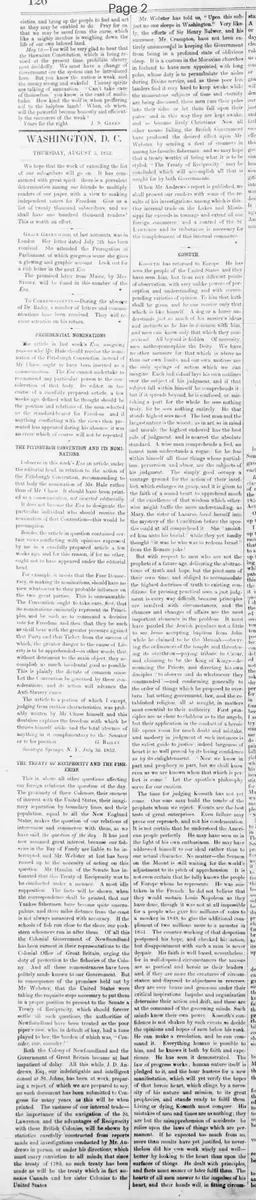
This is, above all other questions affecting our foreign relations, the question of the day. The proximity of these Colonies, their oneness of interest with the United States, their imaginary separation by boundary lines, and their population, equal to all the New England States, makes the question of our relations of intercourse and commerce with them, as we have said, the question of the day. It has just now assumed great interest, because our fisheries in the Bay of Fundy are liable to be interrupted, and Mr. Webster at last has been roused up to the necessity of acting on this question. Mr. Hamlin of the Senate has intimated that this Treaty of Reciprocity was to be conducted under a menace. A most idle supposition. The facts will be shown, when the correspondence shall be printed, that our Yankee fishermen have become quite unscrupulous, and three miles distance from the coast is not always measured with accuracy. If the schools of fish run close to the shore, our pink-stern schooners run in after them. Of all this the Colonial Government of Newfoundland has been earnest in their representations to the Colonial Office of Great Britain, urging the duty of protection to the fisheries of the Colony. And all these remonstrances have been politely made known to our Government. But in consequence of the promises held out by Mr. Webster, that the United States were taking the requisite steps necessary to put them in a proper position to present to the Senate a Treaty of Reciprocity, which should forever settle all such questions, the authorities of Newfoundland have been treated as the poor piper's cow, who, in default of hay, had a tune played to her, the burden of which was, "Consider, cow, consider!"
Both the Colony of Newfoundland and the Government of Great Britain became at last impatient of delay. All this while J. D. Andrews, Esq., our indefatigable and intelligent consul at St. Johns, has been at work, preparing a report, of which we are prepared to say no such document has been submitted to Congress for many years, as this will be when printed. The vastness of our internal trade—the importance of the navigation of the St. Lawrence, and the advantages of Reciprocity with these British Colonies, will be shown by statistics carefully constructed from reports made and investigations conducted by Mr. Andrews in person, or under his directions, which must carry conviction to all minds, that since the treaty of 1783, no such treaty has been made as will be the treaty which in fact annexes Canada and her sister Colonies to the United States.
Mr. Webster has told us, "Upon this subject no one sleeps in Washington." Very likely, the efforts of Sir Henry Bulwer, and his successor, Mr. Crampton, have not been entirely unsuccessful in keeping the Government from being in a profound state of oblivious sleep. It is a custom in the Moravian churches in Iceland to have men appointed, with long poles, whose duty is to perambulate the aisles during Divine service, and, as these poor Icelanders find it very hard to keep awake while the momentous subjects of time and eternity are being discussed, these men ram their poles into their sides or let them fall upon their pates; and in this way they are kept awake, and so become lively Christians. Now all other means failing, the British Government have produced the desired effect upon Mr. Webster, by sending a fleet of steamers in among his favorite fishermen, and we may hope that a treaty worthy of being what it is to be styled, "The Treaty of Reciprocity," may be concluded which will accomplish all that is sought for by both Governments.
When Mr. Andrews's report is published, we shall present our readers with some of the results of his investigations, among which is this: Our internal trade on the Lakes and Mississippi far exceeds in tonnage and extent all our foreign commerce, and a control of the St. Lawrence and its tributaries is necessary for the completion of this internal commerce.
What sub-type of article is it?
What themes does it cover?
What keywords are associated?
What entities or persons were involved?
Where did it happen?
Story Details
Key Persons
Location
Bay Of Fundy, Newfoundland, St. Johns, United States, British Colonies, Canada, St. Lawrence River, Great Lakes, Mississippi River
Event Date
Treaty Of 1783
Story Details
The article discusses the pressing need for a Treaty of Reciprocity to resolve US-British colonial fisheries disputes in the Bay of Fundy, where US fishermen encroach on restricted waters, and to enhance trade via the St. Lawrence. Diplomatic efforts by Webster and consul Andrews aim for a comprehensive agreement annexing colonial commerce to the US.