Thank you for visiting SNEWPapers!
Sign up free
Literary
February 20, 1772
The Virginia Gazette
Richmond, Williamsburg, Richmond County, Virginia
What is this article about?
An essay exploring the moral and philosophical uses of the looking glass for self-reflection, drawing on Plato and Socrates to advise on beauty, vice, virtue, aging, and contemplating death to improve one's character.
Clipping
OCR Quality
98%
Excellent
Full Text
USES of the LOOKING GLASS.
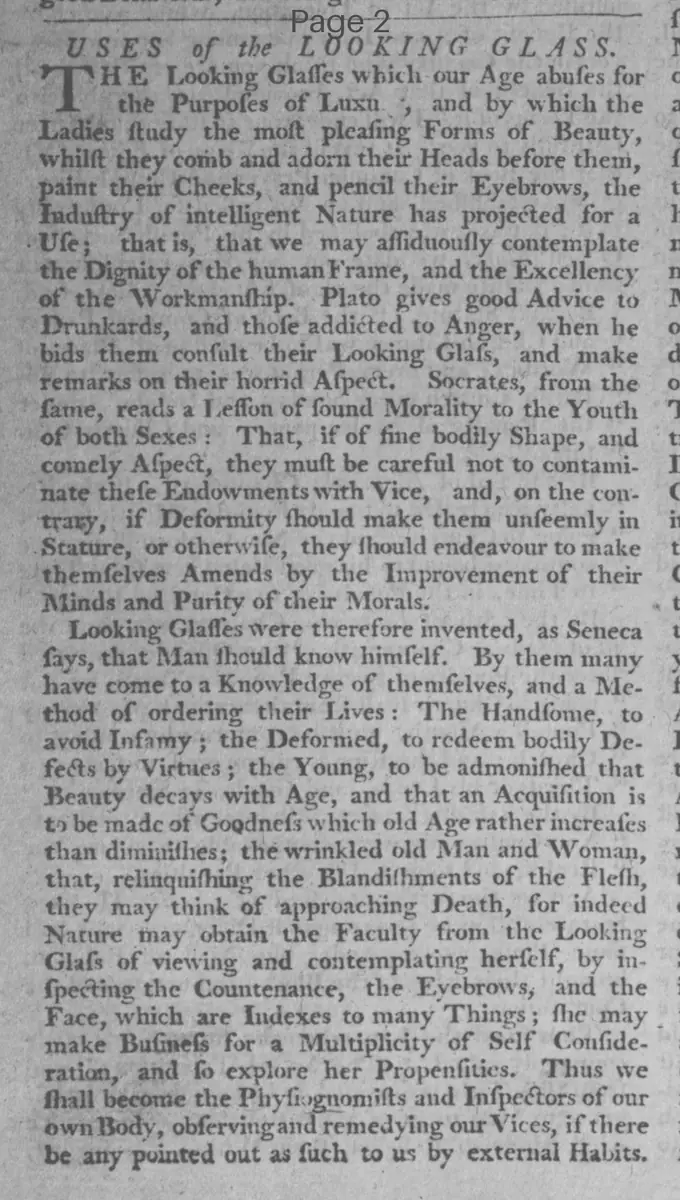
Ladies study the most pleasing Forms of Beauty, whilst they comb and adorn their Heads before them, paint their Cheeks, and pencil their Eyebrows, the Industry of intelligent Nature has projected for a Use; that is, that we may assiduously contemplate the Dignity of the human Frame, and the Excellency of the Workmanship. Plato gives good Advice to Drunkards, and those addicted to Anger, when he bids them consult their Looking Glass, and make remarks on their horrid Aspect. Socrates, from the same, reads a Lesson of sound Morality to the Youth of both Sexes: That, if of fine bodily Shape, and comely Aspect, they must be careful not to contaminate these Endowments with Vice, and, on the contrary, if Deformity should make them unseemly in Stature, or otherwise, they should endeavour to make themselves Amends by the Improvement of their Minds and Purity of their Morals.
Looking Glasses were therefore invented, as Seneca says, that Man should know himself. By them many have come to a Knowledge of themselves, and a Method of ordering their Lives: The Handsome, to avoid Infamy; the Deformed, to redeem bodily Defects by Virtues; the Young, to be admonished that Beauty decays with Age, and that an Acquisition is to be made of Goodness which old Age rather increases than diminishes: the wrinkled old Man and Woman, that, relinquishing the Blandishments of the Flesh, they may think of approaching Death, for indeed Nature may obtain the Faculty from the Looking Glass of viewing and contemplating herself, by inspecting the Countenance, the Eyebrows, and the Face, which are Indexes to many Things; he may make Business for a Multiplicity of Self Consideration, and so explore her Propensities. Thus we shall become the Physiognomists and Inspectors of our own Body, observing and remedying our Vices, if there be any pointed out as such to us by external Habits.
Ladies study the most pleasing Forms of Beauty, whilst they comb and adorn their Heads before them, paint their Cheeks, and pencil their Eyebrows, the Industry of intelligent Nature has projected for a Use; that is, that we may assiduously contemplate the Dignity of the human Frame, and the Excellency of the Workmanship. Plato gives good Advice to Drunkards, and those addicted to Anger, when he bids them consult their Looking Glass, and make remarks on their horrid Aspect. Socrates, from the same, reads a Lesson of sound Morality to the Youth of both Sexes: That, if of fine bodily Shape, and comely Aspect, they must be careful not to contaminate these Endowments with Vice, and, on the contrary, if Deformity should make them unseemly in Stature, or otherwise, they should endeavour to make themselves Amends by the Improvement of their Minds and Purity of their Morals.
Looking Glasses were therefore invented, as Seneca says, that Man should know himself. By them many have come to a Knowledge of themselves, and a Method of ordering their Lives: The Handsome, to avoid Infamy; the Deformed, to redeem bodily Defects by Virtues; the Young, to be admonished that Beauty decays with Age, and that an Acquisition is to be made of Goodness which old Age rather increases than diminishes: the wrinkled old Man and Woman, that, relinquishing the Blandishments of the Flesh, they may think of approaching Death, for indeed Nature may obtain the Faculty from the Looking Glass of viewing and contemplating herself, by inspecting the Countenance, the Eyebrows, and the Face, which are Indexes to many Things; he may make Business for a Multiplicity of Self Consideration, and so explore her Propensities. Thus we shall become the Physiognomists and Inspectors of our own Body, observing and remedying our Vices, if there be any pointed out as such to us by external Habits.
What sub-type of article is it?
Essay
What themes does it cover?
Moral Virtue
Death Mortality
What keywords are associated?
Looking Glass
Self Knowledge
Morality
Plato
Socrates
Seneca
Virtue
Vice
Beauty
Death
Literary Details
Title
Uses Of The Looking Glass.
Subject
Moral Lessons From Self Reflection In The Looking Glass
Key Lines
Plato Gives Good Advice To Drunkards, And Those Addicted To Anger, When He Bids Them Consult Their Looking Glass, And Make Remarks On Their Horrid Aspect.
Socrates, From The Same, Reads A Lesson Of Sound Morality To The Youth Of Both Sexes: That, If Of Fine Bodily Shape, And Comely Aspect, They Must Be Careful Not To Contaminate These Endowments With Vice
Looking Glasses Were Therefore Invented, As Seneca Says, That Man Should Know Himself.
The Young, To Be Admonished That Beauty Decays With Age, And That An Acquisition Is To Be Made Of Goodness Which Old Age Rather Increases Than Diminishes
The Wrinkled Old Man And Woman, That, Relinquishing The Blandishments Of The Flesh, They May Think Of Approaching Death