Thank you for visiting SNEWPapers!
Sign up free
Story
May 31, 1851
Weekly National Intelligencer
Washington, District Of Columbia
What is this article about?
In a US Circuit Court case, the defense by Rufus Choate argues that the Methodist Episcopal Church South, formed after the 1844 schism, has no rights to the Book Concern funds, which are held for the original church's preachers and families.
Clipping
OCR Quality
100%
Excellent
Full Text
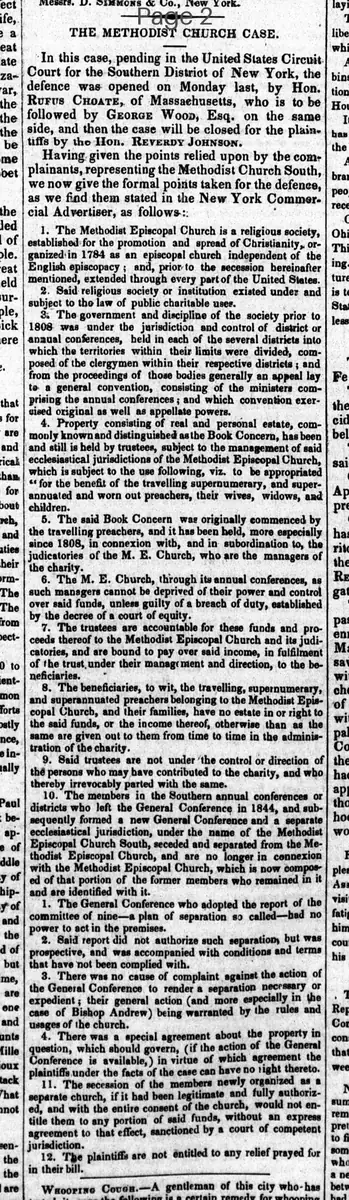
THE METHODIST CHURCH CASE.
In this case, pending in the United States Circuit Court for the Southern District of New York, the defence was opened on Monday last, by Hon. Rufus Choate, of Massachusetts, who is to be followed by George Wood, Esq. on the same side, and then the case will be closed for the plaintiffs by the Hon. Reverdy Johnson.
Having given the points relied upon by the complainants, representing the Methodist Church South, we now give the formal points taken for the defence, as we find them stated in the New York Commercial Advertiser, as follows:
1. The Methodist Episcopal Church is a religious society, established for the promotion and spread of Christianity, organized in 1784 as an episcopal church independent of the English episcopacy; and, prior to the secession hereinafter mentioned, extended through every part of the United States.
2. Said religious society or institution existed under and subject to the law of public charitable uses.
3. The government and discipline of the society prior to 1808 was under the jurisdiction and control of district or annual conferences, held in each of the several districts into which the territories within their limits were divided, composed of the clergymen within their respective districts; and from the proceedings of those bodies generally an appeal lay to a general convention, consisting of the ministers comprising the annual conferences; and which convention exercised original as well as appellate powers.
4. Property consisting of real and personal estate, commonly known and distinguished as the Book Concern, has been and still is held by trustees, subject to the management of said ecclesiastical jurisdictions of the Methodist Episcopal Church, which is subject to the use following, viz. to be appropriated "for the benefit of the travelling supernumerary, and superannuated and worn out preachers, their wives, widows, and children."
5. The said Book Concern was originally commenced by the travelling preachers, and it has been held, more especially since 1808, in connexion with, and in subordination to, the judicatories of the M. E. Church, who are the managers of the charity.
6. The M. E. Church, through its annual conferences, as such managers cannot be deprived of their power and control over said funds, unless guilty of a breach of duty, established by the decree of a court of equity.
7. The trustees are accountable for these funds and proceeds thereof to the Methodist Episcopal Church and its judicatories, and are bound to pay over said income, in fulfilment of the trust under their management and direction, to the beneficiaries.
8. The beneficiaries, to wit, the travelling, supernumerary, and superannuated preachers belonging to the Methodist Episcopal Church, and their families, have no estate in or right to the said funds, or the income thereof, otherwise than as the same are given out to them from time to time in the administration of the charity.
9. Said trustees are not under the control or direction of the persons who may have contributed to the charity, and who thereby irrevocably parted with the same.
10. The members in the Southern annual conferences or districts who left the General Conference in 1844, and subsequently formed a new General Conference and a separate ecclesiastical jurisdiction, under the name of the Methodist Episcopal Church South, seceded and separated from the Methodist Episcopal Church, and are no longer in connexion with the Methodist Episcopal Church, which is now composed of that portion of the former members who remained in it and are identified with it.
11. The General Conference who adopted the report of the committee of nine—a plan of separation so called—had no power to act in the premises.
12. Said report did not authorize such separation, but was prospective, and was accompanied with conditions and terms that have not been complied with.
13. There was no cause of complaint against the action of the General Conference to render a separation necessary or expedient; their general action (and more especially in the case of Bishop Andrew) being warranted by the rules and usages of the church.
14. There was a special agreement about the property in question, which should govern, (if the action of the General Conference is available,) in virtue of which agreement the plaintiffs under the facts of the case can have no right thereto.
15. The secession of the members newly organized as a separate church, if it had been legitimate and fully authorized, and with the entire consent of the church, would not entitle them to any portion of said funds, without an express agreement to that effect, sanctioned by a court of competent jurisdiction.
16. The plaintiffs are not entitled to any relief prayed for in their bill.
In this case, pending in the United States Circuit Court for the Southern District of New York, the defence was opened on Monday last, by Hon. Rufus Choate, of Massachusetts, who is to be followed by George Wood, Esq. on the same side, and then the case will be closed for the plaintiffs by the Hon. Reverdy Johnson.
Having given the points relied upon by the complainants, representing the Methodist Church South, we now give the formal points taken for the defence, as we find them stated in the New York Commercial Advertiser, as follows:
1. The Methodist Episcopal Church is a religious society, established for the promotion and spread of Christianity, organized in 1784 as an episcopal church independent of the English episcopacy; and, prior to the secession hereinafter mentioned, extended through every part of the United States.
2. Said religious society or institution existed under and subject to the law of public charitable uses.
3. The government and discipline of the society prior to 1808 was under the jurisdiction and control of district or annual conferences, held in each of the several districts into which the territories within their limits were divided, composed of the clergymen within their respective districts; and from the proceedings of those bodies generally an appeal lay to a general convention, consisting of the ministers comprising the annual conferences; and which convention exercised original as well as appellate powers.
4. Property consisting of real and personal estate, commonly known and distinguished as the Book Concern, has been and still is held by trustees, subject to the management of said ecclesiastical jurisdictions of the Methodist Episcopal Church, which is subject to the use following, viz. to be appropriated "for the benefit of the travelling supernumerary, and superannuated and worn out preachers, their wives, widows, and children."
5. The said Book Concern was originally commenced by the travelling preachers, and it has been held, more especially since 1808, in connexion with, and in subordination to, the judicatories of the M. E. Church, who are the managers of the charity.
6. The M. E. Church, through its annual conferences, as such managers cannot be deprived of their power and control over said funds, unless guilty of a breach of duty, established by the decree of a court of equity.
7. The trustees are accountable for these funds and proceeds thereof to the Methodist Episcopal Church and its judicatories, and are bound to pay over said income, in fulfilment of the trust under their management and direction, to the beneficiaries.
8. The beneficiaries, to wit, the travelling, supernumerary, and superannuated preachers belonging to the Methodist Episcopal Church, and their families, have no estate in or right to the said funds, or the income thereof, otherwise than as the same are given out to them from time to time in the administration of the charity.
9. Said trustees are not under the control or direction of the persons who may have contributed to the charity, and who thereby irrevocably parted with the same.
10. The members in the Southern annual conferences or districts who left the General Conference in 1844, and subsequently formed a new General Conference and a separate ecclesiastical jurisdiction, under the name of the Methodist Episcopal Church South, seceded and separated from the Methodist Episcopal Church, and are no longer in connexion with the Methodist Episcopal Church, which is now composed of that portion of the former members who remained in it and are identified with it.
11. The General Conference who adopted the report of the committee of nine—a plan of separation so called—had no power to act in the premises.
12. Said report did not authorize such separation, but was prospective, and was accompanied with conditions and terms that have not been complied with.
13. There was no cause of complaint against the action of the General Conference to render a separation necessary or expedient; their general action (and more especially in the case of Bishop Andrew) being warranted by the rules and usages of the church.
14. There was a special agreement about the property in question, which should govern, (if the action of the General Conference is available,) in virtue of which agreement the plaintiffs under the facts of the case can have no right thereto.
15. The secession of the members newly organized as a separate church, if it had been legitimate and fully authorized, and with the entire consent of the church, would not entitle them to any portion of said funds, without an express agreement to that effect, sanctioned by a court of competent jurisdiction.
16. The plaintiffs are not entitled to any relief prayed for in their bill.
What sub-type of article is it?
Historical Event
What themes does it cover?
Justice
Betrayal
Family
What keywords are associated?
Methodist Schism
Book Concern
Property Dispute
Church Separation
1844 Secession
What entities or persons were involved?
Rufus Choate
George Wood
Reverdy Johnson
Bishop Andrew
Where did it happen?
United States Circuit Court For The Southern District Of New York
Story Details
Key Persons
Rufus Choate
George Wood
Reverdy Johnson
Bishop Andrew
Location
United States Circuit Court For The Southern District Of New York
Event Date
1844
Story Details
Defense arguments in a court case over the Methodist Book Concern property following the 1844 schism, asserting that the Methodist Episcopal Church South has no claim to the funds held for church preachers and families.