Thank you for visiting SNEWPapers!
Sign up free
Alexandria Gazette & Daily Advertiser
Alexandria, Virginia
What is this article about?
Bruxelles Assizes trial on April 20, 1819, for conspiracy against Emperor Alexander involving Piger, Buchoz, Pouillet Lacroix, Berth, and Diericks. Defenses claimed it was a fabricated plot by French police agent Buchoz to frighten the Emperor. On May 1, court sentenced Piger and Diericks to 1 year, Berth and Pouillet Lacroix to 3 years, and Buchoz to 6 years with pillory and branding.
Clipping
OCR Quality
Full Text
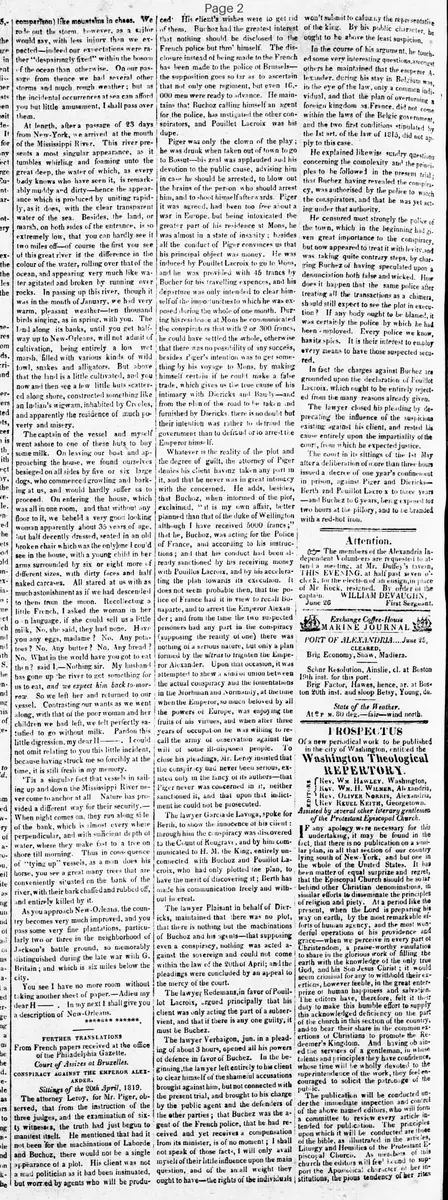
From French papers received at the office
of the Philadelphia Gazette.
Court of Assizes at Bruxelles.
CONSPIRACY AGAINST THE EMPEROR ALEXANDER.
Sittings of the 20th April, 1819.
The attorney Leroy, for Mr. Piger, observed, that from the instruction of the three judges, and the examination of sixty witnesses, the truth had just begun to manifest itself. He mentioned that had it not been for the machinations of Laborde and Buchoz, there would not be a single appearance of a plot. His client was not a mad politician as it had been insinuated, but worried by agents who will be produced: His client's wishes were to get rid of them. Buchoz had the greatest interest that nothing should be disclosed to the French police but through himself. The disclosure instead of being made to the French has been made to the police of Brussels--the supposition goes so far as to ascertain that not only one regiment, but even 16,000 men were ready to advance. He maintains that Buchoz calling himself an agent for the police, has instigated the other conspirators, and Pouillet Lacroix was his dupe.
Piger was only the clown of the play; he was drunk when taken out of town to go to Bossut---his zeal was applauded and his devotion to the public cause, advising him in case he should be arrested, to blow out the brains of the person who should arrest him, and to shoot himself afterwards. Piger it was agreed, had been too free about a war in Europe, but being intoxicated the greater part of his residence at Mons, he was almost in a state of insanity: besides all the conduct of Piger convinces us that his principal object was money. He was induced by Pouillet Lacroix to go to Mons, and he was provided with 45 francs by Bocher for his travelling expenses, and his departure was only intended to clear himself of the importunities to which he was exposed during the whole of one month. During his residence at Mons he communicated the conspirators that with 2 or 300 francs, he could have settled the whole, otherwise that there was no possibility of any success, besides Piger's intention was to get something by his voyage to Mons, by making himself certain if he could make a false trade, which gives us the true cause of his intimacy with Diericks and Baudy---and from the plan of the road to be taken and furnished by Diericks, there is no doubt but their intention was rather to defraud the government than to defraud or to arrest the Emperor himself.
Whatever is the reality of the plot and the degree of guilt, the attorney of Piger denies his client having taken any part in it, and that he never was in great intimacy with the concerned. He adds, besides, that Buchoz, when informed of the plot, exclaimed, "it is my own affair, better planned than that of the duke of Wellington although I have received 5000 francs;" that he, Buchoz, was acting for the Police of France, and according to his instructions; and that his conduct had been already sanctioned by his receiving money with Pouillot Lacroix, and by his accelerating the plan towards its execution. It does not seem probable then, that the police of France had it in view to recall Bonaparte, and to arrest the Emperor Alexander; and from the time the two suspected prisoners had any part in the conspiracy (supposing the reality of one) there was nothing of a serious nature, but only a plan formed by the ultras to frighten the Emperor Alexander. Upon that occasion, it was attempted to shew a kind of union between the actual conspiracy and the lamentations in the Morbihan and Normandy, at the time when the Emperor, so much beloved by all the powers of Europe, was enjoying the fruits of his virtues, and when after three years of occupation he was willing to recall the army of observation against the will of some ill-disposed people. To close his pleadings, Mr. Leroy insisted that the conspiracy had never been serious, existed only in the fancy of its authors---that Piger never was concerned in it, neither sanctioned it, and that upon that indictment he could not be prosecuted.
The lawyer Garcia de Lavoga, spoke for Berth, to show the innocence of his client: through him the conspiracy was discovered to the Count of Rougrave, and by him Communicated to H. M. the King, entirely unconnected with Buchoz and Pouillot Lacroix, who had only plotted the plan, to have the merit of discovering it; Berth has made his communication freely and without interest.
The lawyer Plaisant in behalf of Diericks, maintained that there was no plot, that there is nothing but the machinations of Buchoz and his agents---that supposing even a conspiracy, nothing was acted against the sovereign and could not come within the law of the 20th of April; and the pleadings were concluded by an appeal to the mercy of the court.
The lawyer Redemans, in favor of Pouillot Lacroix, argued principally that his client was only acting the part of a subservient, and that if there is any one guilty, it must be Buchez.
The lawyer Verbaigon, jun. in a pleading of about 3 hours, opened all his powers of defence in favor of Buchez. In the beginning, the lawyer left entirely to his client to clear himself of the shameful accusations brought against him, but not connected with the present trial, and brought to his charge by the public agent and the defenders of the other parties: that Buchez was the agent of the French police, that he had received and yet receives a compensation from its minister, is of no moment; I shall not speak of those facts, I will only avail myself of their little influence upon the main question, and of the small weight they ought to have---the rights of the individuals won't submit to calumny the representative of the king. By his public character, he ought to be above the least suspicion.
In the course of his argument, he touched some very interesting questions, amongst others he maintained that the emperor Alexander, during his stay in Belgium was, in the eye of the law, only a common individual, and that the plan of overturning a foreign kingdom as France, did not come within the laws of the Belgic government, and the two first conditions stipulated by the 1st art. of the law of 1815, did not apply to this case.
He explained likewise sundry questions concerning the complexity and the principles to be followed in the present trial; that Buchez having revealed the conspiracy, was authorised by the police to watch the conspirators, and that he was yet acting under that authority.
He censured most strongly the police of the town, which in the beginning had given great importance to the conspiracy, but now appeared to treat it with levity, and was taking quite contrary steps, by charging Buchez of having speculated upon a denunciation both false and wicked. How does it happen that the same police after treating all the transactions as a chimera, should still expect to see the plot in execution? If any body ought to be blamed, it was certainly the police by which he had been employed. Every police we know, has its spies. It is their interest to employ every means to have those suspected secured.
In fact the charges against Buchez are grounded upon the declaration of Pouillot Lacroix, which ought to be entirely rejected from the many reasons already given.
The lawyer closed his pleading by deprecating the influence of the suspicions existing against his client, and rested his cause entirely upon the impartiality of the court, from which he expected justice.
The court in its sittings of the 1st May after a deliberation of more than three hours issued a decree of one year's confinement in prison, against Piger and Diericks--Berth and Pouillot Lacroix to three years---and Buchez to 6 years, being exposed to two hours at the pillory, and to be branded with a red-hot iron.
What sub-type of article is it?
What keywords are associated?
What entities or persons were involved?
Where did it happen?
Foreign News Details
Primary Location
Bruxelles
Event Date
20th April 1819 To 1st May 1819
Key Persons
Outcome
court sentences on 1st may: piger and diericks to one year's imprisonment; berth and pouillot lacroix to three years' imprisonment; buchez to six years' imprisonment, two hours at the pillory, and branding with a red-hot iron.
Event Details
Trial at the Court of Assizes in Bruxelles on 20th April 1819 for conspiracy against Emperor Alexander. Attorneys for defendants Piger, Berth, Diericks, Pouillot Lacroix, and Buchez argued the plot was fabricated by French police agent Buchoz to frighten the Emperor, involving false claims of 16,000 men ready to advance and links to recalling Bonaparte. Defenses denied serious intent, claiming machinations for personal gain or police intrigue. Court deliberated and issued sentences on 1st May.