Thank you for visiting SNEWPapers!
Sign up free
Literary
November 18, 1853
Loudon Free Press
Loudon, Loudon County, Roane County, Tennessee
What is this article about?
Instructional essay on preparing new grounds for residences, critiquing hasty methods and advocating thorough grading, draining, trenching, and manuring for healthy, ornamental gardening. Adapted by WM. Beal from the Horticulturist for local climate.
Clipping
OCR Quality
98%
Excellent
Full Text
ON THE PREPARATION OF NEW GROUNDS.
Condensed and adapted to the climate from the Horticulturist, by WM. BEAL, for the "Loudon Free Press."
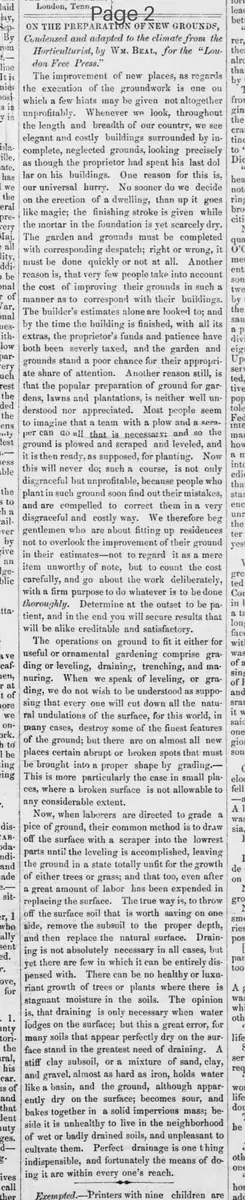
The improvement of new places, as regards the execution of the groundwork is one on which a few hints may be given not altogether unprofitably. Whenever we look, throughout the length and breadth of our country, we see elegant and costly buildings surrounded by incomplete, neglected grounds, looking precisely as though the proprietor had spent his last dollar on his buildings. One reason for this is, our universal hurry. No sooner do we decide on the erection of a dwelling, than up it goes like magic; the finishing stroke is given while the mortar in the foundation is yet scarcely dry. The garden and grounds must be completed with corresponding despatch; right or wrong, it must be done quickly or not at all. Another reason is, that very few people take into account the cost of improving their grounds in such a manner as to correspond with their buildings. The builder's estimates alone are looked to; and by the time the building is finished, with all its extras, the proprietor's funds and patience have both been severely taxed. and the garden and grounds stand a poor chance for their appropriate share of attention. Another reason still, is that the popular preparation of ground for gardens, lawns and plantations, is neither well understood nor appreciated. Most people seem to imagine that a team with a plow and a scraper can do all that is necessary: and so the ground is plowed and scraped and leveled, and it is then ready, as supposed, for planting. Now this will never do; such a course. is not only disgraceful but unprofitable, because people who plant in such ground soon find out their mistakes. and are compelled to correct them in a very disgraceful and costly way. We therefore beg gentlemen who are about fitting up residences not to overlook the improvement of their ground in their estimates—not to regard it as a mere item unworthy of note, but to count the cost carefully, and go about the work deliberately, with a firm purpose to do whatever is to be done thoroughly. Determine at the outset to be patient, and in the end you will secure results that will be alike creditable and satisfactory.
The operations on ground to fit it either for useful or ornamental gardening comprise grading or leveling, draining, trenching, and manuring. When we speak of leveling, or grading, we do not wish to be understood as supposing that every one will cut down all the natural undulations of the surface. for this would, in many cases, destroy some of the finest features of the ground: but there are on almost all new places certain abrupt or broken spots that must be brought into a proper shape by grading.— This is more particularly the case in small places, where a broken surface is not allowable to any considerable extent.
Now, when laborers are directed to grade a piece of ground, their common method is to draw off the surface with a scraper into the lowest parts until the leveling is accomplished, leaving the ground in a state totally unfit for the growth of either trees or grass; and that too, even after a great amount of labor has been expended in replacing the surface. The true way is, to throw off the surface soil that is worth saving on one side, remove the subsoil to the proper depth, and then replace the natural surface. Draining is not absolutely necessary in all cases, but yet there are few in which it can be entirely dispensed with. There can be no healthy or luxuriant growth of trees or plants where there is stagnant moisture in the soils. The opinion is, that draining is only necessary when water lodges on the surface; but this a great error, for many soils that appear perfectly dry on the surface stand in the greatest need of draining. A stiff clay subsoil, or a mixture of sand, clay, and gravel, almost as hard as iron, holds water like a basin, and the ground, although apparently dry on the surface; becomes sour, and bakes together in a solid impervious mass; beside it is unhealthy to live in the neighborhood of wet or badly drained soils, and unpleasant to cultivate them. Perfect drainage is one thing indispensable, and fortunately the means of doing it are within every one's reach.
Condensed and adapted to the climate from the Horticulturist, by WM. BEAL, for the "Loudon Free Press."
The improvement of new places, as regards the execution of the groundwork is one on which a few hints may be given not altogether unprofitably. Whenever we look, throughout the length and breadth of our country, we see elegant and costly buildings surrounded by incomplete, neglected grounds, looking precisely as though the proprietor had spent his last dollar on his buildings. One reason for this is, our universal hurry. No sooner do we decide on the erection of a dwelling, than up it goes like magic; the finishing stroke is given while the mortar in the foundation is yet scarcely dry. The garden and grounds must be completed with corresponding despatch; right or wrong, it must be done quickly or not at all. Another reason is, that very few people take into account the cost of improving their grounds in such a manner as to correspond with their buildings. The builder's estimates alone are looked to; and by the time the building is finished, with all its extras, the proprietor's funds and patience have both been severely taxed. and the garden and grounds stand a poor chance for their appropriate share of attention. Another reason still, is that the popular preparation of ground for gardens, lawns and plantations, is neither well understood nor appreciated. Most people seem to imagine that a team with a plow and a scraper can do all that is necessary: and so the ground is plowed and scraped and leveled, and it is then ready, as supposed, for planting. Now this will never do; such a course. is not only disgraceful but unprofitable, because people who plant in such ground soon find out their mistakes. and are compelled to correct them in a very disgraceful and costly way. We therefore beg gentlemen who are about fitting up residences not to overlook the improvement of their ground in their estimates—not to regard it as a mere item unworthy of note, but to count the cost carefully, and go about the work deliberately, with a firm purpose to do whatever is to be done thoroughly. Determine at the outset to be patient, and in the end you will secure results that will be alike creditable and satisfactory.
The operations on ground to fit it either for useful or ornamental gardening comprise grading or leveling, draining, trenching, and manuring. When we speak of leveling, or grading, we do not wish to be understood as supposing that every one will cut down all the natural undulations of the surface. for this would, in many cases, destroy some of the finest features of the ground: but there are on almost all new places certain abrupt or broken spots that must be brought into a proper shape by grading.— This is more particularly the case in small places, where a broken surface is not allowable to any considerable extent.
Now, when laborers are directed to grade a piece of ground, their common method is to draw off the surface with a scraper into the lowest parts until the leveling is accomplished, leaving the ground in a state totally unfit for the growth of either trees or grass; and that too, even after a great amount of labor has been expended in replacing the surface. The true way is, to throw off the surface soil that is worth saving on one side, remove the subsoil to the proper depth, and then replace the natural surface. Draining is not absolutely necessary in all cases, but yet there are few in which it can be entirely dispensed with. There can be no healthy or luxuriant growth of trees or plants where there is stagnant moisture in the soils. The opinion is, that draining is only necessary when water lodges on the surface; but this a great error, for many soils that appear perfectly dry on the surface stand in the greatest need of draining. A stiff clay subsoil, or a mixture of sand, clay, and gravel, almost as hard as iron, holds water like a basin, and the ground, although apparently dry on the surface; becomes sour, and bakes together in a solid impervious mass; beside it is unhealthy to live in the neighborhood of wet or badly drained soils, and unpleasant to cultivate them. Perfect drainage is one thing indispensable, and fortunately the means of doing it are within every one's reach.
What sub-type of article is it?
Essay
What themes does it cover?
Agriculture Rural
What keywords are associated?
Ground Preparation
Gardening Advice
Landscaping
Grading
Draining
Trenching
Manuring
What entities or persons were involved?
By Wm. Beal
Literary Details
Title
On The Preparation Of New Grounds.
Author
By Wm. Beal
Subject
Preparation Of Grounds For Useful Or Ornamental Gardening
Key Lines
The Improvement Of New Places, As Regards The Execution Of The Groundwork Is One On Which A Few Hints May Be Given Not Altogether Unprofitably.
We Therefore Beg Gentlemen Who Are About Fitting Up Residences Not To Overlook The Improvement Of Their Ground In Their Estimates—Not To Regard It As A Mere Item Unworthy Of Note, But To Count The Cost Carefully, And Go About The Work Deliberately, With A Firm Purpose To Do Whatever Is To Be Done Thoroughly.
Perfect Drainage Is One Thing Indispensable, And Fortunately The Means Of Doing It Are Within Every One's Reach.