Thank you for visiting SNEWPapers!
Sign up free
Story
July 28, 1929
Douglas Daily Dispatch
Douglas, Cochise County, Arizona
What is this article about?
Arizona tax rolls assess 6,198 mules at $100 (Class A) or $45.51 (Class B) each, joking about mule types and contrariness equating to stubborn people; 26,958 horses listed in various classes including range, work, and saddle.
Clipping
OCR Quality
95%
Excellent
Full Text
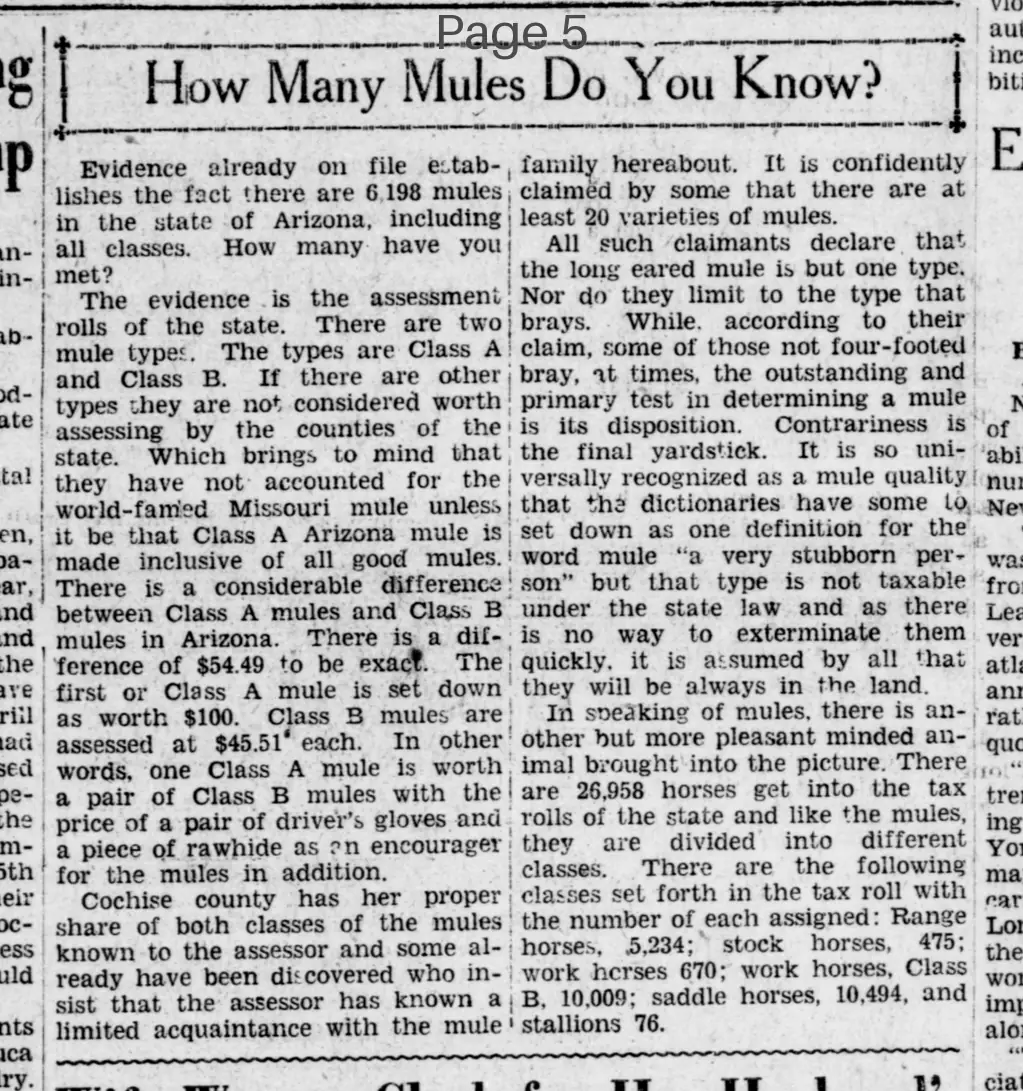
How Many Mules Do You Know?
Evidence already on file establishes the fact there are 6,198 mules in the state of Arizona, including all classes. How many have you met?
The evidence is the assessment rolls of the state. There are two mule types. The types are Class A and Class B. If there are other types they are not considered worth assessing by the counties of the state. Which brings to mind that they have not accounted for the world-famed Missouri mule unless it be that Class A Arizona mule is made inclusive of all good mules.
There is a considerable difference between Class A mules and Class B mules in Arizona. There is a difference of $54.49 to be exact. The first or Class A mule is set down as worth $100. Class B mules are assessed at $45.51 each. In other words, one Class A mule is worth a pair of Class B mules with the price of a pair of driver's gloves and a piece of rawhide as an encourager for the mules in addition.
Cochise county has her proper share of both classes of the mules known to the assessor and some already have been discovered who insist that the assessor has known a limited acquaintance with the mule family hereabout. It is confidently claimed by some that there are at least 20 varieties of mules.
All such claimants declare that the long eared mule is but one type. Nor do they limit to the type that brays. While, according to their claim, some of those not four-footed bray at times, the outstanding and primary test in determining a mule is its disposition. Contrariness is the final yardstick. It is so universally recognized as a mule quality that the dictionaries have some to set down as one definition for the word mule "a very stubborn person" but that type is not taxable under the state law and as there is no way to exterminate them quickly, it is assumed by all that they will be always in the land.
In speaking of mules, there is another but more pleasant minded animal brought into the picture. There are 26,958 horses get into the tax rolls of the state and like the mules, they are divided into different classes. There are the following classes set forth in the tax roll with the number of each assigned: Range horses, 5,234; stock horses, 475; work horses 670; work horses, Class B, 10,009; saddle horses, 10,494, and stallions 76.
Evidence already on file establishes the fact there are 6,198 mules in the state of Arizona, including all classes. How many have you met?
The evidence is the assessment rolls of the state. There are two mule types. The types are Class A and Class B. If there are other types they are not considered worth assessing by the counties of the state. Which brings to mind that they have not accounted for the world-famed Missouri mule unless it be that Class A Arizona mule is made inclusive of all good mules.
There is a considerable difference between Class A mules and Class B mules in Arizona. There is a difference of $54.49 to be exact. The first or Class A mule is set down as worth $100. Class B mules are assessed at $45.51 each. In other words, one Class A mule is worth a pair of Class B mules with the price of a pair of driver's gloves and a piece of rawhide as an encourager for the mules in addition.
Cochise county has her proper share of both classes of the mules known to the assessor and some already have been discovered who insist that the assessor has known a limited acquaintance with the mule family hereabout. It is confidently claimed by some that there are at least 20 varieties of mules.
All such claimants declare that the long eared mule is but one type. Nor do they limit to the type that brays. While, according to their claim, some of those not four-footed bray at times, the outstanding and primary test in determining a mule is its disposition. Contrariness is the final yardstick. It is so universally recognized as a mule quality that the dictionaries have some to set down as one definition for the word mule "a very stubborn person" but that type is not taxable under the state law and as there is no way to exterminate them quickly, it is assumed by all that they will be always in the land.
In speaking of mules, there is another but more pleasant minded animal brought into the picture. There are 26,958 horses get into the tax rolls of the state and like the mules, they are divided into different classes. There are the following classes set forth in the tax roll with the number of each assigned: Range horses, 5,234; stock horses, 475; work horses 670; work horses, Class B, 10,009; saddle horses, 10,494, and stallions 76.
What sub-type of article is it?
Curiosity
What themes does it cover?
Nature
What keywords are associated?
Mules
Arizona
Tax Assessment
Class A Mules
Class B Mules
Horses
Livestock
Stubbornness
Where did it happen?
Arizona
Story Details
Location
Arizona
Story Details
Arizona assessment rolls record 6,198 mules in Class A ($100 each) and Class B ($45.51 each), with humorous notes on mule varieties, stubbornness, and comparisons to untaxable stubborn people; also 26,958 horses in classes like range, stock, work, saddle, and stallions.