Thank you for visiting SNEWPapers!
Sign up free
Editorial
October 19, 1839
The Congregationalist
Hartford, Hartford County, Connecticut
What is this article about?
Editorial discusses Dr. Woodward's letter in the Medical Journal on tobacco's detrimental effects on health and voice, citing Chief Justice Reeve's case of voice loss from excessive use, and notes declining tobacco habits especially among women.
Clipping
OCR Quality
98%
Excellent
Full Text
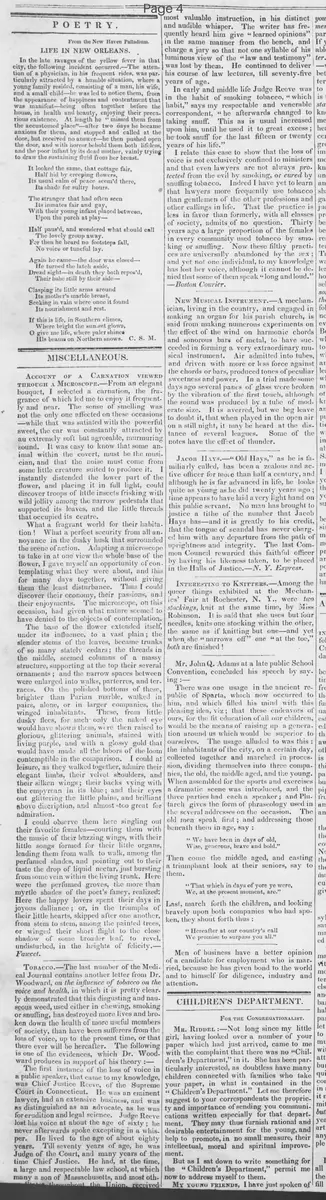
Tobacco.
The last number of the Medical Journal contains another letter from Dr. Woodward, on the influence of tobacco on the voice and health, in which it is pretty clearly demonstrated that this disgusting and nauseous weed, used either in chewing, smoking or snuffling, has destroyed more lives and broken down the health of more useful members of society, than have been sufferers from the loss of voice, up to the present time, or that there ever will be hereafter. The following is one of the evidences, which Dr. Woodward produces in support of his theory:—
The first instance of the loss of voice in a public speaker, that came to my knowledge, was Chief Justice Reeve, of the Supreme Court in Connecticut. He was an eminent lawyer, had an extensive business, and was as distinguished as an advocate, as he was for erudition and legal science. Judge Reeve lost his voice at about the age of sixty; he never afterwards spoke excepting in a whisper. He lived to the age of about eighty years. Till seventy years of age, he was Judge of the Court, and many years of the time Chief Justice. He had, at the time, a large and respectable law school, at which many a son of Massachusetts, and most others throughout the Union, received most valuable instruction, in his distinct and audible whisper. The writer has frequently heard him give "learned opinions" in the same manner from the bench, and charge a jury so that not one syllable of his luminous view of the "law and testimony" was lost by them. He continued to deliver his course of law lectures, till seventy-five years of age.
In early and middle life Judge Reeve was in the habit of smoking tobacco, "which habit," says my respectable and venerable correspondent, "he afterwards changed to taking snuff. This as is usual increased upon him, until he used it to great excess; he took snuff for the last fifteen or twenty years of his life."
I relate this case to show that the loss of voice is not exclusively confined to ministers and that even lawyers are not always protected from the evil by smoking, or cured by snuffing tobacco. Indeed I have yet to learn that lawyers more frequently use tobacco than gentlemen of the other professions and other callings in life. That the practice is less in favor than formerly, with all classes of society, admits of no question. Thirty years ago a large proportion of the females in every community used tobacco by smoking or snuffling. Now these filthy practices are universally abandoned by the sex: and yet not one individual, to my knowledge has lost her voice, although it cannot be denied that some of them speak "long and loud."
—Boston Courier.
The last number of the Medical Journal contains another letter from Dr. Woodward, on the influence of tobacco on the voice and health, in which it is pretty clearly demonstrated that this disgusting and nauseous weed, used either in chewing, smoking or snuffling, has destroyed more lives and broken down the health of more useful members of society, than have been sufferers from the loss of voice, up to the present time, or that there ever will be hereafter. The following is one of the evidences, which Dr. Woodward produces in support of his theory:—
The first instance of the loss of voice in a public speaker, that came to my knowledge, was Chief Justice Reeve, of the Supreme Court in Connecticut. He was an eminent lawyer, had an extensive business, and was as distinguished as an advocate, as he was for erudition and legal science. Judge Reeve lost his voice at about the age of sixty; he never afterwards spoke excepting in a whisper. He lived to the age of about eighty years. Till seventy years of age, he was Judge of the Court, and many years of the time Chief Justice. He had, at the time, a large and respectable law school, at which many a son of Massachusetts, and most others throughout the Union, received most valuable instruction, in his distinct and audible whisper. The writer has frequently heard him give "learned opinions" in the same manner from the bench, and charge a jury so that not one syllable of his luminous view of the "law and testimony" was lost by them. He continued to deliver his course of law lectures, till seventy-five years of age.
In early and middle life Judge Reeve was in the habit of smoking tobacco, "which habit," says my respectable and venerable correspondent, "he afterwards changed to taking snuff. This as is usual increased upon him, until he used it to great excess; he took snuff for the last fifteen or twenty years of his life."
I relate this case to show that the loss of voice is not exclusively confined to ministers and that even lawyers are not always protected from the evil by smoking, or cured by snuffing tobacco. Indeed I have yet to learn that lawyers more frequently use tobacco than gentlemen of the other professions and other callings in life. That the practice is less in favor than formerly, with all classes of society, admits of no question. Thirty years ago a large proportion of the females in every community used tobacco by smoking or snuffling. Now these filthy practices are universally abandoned by the sex: and yet not one individual, to my knowledge has lost her voice, although it cannot be denied that some of them speak "long and loud."
—Boston Courier.
What sub-type of article is it?
Science Or Medicine
Moral Or Religious
What keywords are associated?
Tobacco Health Effects
Voice Loss
Smoking Dangers
Snuff Use
Medical Journal
What entities or persons were involved?
Dr. Woodward
Chief Justice Reeve
Boston Courier
Editorial Details
Primary Topic
Harmful Effects Of Tobacco On Health And Voice
Stance / Tone
Anti Tobacco Warning
Key Figures
Dr. Woodward
Chief Justice Reeve
Boston Courier
Key Arguments
Tobacco Use In Chewing, Smoking, Or Snuffling Has Destroyed More Lives And Health Than Voice Loss Cases
Chief Justice Reeve Lost His Voice Around Age 60 After Excessive Tobacco Use, Switching From Smoking To Snuff
Loss Of Voice Not Confined To Ministers; Affects Lawyers Too
Tobacco Use Declining Across Society, Especially Abandoned By Women Who Have Not Lost Voices Despite Speaking Loudly