Thank you for visiting SNEWPapers!
Sign up free
Story
April 22, 1868
North Iowa Times
Mcgregor, Clayton County, Iowa
What is this article about?
A train on the Erie Railway derailed due to a broken rail, plunging cars down a 75-foot rocky embankment, killing many passengers. Reported with delay amid company crisis; calls for railroad safety reforms like wider embankments, better inspections, and stove-free heating.
Clipping
OCR Quality
95%
Excellent
Full Text
The heat Messenger.
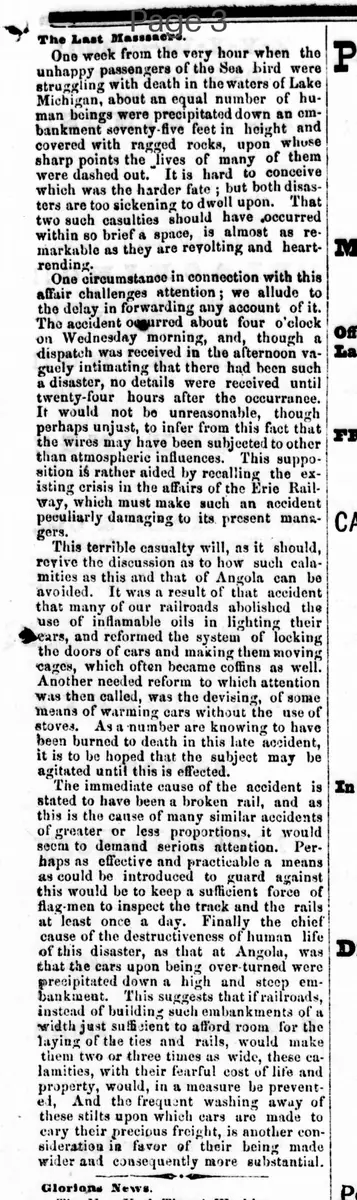
One week from the very hour when the unhappy passengers of the Sea Bird were struggling with death in the waters of Lake Michigan, about an equal number of human beings were precipitated down an embankment seventy-five feet in height and covered with ragged rocks, upon whose sharp points the "lives of many of them were dashed out." It is hard to conceive which was the harder fate; but both disasters are too sickening to dwell upon. That two such casualties should have occurred within so brief a space, is almost as remarkable as they are revolting and heart-rending.
One circumstance in connection with this affair challenges attention; we allude to the delay in forwarding any account of it. The accident occurred about four o'clock on Wednesday morning, and, though a dispatch was received in the afternoon vaguely intimating that there had been such a disaster, no details were received until twenty-four hours after the occurrence.
It would not be unreasonable, though perhaps unjust, to infer from this fact that the wires may have been subjected to other than atmospheric influences. This supposition is rather aided by recalling the existing crisis in the affairs of the Erie Railway, which must make such an accident peculiarly damaging to its present managers.
This terrible casualty will, as it should, revive the discussion as to how such calamities as this and that of Angola can be avoided. It was a result of that accident that many of our railroads abolished the use of inflammable oils in lighting their cars, and reformed the system of locking the doors of cars and making them moving cages, which often became coffins as well.
Another needed reform to which attention was then called, was the devising of some means of warming cars without the use of stoves. As a number are known to have been burned to death in this late accident, it is to be hoped that the subject may be agitated until this is effected.
The immediate cause of the accident is stated to have been a broken rail, and as this is the cause of many similar accidents of greater or less proportions, it would seem to demand serious attention. Perhaps as effective and practicable a means as could be introduced to guard against this would be to keep a sufficient force of flag-men to inspect the track and the rails at least once a day. Finally the chief cause of the destructiveness of human life of this disaster, as that at Angola, was that the cars upon being overturned were precipitated down a high and steep embankment. This suggests that if railroads, instead of building such embankments of a width just sufficient to afford room for the laying of the ties and rails, would make them two or three times as wide, these calamities, with their fearful cost of life and property, would, in a measure be prevented. And the frequent washing away of these stilts upon which cars are made to carry their precious freight, is another consideration in favor of their being made wider and consequently more substantial.
One week from the very hour when the unhappy passengers of the Sea Bird were struggling with death in the waters of Lake Michigan, about an equal number of human beings were precipitated down an embankment seventy-five feet in height and covered with ragged rocks, upon whose sharp points the "lives of many of them were dashed out." It is hard to conceive which was the harder fate; but both disasters are too sickening to dwell upon. That two such casualties should have occurred within so brief a space, is almost as remarkable as they are revolting and heart-rending.
One circumstance in connection with this affair challenges attention; we allude to the delay in forwarding any account of it. The accident occurred about four o'clock on Wednesday morning, and, though a dispatch was received in the afternoon vaguely intimating that there had been such a disaster, no details were received until twenty-four hours after the occurrence.
It would not be unreasonable, though perhaps unjust, to infer from this fact that the wires may have been subjected to other than atmospheric influences. This supposition is rather aided by recalling the existing crisis in the affairs of the Erie Railway, which must make such an accident peculiarly damaging to its present managers.
This terrible casualty will, as it should, revive the discussion as to how such calamities as this and that of Angola can be avoided. It was a result of that accident that many of our railroads abolished the use of inflammable oils in lighting their cars, and reformed the system of locking the doors of cars and making them moving cages, which often became coffins as well.
Another needed reform to which attention was then called, was the devising of some means of warming cars without the use of stoves. As a number are known to have been burned to death in this late accident, it is to be hoped that the subject may be agitated until this is effected.
The immediate cause of the accident is stated to have been a broken rail, and as this is the cause of many similar accidents of greater or less proportions, it would seem to demand serious attention. Perhaps as effective and practicable a means as could be introduced to guard against this would be to keep a sufficient force of flag-men to inspect the track and the rails at least once a day. Finally the chief cause of the destructiveness of human life of this disaster, as that at Angola, was that the cars upon being overturned were precipitated down a high and steep embankment. This suggests that if railroads, instead of building such embankments of a width just sufficient to afford room for the laying of the ties and rails, would make them two or three times as wide, these calamities, with their fearful cost of life and property, would, in a measure be prevented. And the frequent washing away of these stilts upon which cars are made to carry their precious freight, is another consideration in favor of their being made wider and consequently more substantial.
What sub-type of article is it?
Disaster
Historical Event
What themes does it cover?
Catastrophe
Misfortune
Moral Virtue
What keywords are associated?
Train Derailment
Broken Rail
Embankment Plunge
Erie Railway
Safety Reforms
Reporting Delay
Passenger Deaths
Where did it happen?
Erie Railway
Story Details
Location
Erie Railway
Event Date
Wednesday Morning, One Week After Sea Bird Disaster
Story Details
Train derails on broken rail, cars plunge down 75-foot rocky embankment killing many; delay in reporting amid Erie Railway crisis; compares to Sea Bird and Angola wrecks; urges reforms like wider embankments, daily inspections, non-inflammable lighting, and stove-free heating.