Thank you for visiting SNEWPapers!
Sign up free
Phenix Gazette
Alexandria, Virginia
What is this article about?
In a March 25, 1823 letter from Monticello, Thomas Jefferson thanks a Massachusetts manufacturer for a sample of 'negro cloth,' critiques its suitability for Virginia slaves, advocates for domestic manufacturing over European imports, and praises Henry Clay's talents and protective policies while requesting privacy amid political excitement.
Clipping
OCR Quality
Full Text
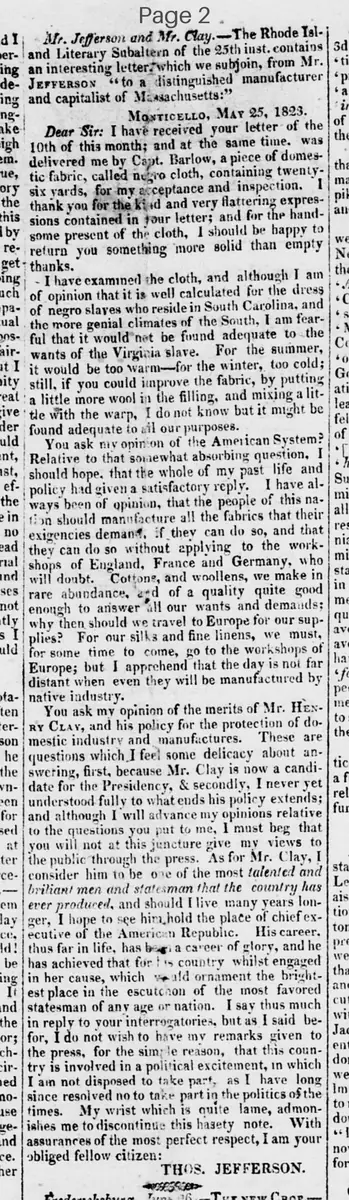
Monticello, Mar 25, 1823.
Dear Sir: I have received your letter of the 10th of this month: and at the same time, was delivered me by Capt. Barlow, a piece of domestic fabric, called negro cloth, containing twenty-six yards, for my acceptance and inspection. I thank you for the kind and very flattering expressions contained in your letter; and for the handsome present of the cloth, I should be happy to return you something more solid than empty thanks.
I have examined the cloth, and although I am of opinion that it is well calculated for the dress of negro slaves who reside in South Carolina, and the more genial climates of the South. I am fearful that it would not be found adequate to the wants of the Virginia slave. For the summer, it would be too warm—for the winter, too cold; still, if you could improve the fabric, by putting a little more wool in the filling, and mixing a little with the warp, I do not know but it might be found adequate to all our purposes.
You ask my opinion of the American System? Relative to that somewhat absorbing question, I should hope, that the whole of my past life and policy had given a satisfactory reply. I have always been of opinion, that the people of this nation should manufacture all the fabrics that their exigencies demand, if they can do so, and that they can do so without applying to the work-shops of England, France and Germany, who will doubt. Cottons, and woollens, we make in rare abundance, and of a quality quite good enough to answer all our wants and demands: why then should we travel to Europe for our supplies? For our silks and fine linens, we must, for some time to come, go to the workshops of Europe; but I apprehend that the day is not far distant when even they will be manufactured by native industry.
You ask my opinion of the merits of Mr. Henry Clay, and his policy for the protection of domestic industry and manufactures. These are questions which I feel some delicacy about answering, first, because Mr. Clay is now a candidate for the Presidency. & secondly, I never yet understood fully to what ends his policy extends; and although I will advance my opinions relative to the questions you put to me, I must beg that you will not at this juncture give my views to the public through the press. As for Mr. Clay, I consider him to be one of the most talented and brilliant men and statesman that the country has ever produced, and should I live many years longer, I hope to see him hold the place of chief executive of the American Republic. His career, thus far in life, has been a career of glory, and he has achieved that for his country whilst engaged in her cause, which would ornament the brightest place in the escutcheon of the most favored statesman of any age or nation. I say thus much in reply to your interrogatories, but as I said before, I do not wish to have my remarks given to the press, for the simple reason, that this country is involved in a political excitement, in which I am not disposed to take part, as I have long since resolved not to take part in the politics of the times. My wrist which is quite lame, admonishes me to discontinue this hasty note. With assurances of the most perfect respect, I am your obliged fellow citizen,
THOS. JEFFERSON.
What sub-type of article is it?
What themes does it cover?
What keywords are associated?
What entities or persons were involved?
Where did it happen?
Story Details
Key Persons
Location
Monticello
Event Date
Mar 25, 1823
Story Details
Jefferson receives and critiques a sample of negro cloth from a Massachusetts manufacturer, suggests improvements for Virginia use, affirms support for the American System of domestic manufacturing, praises Henry Clay's talents and policies while requesting his opinions remain private due to political sensitivities.