Thank you for visiting SNEWPapers!
Sign up free
Literary
July 30, 1881
Sacramento Daily Record Union
Sacramento, Sacramento County, California
What is this article about?
In this romantic short story, the narrator pursues Janet, a young woman on a Cook's tour in Europe, after her uncle falls ill in Aigle, Switzerland. He rescues her from a mountain fall in Callaz, they bond during the uncle's death and funeral, and he proposes, leading to marriage upon returning home.
Clipping
OCR Quality
98%
Excellent
Full Text
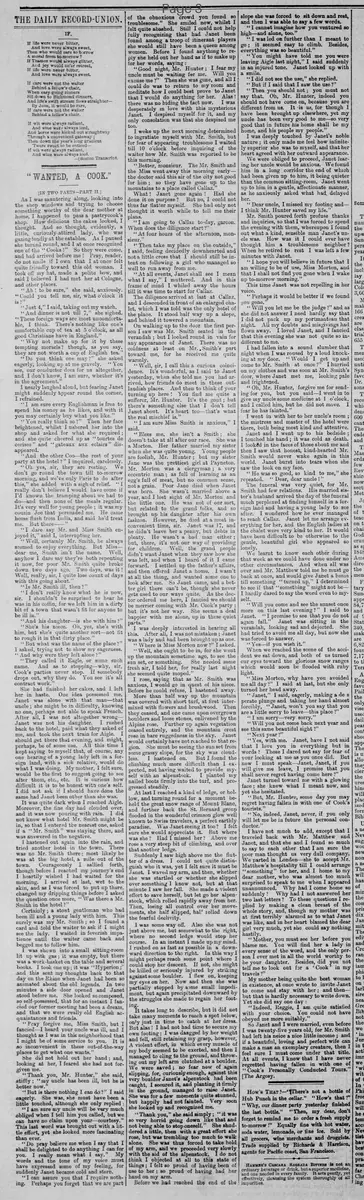
"WANTED, A COOK."
[IN TWO PARTS—PART II]
As I was sauntering along, looking into the shop windows and trying to choose something worthy of the dear mother at home, I happened to pass a pastrycook's shop. How delicious the cakes looked, I thought. And so thought, evidently, a little, curiously-attired lady, who was gazing fondly at the eatables. As I paused she turned round, and I at once recognized one of the "Cooks!" So they were come, and had arrived before me! Pray, reader, do not smile if I own that I at once felt quite friendly toward this old woman. I took off my hat, made a polite bow, and said I believed I had met her at Cologne and other places.
"Ah! to be sure," she said, anxiously. "Could you tell me, sir, what o'clock it is?"
"Just 4," I said, taking out my watch.
"And dinner is not till 7," she sighed. "These foreign ways are most uncomfortable, I think. There's nothing like one's comfortable cup of tea at 5 o'clock, as all good Christians have in England."
"Why not make up for it by these tempting morsels? though, as you say, they are not worth a cup of English tea."
"Do you think one may?" she asked eagerly, looking up at me gravely. "You see, our conductor does for us altogether, and I don't know, I am sure, whether it's in the agreement."
I nearly laughed aloud, but fearing Janet might suddenly appear round the corner, I refrained.
"I am sure every Englishman is free to spend his money as he likes, and with it you may certainly buy what you like."
"You really think so?" Then her face brightened, whilst I ushered her into the shop and asked for what she required; and she quite cheered up as "tourtes de cerises" and "gateaux aux eclairs" disappeared.
"And the other Cook—the rest of your party at the hotel?" I inquired, carelessly.
"Oh yes, sir, they are resting. We don't go round the town till to-morrow morning, and we've only Paris to do after this," she added with a sigh of relief. "I really don't believe I would have come if I'd known the tramping about we had to do—and then none of the meals regular. It's very well for young people; it was my cousin Joe that persuaded me. He came home flush from India, and said he'd treat me. But there—"
"I dare say Mr. and Miss Smith enjoyed it," said I, interrupting her.
"Well, certainly Mr. Smith, he always seemed to enjoy everything. But Miss—dear me, Smith isn't the name. Well, anyhow I dare say they're both repenting it now, for poor Mr. Smith quite broke down two days ago. Two days, was it? Well, really, sir, I quite lose count of days with this going about."
"Is Mr. Smith ill, then?"
"I don't really know what he is now, sir. I shouldn't be surprised to hear he was in his coffin, for we left him in a dirty bit of a town that wasn't fit for anyone to be ill in."
"And his daughter—is she with him?"
"She's his niece. Oh, yes, she's with him, but she's quite another sort—not fit to rough it in that dirty place."
"But what was the name of the place?" I asked, trying not to show my eagerness. "And why were they left alone?"
"They called it Eagle, or some such name. And as to stopping—why, sir, Cook's parties never stop. If somebody drops out, why they do. You see it's all contract work."
She had finished her cakes, and I left her in haste. One idea possessed me. Janet was alone with that man—that uncle: she might be in difficulty, knowing no one, perhaps not able to speak French. After all, I was not altogether wrong—Janet was not his daughter. I rushed back to the hotel, paid what they asked of me, and took the next train for Aigle. I should get there that evening, and might, perhaps, be of some use. All this time I kept saying to myself that, of course, anyone hearing of a young lady left in a foreign land, with a sick relative, would do what I was doing. My mother, I felt sure, would be the first to suggest going to see after them, etc., etc. It is curious how difficult it is to be honest with one's self. I did not ask if I should have done the same had Janet been other than she was.
It was quite dark when I reached Aigle. Moreover, the fine day had clouded over and it was now pouring with rain. I did not know what hotel Mr. Smith might be in, so that I entered the nearest one, asked if a "Mr. Smith" was staying there, and was answered in the negative.
I hastened out again into the rain, and tried another hotel in the town. There was no Mr. Smith there: most likely he was at the big hotel, a mile out of the town. Courageously I sallied forth, though before I reached my journey's end I heartily wished I had waited for the morning. I arrived at last, wet to the skin, and as I was forced to put up there, changed my dripping things before I asked the question once more, "Was there a Mr. Smith in the hotel?"
Certainly; a stout gentleman who had been ill and a young lady with him. This surely was my Mr. Smith; so I found a card and told the waiter to ask if I might see the lady. I waited in feverish impatience until the waiter came back and begged me to follow him.
I was shown into a small sitting-room lit up with gas; it was empty, but there was a work-basket on the table and several books. I took one up; it was "Hyperion," and this sent my thoughts back to that day on the Rhine when Janet had been so animated about the old legends. In two minutes a side door opened and Janet stood before me. She looked so composed, so self-possessed, that for an instant I fancied our former meeting had been a dream, and that we were really old English acquaintances and friends.
"Pray forgive me, Miss Smith, but I fancied—I heard your uncle was ill, and I thought as I was in this neighborhood that I might be of some service to you. It is so inconvenient in these out-of-the-way places to get what one wants."
She did not hold out her hand; and looking at her, I feared she had not forgiven me.
"Thank you, Mr. Hunter," she said stiffly; "my uncle has been ill, but he is better now."
"But is there nothing I can do?" I said eagerly. She was, she must have been a little touched, although she only replied:
"I am sure my uncle will be very much obliged when I tell him you called, but we can have no claim upon your—courtesy."
This last word was brought out with a little effort, yet she looked more fascinating than ever.
"Do pray believe me when I say that I shall be delighted to do anything I can for you. I really mean what I say." My words and the tone of my voice must have expressed some of my feeling, for suddenly Janet became cold and stern.
"I can assure you that I require nothing. Perhaps you forget that we are part of the obnoxious crowd you found so troublesome." She smiled now, whilst I felt quite abashed. Still I could not help fully recognizing that had Janet been found among a troop of itinerant players she would still have been a queen among women. Before I found anything to reply she held out her hand as if to make up for her words, saying:
"Good night, Mr. Hunter; I fear my uncle must be waiting for me. Will you excuse me?" Then she was gone, and all I could do was to return to my room and meditate how I could best prove to Janet that I would do anything for her. Alas! there was no hiding the fact now. I was desperately in love with this mysterious Janet. I despised myself for it, and my only consolation was that she despised me too.
I woke up the next morning determined to ingratiate myself with Mr. Smith, but for fear of appearing troublesome I waited till 10 o'clock before inquiring of the waiter how Mr. Smith was reported to be this morning.
"Better, monsieur. The Mr. Smith and the Miss went away this morning early—the doctor said this air of the city not good for him; so they have gone up to the mountains to a place called Callaz."
What! Janet gone again! Had she done it on purpose? But no, I could not thus far flatter myself. She had only not thought it worth while to tell me their plans.
"I am going to Callaz to-day, garcon. When does the diligence start?"
"At four hours of the afternoon, mon sieur."
"Then take my place on the outside," I said, feeling decidedly downhearted and not a little cross that I should still be intent on following a girl who managed so well to run away from me.
"At all events, Janet shall see I mean what I say," I muttered. And in this frame of mind I whiled away the hours till it was time to start for Callaz.
The diligence arrived at last at Callaz, and I descended in front of an enlarged chalet, which I was told was the only hotel of the place. It stood half way up a slope, and behind it towered a mountain.
On walking up to the door the first person I saw was Mr. Smith seated in the verandah; but I looked round in vain for any appearance of Janet. There was no coldness at least on Mr. Smith's part toward me, for he received me quite warmly.
"Well, sir, I call this a curious coincidence. It's wonderful, as I said to Janet yesterday, when she told me you had arrived, how friends do meet in these outlandish places. And then to think of your turning up here! You find me quite a sufferer, Mr. Hunter. It's the gout; but there's something else that I don't tell Janet about. It's heart too—that's what the real mischief is."
"I am sure Miss Smith is anxious," I said.
"Bless me, she isn't a Smith; she doesn't take at all after our race. She was a Morton. Her father married my sister when she was quite young. Young people are foolish, Mr. Hunter; but my sister Jane was the prettiest girl at Payneton. Mr. Morton was a clergyman; a very eccentric man; as full of learning as an egg's full of meat, but no common sense, not a grain. Poor Jane died when Janet was born. She wasn't married above a year, and I lost sight of Mr. Morton and the little one. He was not of our sort, but related to the grand folks, and so brought up his daughter after his own fashion. However, he died at a most inconvenient time, sir. Janet was 17, and he didn't leave her a penny, but debts in plenty. He wasn't a bad man either; but, there, it's not our way of providing for children. Well, the grand people didn't want Janet when they saw how she was left, and when I heard of it I came forward. I settled up the father's affairs, and then offered Janet a home. I wasn't at all the thing, and wanted some one to look after me. So Janet came, and a better girl there can't be, though she never gets used to our ways quite. As the doctor ordered me here, I fancied we should be merrier coming with Mr. Cook's party; but it's not her way. She seems a deal happier with me alone, up in these quiet parts."
I was deeply interested in hearing all this. After all, I was not mistaken; Janet was a lady and had been brought up as one.
"Where is Miss Morton now?" I asked.
"Well, she ought to be in, for she went up the mountain sometime ago, to see the sun set, or something. She needed some fresh air, I told her, for really last night she seemed quite moped."
I rose, saying that as Mr. Smith was anxious, I would go in quest of his niece. Before he could refuse, I hastened away.
More than half way up the mountain was covered with short turf, at first intermingled with flowers and brushwood. Then they ceased, and one came upon overgrown boulders and loose stones, enlivened by the Alpine rose. Further up again vegetation ceased entirely, and the mountain crest rose in bare ruggedness in the sky. Janet would certainly have not reached to that region. She must be seeing the sun set from some grassy slope, for the sky was cloudless. I hastened on. But I found the climbing much more difficult than I expected, not having waited to provide myself with an alpenstock. I planted my nailed boots firmly into the turf, and progressed steadily.
At last I reached a kind of ledge, or hollow, and turning round for a moment beheld the great snow range of Mount Blanc, and further back the St. Bernard group flooded in the wonderful crimson glow well known to Swiss travelers, a perfect earthly paradise. Was Janet seeing it too? I felt sure she would appreciate it. But where was she? Had I missed her? Above me rose a very steep bit of climbing, and over that another ledge.
Suddenly I saw high above me the flutter of a dress. I could not quite distinguish who it was, yet I felt sure it must be Janet. I waved my arm, and then, whether she was startled or whether she slipped over something I know not, but at that minute I saw her fall. She made a violent effort to save herself, but let go her alpenstock, which rolled rapidly away from her. Then, losing all control over her movements, she half slipped, half rolled down the fearful declivity.
I was some way off. Also she was not just above me, but somewhat to the right, where no second ledge would stop her course. In an instant I made up my mind. I rushed on as fast as possible in a downward direction to the right. In this way I might perhaps reach some point where I could stop her descent. If not, she might be killed or seriously injured by striking against some boulder. I flew on, keeping my eyes on her. Now and then she was partially stopped by some small impediment, but again precipitated downward by the struggles she made to regain her footing.
It takes long to describe, but it did not take many moments to reach a spot below, only just in time to catch at her dress. But alas! I had not had time to secure my own footing: I was dragged by her weight and fell, still retaining my grasp, however. A violent effort, in which every muscle of my body seemed to be exerted, and then I managed to cling to the ground, and throwing out my left arm clutched at a boulder.
We were saved; no fear now of again slipping, for, curiously enough, against this very boulder Janet's alpenstock had been caught. I secured it, and planting it firmly in the ground, managed to raise Janet.
She was for a few moments quite stunned, but happily had not fainted. Very soon she looked up and recognized me.
"Thank you," she said simply; "it was so very horrid going down like that and not being able to stop oneself." She shuddered a little, then with a great effort she rose, but was trembling too much to walk alone. She was thus forced to take hold of my arm, and we proceeded very slowly with the aid of the alpenstock. I do not think I objected at all to this state of things; I felt so proud of having been of use to her; so proud of having had her hand on my arm.
Before we had reached the end of the slope she was forced to sit down and rest, and then I was able to say a few words.
"I cannot imagine how you ventured so high—and alone, too."
"I was led on further than I meant to go; it seemed easy to climb. Besides, everything was so beautiful."
"You might have told me you were leaving Aigle last night," I said suddenly in an injured tone. Janet looked up with a smile.
"I did not see the use." she replied.
"But if I said that I saw the use?"
"Then you should not; you must not say that. Oh, Mr. Hunter, indeed you should not have come on, because you are different from us. It is us, for though I have been brought up elsewhere, yet my uncle has been very good to me—so very good that in future his home shall be my home, and his people my people."
I was deeply touched by Janet's noble nature; it only made me feel how infinitely superior she was to myself, and that her heart agreed with her outward appearance.
We were obliged to proceed, Janet fearing her uncle would be anxious. We found him in a long corridor the end of which had been given up to him, it being quieter than the common sitting-room. Janet went up to him in a gentle, affectionate manner, as he anxiously asked what had delayed her.
"Dear uncle, I missed my footing and I think Mr. Hunter saved my life."
Mr. Smith poured forth profuse thanks and inquiries, so that I was forced to spend the evening with them, whereupon I found out what a kind, sensible man Janet's uncle was. How was it I could ever have thought him a troublesome neighbor?
When he retired to rest I was left a few minutes with Janet.
"I hope you will believe in future that I am willing to be of use, Miss Morton, and that I shall not find you gone when I wake up to-morrow morning."
This time Janet was not repelling in her voice.
"Perhaps it would be better if we found you gone."
"Will you let me be the judge?" and as she did not answer I need hardly say that I did not pack up my portmanteau that night. All my doubts and misgivings had flown away. I loved Janet, and I fancied that this evening she was not quite so indifferent to me.
I had fallen into a sound slumber that night when I was roused by a loud knocking at my door. "Would I get up and come to Mr. Smith at once?" I hurried on my clothes and was soon at Mr. Smith's door, where Janet met me, looking pale and frightened.
"Oh, Mr. Hunter, forgive me for sending for you, but you said—I went in to give my uncle some medicine at 1 o'clock, and I called him, but he did not move. I fear he has fainted."
I went in with her to her uncle's room; the mistress and master of the hotel were there, both being most kind and attentive. Janet and I went up to his bedside; I touched his hand; it was cold as death. I looked in the faces of those about me and then I saw that honest, kind-hearted Mr. Smith would never wake again in this world. Janet burst into tears when she saw the look on my face.
"He was so good, so kind to me," she repeated. "Dear, dear uncle!"
The funeral was very quiet, for Mr. Smith had few relations. His married sister's husband arrived the day of the funeral much perplexed at finding himself in a foreign land and having a young lady to see after. I wondered how he ever managed to reach Callaz. Janet let me arrange everything for her, and the English ladies at the chalet were very kind to her. It would have been difficult to be otherwise to the gentle, beautiful girl who appeared so lonely.
We learnt to know each other during that week as we could have done under no other circumstances. And when all was over and Mr. Matthew told me he must go back at once, and would give Janet a home till something "turned up," I determined to see if that "something" might not be I. I hardly dared to say the word even to myself.
"Will you come and see the sunset once more on this last evening?" I said to Janet. "I promise to see that you do not again fall." Janet was sitting in the verandah, looking sad and dejected. She had tried to avoid me all day, but now she was forced to answer.
"Yes—if you wish it."
When we reached the scene of the accident we sat down, and both of us turned our eyes toward the glorious snow ranges which would soon be flooded with ruby light.
"Miss Morton, why have you avoided me all day?" I said at last, but she only turned her head away.
"Janet," I said, eagerly, making a desperate plunge and taking her hand almost forcibly, "Janet, won't you say that you are a little sorry to leave—this place?"
"I am sorry—very sorry."
"Will you not come back next year and see this same beautiful sight?"
"Next year?"
"Yes, with me. Janet, have I not said that I love you in everything but in words? Those I dared not say for fear of your looking at me as you once did. But now I must speak—Janet, Janet, if you will give me leave, I promise that you shall never regret having come here?"
Janet turned toward me with a glowing face; she knew what I meant now, and yet she hesitated.
"But, Mr. Hunter, some day you may regret having fallen in with one of Cook's tourists."
"No, indeed, Janet, never, if you only will let me be in future the personal conductor."
I have not much to add, except that I traveled back with Mr. Matthew and Janet, and that she and I found so much to say to each other that I am sure the poor man thought us very dull company.
We parted in London—she to accept Mr. Matthew's hospitality till I could arrange "something" for her, and I home to my dear mother, who was almost too much surprised to speak to me when I appeared unannounced. "Why had I come home so suddenly? Why had I not answered her two last letters?" To these questions I replied by making a clean breast of the whole story, and, though my mother was at first terribly alarmed as to what Janet was like, and in her heart blamed the dear girl very much, yet she could say nothing hastily.
"Mother, you must see her before you blame me. You will find her a lady in every sense of the word, and the only person I ever met in all the world worthy to be your daughter. Besides, did you not tell me to look out for a Cook in my travels?"
My mother being quite the best woman in existence, at once wrote to invite Janet to come and stay with her: and then—but that is hardly necessary to write down.
Yet she did say one day:
"Indeed, Reggie, I am quite satisfied with your choice. You could not have obeyed me more suitably."
So Janet and I were married, even before I was twenty-five years old, for Mr. Smith had left his niece a nice little income; and if a beautiful, loving and perfect wife can make a man an exemplary creature, then I feel sure I must come under that title.
At all events, I know that I have never regretted having fallen in with one of "Cook's Personally Conducted Tours."
[The Argosy.
[IN TWO PARTS—PART II]
As I was sauntering along, looking into the shop windows and trying to choose something worthy of the dear mother at home, I happened to pass a pastrycook's shop. How delicious the cakes looked, I thought. And so thought, evidently, a little, curiously-attired lady, who was gazing fondly at the eatables. As I paused she turned round, and I at once recognized one of the "Cooks!" So they were come, and had arrived before me! Pray, reader, do not smile if I own that I at once felt quite friendly toward this old woman. I took off my hat, made a polite bow, and said I believed I had met her at Cologne and other places.
"Ah! to be sure," she said, anxiously. "Could you tell me, sir, what o'clock it is?"
"Just 4," I said, taking out my watch.
"And dinner is not till 7," she sighed. "These foreign ways are most uncomfortable, I think. There's nothing like one's comfortable cup of tea at 5 o'clock, as all good Christians have in England."
"Why not make up for it by these tempting morsels? though, as you say, they are not worth a cup of English tea."
"Do you think one may?" she asked eagerly, looking up at me gravely. "You see, our conductor does for us altogether, and I don't know, I am sure, whether it's in the agreement."
I nearly laughed aloud, but fearing Janet might suddenly appear round the corner, I refrained.
"I am sure every Englishman is free to spend his money as he likes, and with it you may certainly buy what you like."
"You really think so?" Then her face brightened, whilst I ushered her into the shop and asked for what she required; and she quite cheered up as "tourtes de cerises" and "gateaux aux eclairs" disappeared.
"And the other Cook—the rest of your party at the hotel?" I inquired, carelessly.
"Oh yes, sir, they are resting. We don't go round the town till to-morrow morning, and we've only Paris to do after this," she added with a sigh of relief. "I really don't believe I would have come if I'd known the tramping about we had to do—and then none of the meals regular. It's very well for young people; it was my cousin Joe that persuaded me. He came home flush from India, and said he'd treat me. But there—"
"I dare say Mr. and Miss Smith enjoyed it," said I, interrupting her.
"Well, certainly Mr. Smith, he always seemed to enjoy everything. But Miss—dear me, Smith isn't the name. Well, anyhow I dare say they're both repenting it now, for poor Mr. Smith quite broke down two days ago. Two days, was it? Well, really, sir, I quite lose count of days with this going about."
"Is Mr. Smith ill, then?"
"I don't really know what he is now, sir. I shouldn't be surprised to hear he was in his coffin, for we left him in a dirty bit of a town that wasn't fit for anyone to be ill in."
"And his daughter—is she with him?"
"She's his niece. Oh, yes, she's with him, but she's quite another sort—not fit to rough it in that dirty place."
"But what was the name of the place?" I asked, trying not to show my eagerness. "And why were they left alone?"
"They called it Eagle, or some such name. And as to stopping—why, sir, Cook's parties never stop. If somebody drops out, why they do. You see it's all contract work."
She had finished her cakes, and I left her in haste. One idea possessed me. Janet was alone with that man—that uncle: she might be in difficulty, knowing no one, perhaps not able to speak French. After all, I was not altogether wrong—Janet was not his daughter. I rushed back to the hotel, paid what they asked of me, and took the next train for Aigle. I should get there that evening, and might, perhaps, be of some use. All this time I kept saying to myself that, of course, anyone hearing of a young lady left in a foreign land, with a sick relative, would do what I was doing. My mother, I felt sure, would be the first to suggest going to see after them, etc., etc. It is curious how difficult it is to be honest with one's self. I did not ask if I should have done the same had Janet been other than she was.
It was quite dark when I reached Aigle. Moreover, the fine day had clouded over and it was now pouring with rain. I did not know what hotel Mr. Smith might be in, so that I entered the nearest one, asked if a "Mr. Smith" was staying there, and was answered in the negative.
I hastened out again into the rain, and tried another hotel in the town. There was no Mr. Smith there: most likely he was at the big hotel, a mile out of the town. Courageously I sallied forth, though before I reached my journey's end I heartily wished I had waited for the morning. I arrived at last, wet to the skin, and as I was forced to put up there, changed my dripping things before I asked the question once more, "Was there a Mr. Smith in the hotel?"
Certainly; a stout gentleman who had been ill and a young lady with him. This surely was my Mr. Smith; so I found a card and told the waiter to ask if I might see the lady. I waited in feverish impatience until the waiter came back and begged me to follow him.
I was shown into a small sitting-room lit up with gas; it was empty, but there was a work-basket on the table and several books. I took one up; it was "Hyperion," and this sent my thoughts back to that day on the Rhine when Janet had been so animated about the old legends. In two minutes a side door opened and Janet stood before me. She looked so composed, so self-possessed, that for an instant I fancied our former meeting had been a dream, and that we were really old English acquaintances and friends.
"Pray forgive me, Miss Smith, but I fancied—I heard your uncle was ill, and I thought as I was in this neighborhood that I might be of some service to you. It is so inconvenient in these out-of-the-way places to get what one wants."
She did not hold out her hand; and looking at her, I feared she had not forgiven me.
"Thank you, Mr. Hunter," she said stiffly; "my uncle has been ill, but he is better now."
"But is there nothing I can do?" I said eagerly. She was, she must have been a little touched, although she only replied:
"I am sure my uncle will be very much obliged when I tell him you called, but we can have no claim upon your—courtesy."
This last word was brought out with a little effort, yet she looked more fascinating than ever.
"Do pray believe me when I say that I shall be delighted to do anything I can for you. I really mean what I say." My words and the tone of my voice must have expressed some of my feeling, for suddenly Janet became cold and stern.
"I can assure you that I require nothing. Perhaps you forget that we are part of the obnoxious crowd you found so troublesome." She smiled now, whilst I felt quite abashed. Still I could not help fully recognizing that had Janet been found among a troop of itinerant players she would still have been a queen among women. Before I found anything to reply she held out her hand as if to make up for her words, saying:
"Good night, Mr. Hunter; I fear my uncle must be waiting for me. Will you excuse me?" Then she was gone, and all I could do was to return to my room and meditate how I could best prove to Janet that I would do anything for her. Alas! there was no hiding the fact now. I was desperately in love with this mysterious Janet. I despised myself for it, and my only consolation was that she despised me too.
I woke up the next morning determined to ingratiate myself with Mr. Smith, but for fear of appearing troublesome I waited till 10 o'clock before inquiring of the waiter how Mr. Smith was reported to be this morning.
"Better, monsieur. The Mr. Smith and the Miss went away this morning early—the doctor said this air of the city not good for him; so they have gone up to the mountains to a place called Callaz."
What! Janet gone again! Had she done it on purpose? But no, I could not thus far flatter myself. She had only not thought it worth while to tell me their plans.
"I am going to Callaz to-day, garcon. When does the diligence start?"
"At four hours of the afternoon, mon sieur."
"Then take my place on the outside," I said, feeling decidedly downhearted and not a little cross that I should still be intent on following a girl who managed so well to run away from me.
"At all events, Janet shall see I mean what I say," I muttered. And in this frame of mind I whiled away the hours till it was time to start for Callaz.
The diligence arrived at last at Callaz, and I descended in front of an enlarged chalet, which I was told was the only hotel of the place. It stood half way up a slope, and behind it towered a mountain.
On walking up to the door the first person I saw was Mr. Smith seated in the verandah; but I looked round in vain for any appearance of Janet. There was no coldness at least on Mr. Smith's part toward me, for he received me quite warmly.
"Well, sir, I call this a curious coincidence. It's wonderful, as I said to Janet yesterday, when she told me you had arrived, how friends do meet in these outlandish places. And then to think of your turning up here! You find me quite a sufferer, Mr. Hunter. It's the gout; but there's something else that I don't tell Janet about. It's heart too—that's what the real mischief is."
"I am sure Miss Smith is anxious," I said.
"Bless me, she isn't a Smith; she doesn't take at all after our race. She was a Morton. Her father married my sister when she was quite young. Young people are foolish, Mr. Hunter; but my sister Jane was the prettiest girl at Payneton. Mr. Morton was a clergyman; a very eccentric man; as full of learning as an egg's full of meat, but no common sense, not a grain. Poor Jane died when Janet was born. She wasn't married above a year, and I lost sight of Mr. Morton and the little one. He was not of our sort, but related to the grand folks, and so brought up his daughter after his own fashion. However, he died at a most inconvenient time, sir. Janet was 17, and he didn't leave her a penny, but debts in plenty. He wasn't a bad man either; but, there, it's not our way of providing for children. Well, the grand people didn't want Janet when they saw how she was left, and when I heard of it I came forward. I settled up the father's affairs, and then offered Janet a home. I wasn't at all the thing, and wanted some one to look after me. So Janet came, and a better girl there can't be, though she never gets used to our ways quite. As the doctor ordered me here, I fancied we should be merrier coming with Mr. Cook's party; but it's not her way. She seems a deal happier with me alone, up in these quiet parts."
I was deeply interested in hearing all this. After all, I was not mistaken; Janet was a lady and had been brought up as one.
"Where is Miss Morton now?" I asked.
"Well, she ought to be in, for she went up the mountain sometime ago, to see the sun set, or something. She needed some fresh air, I told her, for really last night she seemed quite moped."
I rose, saying that as Mr. Smith was anxious, I would go in quest of his niece. Before he could refuse, I hastened away.
More than half way up the mountain was covered with short turf, at first intermingled with flowers and brushwood. Then they ceased, and one came upon overgrown boulders and loose stones, enlivened by the Alpine rose. Further up again vegetation ceased entirely, and the mountain crest rose in bare ruggedness in the sky. Janet would certainly have not reached to that region. She must be seeing the sun set from some grassy slope, for the sky was cloudless. I hastened on. But I found the climbing much more difficult than I expected, not having waited to provide myself with an alpenstock. I planted my nailed boots firmly into the turf, and progressed steadily.
At last I reached a kind of ledge, or hollow, and turning round for a moment beheld the great snow range of Mount Blanc, and further back the St. Bernard group flooded in the wonderful crimson glow well known to Swiss travelers, a perfect earthly paradise. Was Janet seeing it too? I felt sure she would appreciate it. But where was she? Had I missed her? Above me rose a very steep bit of climbing, and over that another ledge.
Suddenly I saw high above me the flutter of a dress. I could not quite distinguish who it was, yet I felt sure it must be Janet. I waved my arm, and then, whether she was startled or whether she slipped over something I know not, but at that minute I saw her fall. She made a violent effort to save herself, but let go her alpenstock, which rolled rapidly away from her. Then, losing all control over her movements, she half slipped, half rolled down the fearful declivity.
I was some way off. Also she was not just above me, but somewhat to the right, where no second ledge would stop her course. In an instant I made up my mind. I rushed on as fast as possible in a downward direction to the right. In this way I might perhaps reach some point where I could stop her descent. If not, she might be killed or seriously injured by striking against some boulder. I flew on, keeping my eyes on her. Now and then she was partially stopped by some small impediment, but again precipitated downward by the struggles she made to regain her footing.
It takes long to describe, but it did not take many moments to reach a spot below, only just in time to catch at her dress. But alas! I had not had time to secure my own footing: I was dragged by her weight and fell, still retaining my grasp, however. A violent effort, in which every muscle of my body seemed to be exerted, and then I managed to cling to the ground, and throwing out my left arm clutched at a boulder.
We were saved; no fear now of again slipping, for, curiously enough, against this very boulder Janet's alpenstock had been caught. I secured it, and planting it firmly in the ground, managed to raise Janet.
She was for a few moments quite stunned, but happily had not fainted. Very soon she looked up and recognized me.
"Thank you," she said simply; "it was so very horrid going down like that and not being able to stop oneself." She shuddered a little, then with a great effort she rose, but was trembling too much to walk alone. She was thus forced to take hold of my arm, and we proceeded very slowly with the aid of the alpenstock. I do not think I objected at all to this state of things; I felt so proud of having been of use to her; so proud of having had her hand on my arm.
Before we had reached the end of the slope she was forced to sit down and rest, and then I was able to say a few words.
"I cannot imagine how you ventured so high—and alone, too."
"I was led on further than I meant to go; it seemed easy to climb. Besides, everything was so beautiful."
"You might have told me you were leaving Aigle last night," I said suddenly in an injured tone. Janet looked up with a smile.
"I did not see the use." she replied.
"But if I said that I saw the use?"
"Then you should not; you must not say that. Oh, Mr. Hunter, indeed you should not have come on, because you are different from us. It is us, for though I have been brought up elsewhere, yet my uncle has been very good to me—so very good that in future his home shall be my home, and his people my people."
I was deeply touched by Janet's noble nature; it only made me feel how infinitely superior she was to myself, and that her heart agreed with her outward appearance.
We were obliged to proceed, Janet fearing her uncle would be anxious. We found him in a long corridor the end of which had been given up to him, it being quieter than the common sitting-room. Janet went up to him in a gentle, affectionate manner, as he anxiously asked what had delayed her.
"Dear uncle, I missed my footing and I think Mr. Hunter saved my life."
Mr. Smith poured forth profuse thanks and inquiries, so that I was forced to spend the evening with them, whereupon I found out what a kind, sensible man Janet's uncle was. How was it I could ever have thought him a troublesome neighbor?
When he retired to rest I was left a few minutes with Janet.
"I hope you will believe in future that I am willing to be of use, Miss Morton, and that I shall not find you gone when I wake up to-morrow morning."
This time Janet was not repelling in her voice.
"Perhaps it would be better if we found you gone."
"Will you let me be the judge?" and as she did not answer I need hardly say that I did not pack up my portmanteau that night. All my doubts and misgivings had flown away. I loved Janet, and I fancied that this evening she was not quite so indifferent to me.
I had fallen into a sound slumber that night when I was roused by a loud knocking at my door. "Would I get up and come to Mr. Smith at once?" I hurried on my clothes and was soon at Mr. Smith's door, where Janet met me, looking pale and frightened.
"Oh, Mr. Hunter, forgive me for sending for you, but you said—I went in to give my uncle some medicine at 1 o'clock, and I called him, but he did not move. I fear he has fainted."
I went in with her to her uncle's room; the mistress and master of the hotel were there, both being most kind and attentive. Janet and I went up to his bedside; I touched his hand; it was cold as death. I looked in the faces of those about me and then I saw that honest, kind-hearted Mr. Smith would never wake again in this world. Janet burst into tears when she saw the look on my face.
"He was so good, so kind to me," she repeated. "Dear, dear uncle!"
The funeral was very quiet, for Mr. Smith had few relations. His married sister's husband arrived the day of the funeral much perplexed at finding himself in a foreign land and having a young lady to see after. I wondered how he ever managed to reach Callaz. Janet let me arrange everything for her, and the English ladies at the chalet were very kind to her. It would have been difficult to be otherwise to the gentle, beautiful girl who appeared so lonely.
We learnt to know each other during that week as we could have done under no other circumstances. And when all was over and Mr. Matthew told me he must go back at once, and would give Janet a home till something "turned up," I determined to see if that "something" might not be I. I hardly dared to say the word even to myself.
"Will you come and see the sunset once more on this last evening?" I said to Janet. "I promise to see that you do not again fall." Janet was sitting in the verandah, looking sad and dejected. She had tried to avoid me all day, but now she was forced to answer.
"Yes—if you wish it."
When we reached the scene of the accident we sat down, and both of us turned our eyes toward the glorious snow ranges which would soon be flooded with ruby light.
"Miss Morton, why have you avoided me all day?" I said at last, but she only turned her head away.
"Janet," I said, eagerly, making a desperate plunge and taking her hand almost forcibly, "Janet, won't you say that you are a little sorry to leave—this place?"
"I am sorry—very sorry."
"Will you not come back next year and see this same beautiful sight?"
"Next year?"
"Yes, with me. Janet, have I not said that I love you in everything but in words? Those I dared not say for fear of your looking at me as you once did. But now I must speak—Janet, Janet, if you will give me leave, I promise that you shall never regret having come here?"
Janet turned toward me with a glowing face; she knew what I meant now, and yet she hesitated.
"But, Mr. Hunter, some day you may regret having fallen in with one of Cook's tourists."
"No, indeed, Janet, never, if you only will let me be in future the personal conductor."
I have not much to add, except that I traveled back with Mr. Matthew and Janet, and that she and I found so much to say to each other that I am sure the poor man thought us very dull company.
We parted in London—she to accept Mr. Matthew's hospitality till I could arrange "something" for her, and I home to my dear mother, who was almost too much surprised to speak to me when I appeared unannounced. "Why had I come home so suddenly? Why had I not answered her two last letters?" To these questions I replied by making a clean breast of the whole story, and, though my mother was at first terribly alarmed as to what Janet was like, and in her heart blamed the dear girl very much, yet she could say nothing hastily.
"Mother, you must see her before you blame me. You will find her a lady in every sense of the word, and the only person I ever met in all the world worthy to be your daughter. Besides, did you not tell me to look out for a Cook in my travels?"
My mother being quite the best woman in existence, at once wrote to invite Janet to come and stay with her: and then—but that is hardly necessary to write down.
Yet she did say one day:
"Indeed, Reggie, I am quite satisfied with your choice. You could not have obeyed me more suitably."
So Janet and I were married, even before I was twenty-five years old, for Mr. Smith had left his niece a nice little income; and if a beautiful, loving and perfect wife can make a man an exemplary creature, then I feel sure I must come under that title.
At all events, I know that I have never regretted having fallen in with one of "Cook's Personally Conducted Tours."
[The Argosy.
What sub-type of article is it?
Prose Fiction
What themes does it cover?
Love Romance
Social Manners
What keywords are associated?
Romance
Travel
Tourists
Switzerland
Cook Tours
Mountain Rescue
Marriage
Literary Details
Title
"Wanted, A Cook." [In Two Parts—Part Ii]
Key Lines
"No, Indeed, Janet, Never, If You Only Will Let Me Be In Future The Personal Conductor."
So Janet And I Were Married, Even Before I Was Twenty Five Years Old, For Mr. Smith Had Left His Niece A Nice Little Income; And If A Beautiful, Loving And Perfect Wife Can Make A Man An Exemplary Creature, Then I Feel Sure I Must Come Under That Title.
At All Events, I Know That I Have Never Regretted Having Fallen In With One Of "Cook's Personally Conducted Tours."