Thank you for visiting SNEWPapers!
Sign up free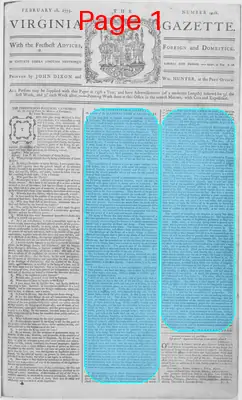
The Virginia Gazette
Richmond, Williamsburg, Richmond County, Virginia
What is this article about?
An article from the Pennsylvania Gazette detailing the manufacture of saltpetre, debunking myths of its natural abundance in Asia, describing methods used in Germany, France, Prussia, Hanover, and India, and suggesting its potential production in American colonies for medicine, provisions, and gunpowder.
Clipping
OCR Quality
Full Text
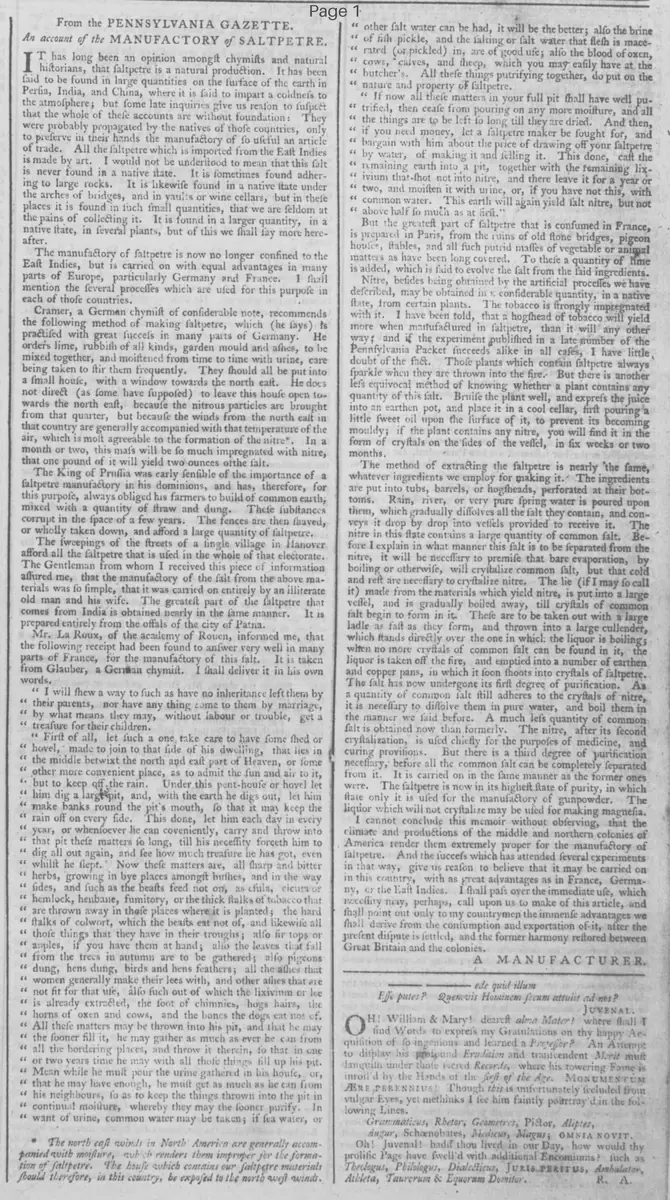
An account of the MANUFACTORY of SALTPETRE.
It has long been an opinion amongst chymists and natural historians, that saltpetre is a natural production. It has been said to be found in large quantities on the surface of the earth in Persia, India, and China, where it is said to impart a coldness to the atmosphere; but some late inquiries give us reason to suspect that the whole of these accounts are without foundation: They were probably propagated by the natives of those countries, only to preserve in their hands the manufactory of so useful an article of trade. All the saltpetre which is imported from the East Indies is made by art. I would not be understood to mean that this salt is never found in a native state. It is sometimes found adhering to large rocks. It is likewise found in a native state under the arches of bridges, and in vaults or wine cellars, but in these places it is found in such small quantities, that we are seldom at the pains of collecting it. It is found in a larger quantity, in a native state, in several plants, but of this we shall say more hereafter.
The manufactory of saltpetre is now no longer confined to the East Indies, but is carried on with equal advantages in many parts of Europe, particularly Germany and France. I shall mention the several processes which are used for this purpose in each of those countries.
Cramer, a German chymist of considerable note, recommends the following method of making saltpetre, which (he says) is practised with great success in many parts of Germany.
He orders lime, rubbish of all kinds, garden mould and ashes, to be mixed together, and moistened from time to time with urine, care being taken to stir them frequently. They should all be put into a small house, with a window towards the north east. He does not direct (as some have supposed) to leave this house open towards the north east, because the nitrous particles are brought from that quarter, but because the winds from the north east in that country are generally accompanied with that temperature of the air, which is most agreeable to the formation of the nitre. In a month or two, this mass will be so much impregnated with nitre, that one pound of it will yield two ounces of the salt.
The King of Prussia was early sensible of the importance of a saltpetre manufactory in his dominions, and has, therefore, for this purpose, always obliged his farmers to build of common earth; mixed with a quantity of straw and dung. These substances corrupt in the space of a few years. The fences are then shaved, or wholly taken down, and afford a large quantity of saltpetre.
The sweepings of the streets of a single village in Hanover afford all the saltpetre that is used in the whole of that electorate. The Gentleman from whom I received this piece of information assured me, that the manufactory of the salt from the above materials was so simple, that it was carried on entirely by an illiterate old man and his wife. The greatest part of this saltpetre that comes from India is obtained nearly in the same manner. It is prepared entirely from the offals of the city of Patna.
Mr. La Roux, of the academy of Rouen, informed me, that the following receipt had been found to answer very well in many parts of France, for the manufactory of this salt. It is taken from Glauber, a German chymist. I shall deliver it in his own words.
"I will shew a way to such as have no inheritance left them by their parents, nor have any thing come to them by marriage, by what means they may, without labour or trouble, get a treasure for their children.
First of all, let such a one take care to have some shed or hovel, made to join to that side of his dwelling, that lies in the middle betwixt the north and east. Or some other more convenient place, as to admit the sun and air to it, but to keep off the rain. Under this pent-house or hovel let him dig a large pit, and, with the earth he digs out, let him make banks round the pit's mouth, so that it may keep the rain off on every side. This done, let him each day in every year, or whensoever he can conveniently, carry and throw into that pit these matters so long, till his necessity forceth him to dig all out again, and see how much treasure he has got, even whilest he slept. Now these matters are, all sharp and bitter herbs, growing in bye places amongst bushes, and in the way sides, and such as the beasts feed not on, as cicuta, or hemlock, henbane, fumitory, or the thick stalks of tobacco that are thrown away in those places where it is planted; the hard stalks of colewort, which the beasts eat not of, and likewise all those things that they have in their trouzes; also fir tops or apples, if you have them at hand; also the leaves that fall from the trees in autumn are to be gathered; also pigeons dung, hens dung, birds and hens feathers; all the ashes that women generally make their lye with, and other ashes that are not fit for that use, also such out of which the lixivium or lye is already extracted, the soot of chimnies, hogs hairs, the horns of oxen and cows, and the bones the dogs eat not of.
All these matters may be thrown into his pit, and that he may the sooner fill it, he may gather as much as ever he can from all the bordering places, and throw it therein, so that in one or two years time he may with all those things fill up his pit.
Mean while he must pour the urine gathered in his house, or, that he may have enough, he must get as much as be can from his neighbours, so as to keep the things thrown into the pit in continual moisture, whereby they may the sooner purify. In want of urine, common water may be taken; if sea water, or other salt water can be had, it will be the better; also the brine of fish pickle, and the salting or salt water that flesh is macerated (or pickled) in, are of good use; also the blood of oxen, cows, calves, and sheep, which you may easily have at the butcher's. All these things putrifying together, do put on the nature and property of saltpetre.
If now all these matters in your full pit shall have well putrified, then cease from pouring on any more moisture, and all the things are to be left so long till they are dried. And then, if you need money, let a saltpetre maker be sought for, and bargain with him about the price of drawing off your saltpetre by water, of making it and selling it. This done, cast the remaining earth into a pit, together with the remaining lixivium that shot not into nitre, and there leave it for a year or two, and moisten it with urine, or, if you have not this, with common water. This earth will again yield salt nitre, but not above half so much as at first."
But the greatest part of saltpetre that is consumed in France, is prepared in Paris, from the ruins of old stone bridges, pigeon houses, stables, and all such putrid masses of vegetable or animal matters as have been long covered. To these a quantity of lime is added, which is said to evolve the salt from the said ingredients.
Nitre, besides being obtained by the artificial processes we have described, may be obtained in very considerable quantity, in a native state, from certain plants. The tobacco is strongly impregnated with it. I have been told, that a hogshead of tobacco will yield more when manufactured into saltpetre, than it will any other way; and if the experiment published in a late number of the Pennsylvania Packet succeeds alike in all cases, I have little doubt of the fact. Those plants which contain saltpetre always sparkle when they are thrown into the fire. But there is another less equivocal method of knowing whether a plant contains any quantity of this salt. Bruise the plant well, and express the juice into an earthen pot, and place it in a cool cellar, first pouring a little sweet oil upon the surface of it, to prevent its becoming mouldy; if the plant contains any nitre, you will find it in the form of crystals on the sides of the vessel, in six weeks or two months.
The method of extracting the saltpetre is nearly the same, whatever ingredients we employ for making it. The ingredients are put into tubs, barrels, or hogsheads, perforated at their bottoms. Rain, river, or very pure spring water is poured upon them, which gradually dissolves all the salt they contain, and conveys it drop by drop into vessels provided to receive it. The nitre in this state contains a large quantity of common salt. Before I explain in what manner this salt is to be separated from the nitre, it will be necessary to premise that bare evaporation, by boiling or otherwise, will crystalize common salt, but that cold and rest are necessary to crystalize nitre. The lye (if I may so call it) made from the materials which yield nitre, is put into a large vessel, and is gradually boiled away, till crystals of common salt begin to form in it. These are to be taken out with a large ladle as fast as they form, and thrown into a large cullender, which stands directly over the one in which the liquor is boiling; when no more crystals of common salt can be found in it, the liquor is taken off the fire, and emptied into a number of earthen and copper pans, in which it soon shoots into crystals of saltpetre.
The salt has now undergone its first degree of purification. As a quantity of common salt still adheres to the crystals of nitre, it is necessary to dissolve them in pure water, and boil them in the manner we did before. A much less quantity of common salt is obtained now than formerly. The nitre, after its second crystallization, is used chiefly for the purposes of medicine, and curing provisions. But there is a third degree of purification necessary, before all the common salt can be completely separated from it. It is carried on in the same manner as the former ones were. The saltpetre is now in its highest state of purity, in which state only it is used for the manufactory of gunpowder. The liquor which will not crystalize may be used for making magnesia.
I cannot conclude this memoir without observing, that the climate and productions of the middle and northern colonies of America render them extremely proper for the manufactory of saltpetre. And the success which has attended several experiments in that way, give us reason to believe that it may be carried on in this country, with as great advantages as in France, Germany, or the East Indies. I shall pass over the immediate use, which necessity may, perhaps, call upon us to make of this article, and shall point out only to my countrymen the immense advantages we shall derive from the consumption and exportation of it, after the present dispute is settled, and the former harmony restored between Great Britain and the colonies.
A MANUFACTURER.
What sub-type of article is it?
What themes does it cover?
What keywords are associated?
What entities or persons were involved?
Where did it happen?
Story Details
Key Persons
Location
Persia, India, China, Germany, France, Hanover, Patna, Rouen, Paris, Middle And Northern Colonies Of America
Story Details
Detailed account of saltpetre production methods using mixtures of waste materials, urine, and lime in various countries, extraction and purification processes, natural occurrences in plants like tobacco, and promotion of manufacturing in American colonies for economic benefits.