Thank you for visiting SNEWPapers!
Sign up free
The National Intelligencer And Washington Advertiser
Washington, District Of Columbia
What is this article about?
Account from General Ramel's book on the exile of French citizens Barthélemy, Pichegru, and others to Cayenne after political condemnation. Details their sufferings, separations from families, harsh voyage, imprisonment, deaths of some exiles, and eventual escape to Surinam and England on September 21.
Merged-components note: Continuation of the account from General Ramel's work on the exile and transportation of French citizens Barthélemy, Pichegru, and others to Cayenne, spanning two components on page 4.
Clipping
OCR Quality
Full Text
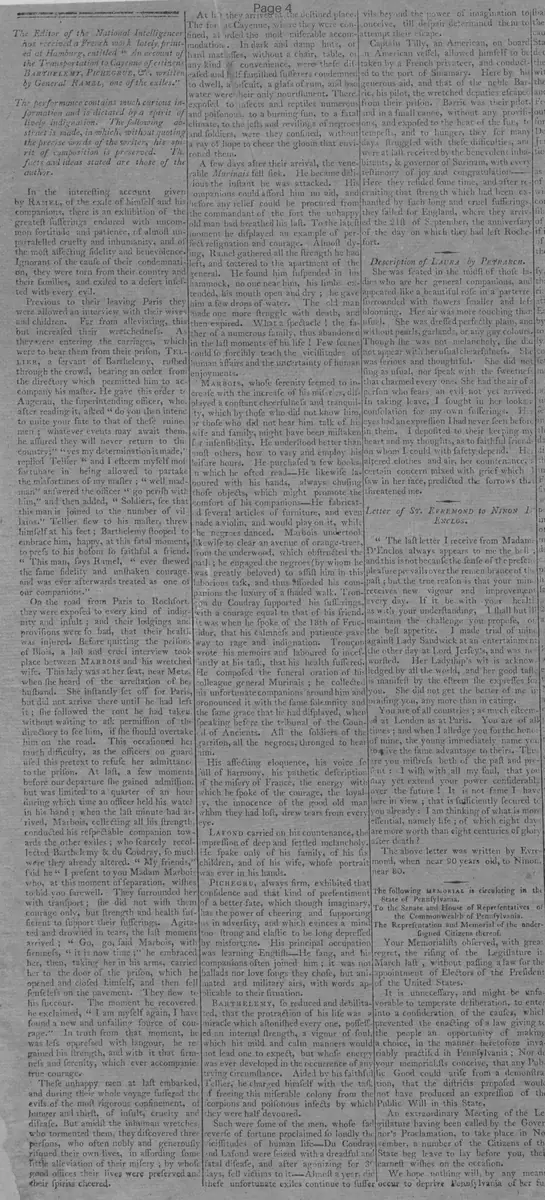
The performance contains much curious information and is dictated by a spirit of lively indignation. The following abstract is made, in which, without quoting the precise words of the writer, his spirit of composition is preserved. The facts and ideas stated are those of the author.
In the interesting account given by RAMEL, of the exile of himself and his companions, there is an exhibition of the greatest sufferings endured with uncommon fortitude and patience, of almost unparalleled cruelty and inhumanity, and of the most affecting fidelity and benevolence.
Ignorant of the cause of their condemnation, they were torn from their country and their families, and exiled to a desert infested with every evil.
Previous to their leaving Paris they were allowed an interview with their wives and children. Far from alleviating, this but increased their wretchedness. As they were entering the carriages, which were to bear them from their prison, TELLier, a servant of Barthélemy, rushed through the crowd, bearing an order from the directory which permitted him to accompany his master. He gave this order to Augereau, the superintending officer, who, after reading it, asked "do you then intend to unite your fate to that of these ruined men; whatever events may await them. Be assured they will never return to this country;" "yes my determination is made," replied Tellier "and I esteem myself most fortunate in being allowed to partake in the misfortunes of my master;" "well madman" answered the officer "go perish with him," and then added, "Soldiers, see that this man is joined to the number of villains." Tellier flew to his master, threw himself at his feet; Barthélemy stooped to embrace him, happy, at this fatal moment, to press to his bosom so faithful a friend.
"This man, says Ramel, "ever showed the same fidelity and unshaken courage. And was ever afterwards treated as one of our companions."
On the road from Paris to Rochefort. they were exposed to every kind of indignity and insult; and their lodgings and provisions were so bad, that their health was injured. Before quitting the prison of Blois, a last and cruel interview took place between Marbois and his wretched wife. This lady was at her seat, near Metz. when she heard of the arrestation of her husband. She instantly set off for Paris, but did not arrive there until he had left it: she followed the rout he had taken. without waiting to ask permission of the directory to see him, if she should overtake him on the road. This occasioned her much difficulty, as the officers on guard used this pretext to refuse her admittance to the prison. At last, a few moments before our departure she gained admission. but was limited to a quarter of an hour during which time an officer held his watch in his hand; when the last minute had arrived, Marbois, collecting all his strength, conducted his respectable companion towards the other exiles; who scarcely recollected Barthelemy & du Coudray, so much were they already altered. "My friends," said he "I present to you Madam Marbois who, at this moment of separation, wishes to bid you farewell." They surrounded her with transport; he did not wish them courage only, but strength and health sufficient to support their sufferings. Agitated and drowned in tears, the last moment arrived; "Go, go, said Marbois, with firmness, "it is now time;" he embraced her, then, taking her in his arms, carried her to the door of the prison, which he opened and closed himself, and then fell senseless on the pavement. They flew to his succour. The moment he recovered he exclaimed, "I am myself again, I have found a new and unfailing source of courage." In truth from that moment, he was less oppressed with languor, he regained his strength, and with it that firmness and serenity, which ever accompany true courage.
These unhappy men at last embarked and during their whole voyage suffered the evils of the most rigorous confinement, of hunger and thirst, of insult, cruelty and disease. But amidst the inhuman wretches who tormented them, they discovered three persons, who often nobly and generously risked their own lives, in affording some little alleviation of their misery; by whose good offices their lives were preserved and their spirits cheered.
At last they arrived at the destined place. The fort at Cayenne, where they were confined, afforded the most miserable accommodation. In dark and damp huts, on hard mats, without a chair, table, or any kind of convenience, were these diseased and half famished sufferers condemned to dwell, a biscuit, a glass of rum, and bad water were their only nourishment. There. exposed to insects and reptiles numerous and poisonous, to a burning sun, to a fatal climate, to the jests and revilings of negroes and soldiers, were they confined, without a ray of hope to cheer the gloom that environed them.
A few days after their arrival, the venerable Murinais fell sick. He became delirious the instant he was attacked. His companions could afford him no aid, and before any relief could be procured from the commandant of the fort the unhappy old man had breathed his last. To the latest moment he displayed an example of perfect resignation and courage. Almost dying, Ramel gathered all the strength he had left, and tottered to the apartment of the general. He found him suspended in his hammock, no one near him, his limbs extended, his mouth open and dry; he gave him a few drops of water. The old man made one more struggle with death, and then expired. What a spectacle! the father of a numerous family, thus abandoned in the last moments of his life! Few scenes could so forcibly teach the vicissitudes of human affairs and the uncertainty of human enjoyments.
Marbois, whose serenity seemed to increase with the increase of his miseries, displayed a constant cheerfulness and tranquility, which by those who did not know him, or those who did not hear him talk of his wife and family, might have been mistaken for insensibility. He understood better than most others, how to vary and employ his leisure hours. He purchased a few books. in which he often read. He likewise laboured with his hands, always choosing those objects, which might promote the comfort of his companions--He fabricated several articles of furniture, and even made a violin, and would play on it, while the negroes danced. Marbois undertook likewise to clear an avenue of orange-trees, from the underwood, which obstructed the path; he engaged the negroes (by whom he was greatly beloved) to assist him in this laborious task, and thus afforded his companions the luxury of a shaded walk. Tronçon du Coudray supported his sufferings. with a courage equal to that of his friend. it was when he spoke of the 18th of Fructidor, that his calmness and patience gave way to rage and indignation. Tronçon wrote his memoirs and laboured so incessantly at his task, that his health suffered. He composed the funeral oration of his colleague general Murinais; he collected his unfortunate companions around him and pronounced it with the same solemnity and the same grace that he had displayed, when speaking before the tribunal of the Council of Ancients. All the soldiers of the garrison, all the negroes, thronged to hear him.
His affecting eloquence, his voice full of harmony, his pathetic description of the misery of France, the energy with which he spoke of the courage, the loyalty, the innocence of the good old man whom they had lost, drew tears from every eye.
LaFond carried on his countenance, the impression of deep and settled melancholy. He spoke only of his family, of his six children, and of his wife, whose portrait was ever in his hands.
Pichegru, always firm, exhibited that confidence and that kind of presentiment of a better fate, which though imaginary, has the power of cheering and supporting us in adversity, and which evinces a mind too strong and elastic to be long depressed by misfortune. His principal occupation was learning English-He sang, and his companions often joined him; it was not ballads nor love songs they chose, but animated and military airs, with words applicable to their situation.
Barthélemy, so reduced and debilitated, that the protraction of his life was a miracle which astonished every one, possessed an internal strength, a vigour of soul, which his mild and calm manners would not lead one to expect, but whose energy was ever developed in the occurrence of any trying circumstance. Aided by his faithful Tellier, he charged himself with the task of freeing this miserable colony from the scorpions and poisonous insects by which they were half devoured.
Such were some of the men, whose adverse fortune proclaimed so loudly the vicissitudes of human life Du Coudray and Lafond were seized with a dreadful and fatal disease, and after agonizing for 30 days, fell victims to it. Almost a year, these unfortunate exiles continue to suffer evils beyond the power of imagination to conceive, till despair determined them to attempt their escape.
Captain Tilly, an American, on board an American vessel, allowed himself to be taken by a French privateer, and conducted to the port of Sinnamary. Here by his generous aid, and that of the noble Barric, his pilot, the wretched deputies escaped from their prison. Barric was their pilot, and in a small canoe, without any provisions, and exposed to the heat of the sun, to tempests, and to hunger, they for many days struggled with these difficulties, and were at last received by the benevolent inhabitants, & governor of Surinam, with every testimony of joy and congratulation-- Here they resided some time, and after recruiting that strength which had been exhausted by such long and cruel sufferings, they sailed for England, where they arrived the 21st of September, the anniversary of the day on which they had left Rochefort.
What sub-type of article is it?
What keywords are associated?
What entities or persons were involved?
Where did it happen?
Foreign News Details
Primary Location
Cayenne
Event Date
The 21st Of September
Key Persons
Outcome
deaths of murinais, du coudray, and lafond from disease; surviving exiles escaped to surinam and then to england on the 21st of september.
Event Details
French political figures including Barthélemy and Pichegru were exiled to Cayenne without knowing the cause, suffering separations from families, indignities during journey to Rochefort, harsh voyage with confinement, hunger, and disease. In Cayenne, they endured miserable conditions in the fort, exposure to climate and insects, with limited food. Some showed resilience through activities and mutual support; Murinais died shortly after arrival. After nearly a year, aided by American Captain Tilly and pilot Barric, survivors escaped by canoe to Surinam and later sailed to England.